

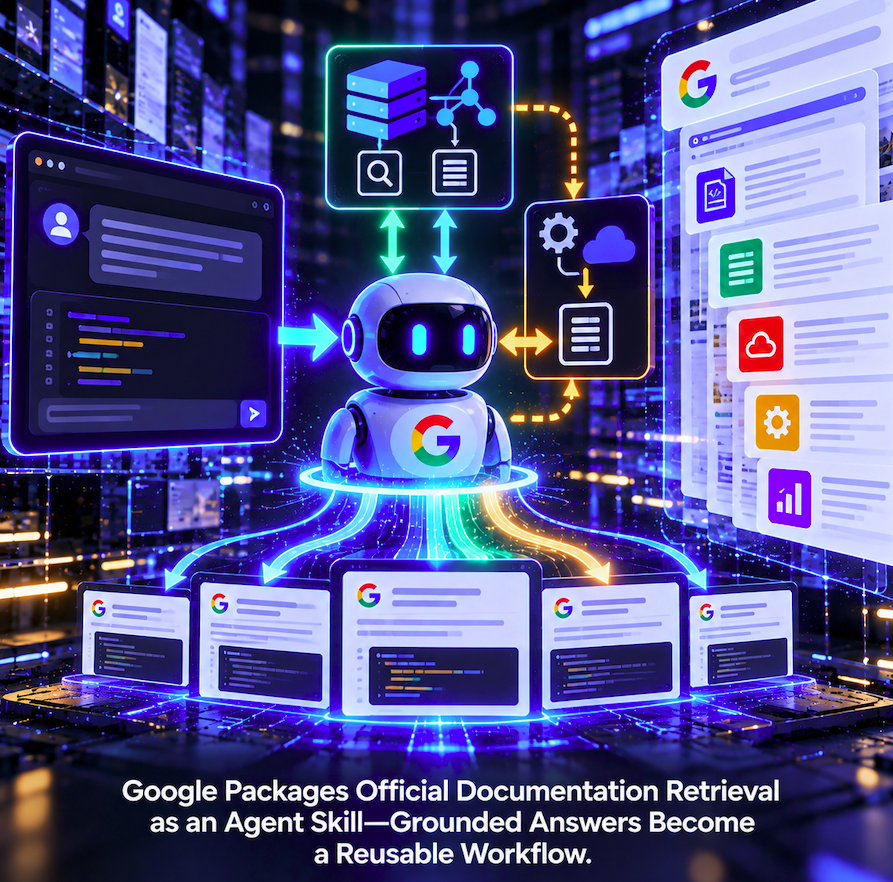

Google has turned official documentation retrieval into a reusable instruction package for coding agents. On September 25, the company released an open-source agent skill called retrieving-developer-knowledge, designed to teach compatible AI assistants when to search Google’s Developer Knowledge corpus, which retrieval tool to choose and how to fall back to the REST API when an MCP connection is unavailable.
The release is documented in Google’s official Developer Knowledge release notes and published in the public google/skills repository. Google describes Agent Skills as reusable instruction sets that assistants read before beginning a task. In this case, the skill packages retrieval strategy rather than product knowledge itself: the underlying documentation remains in Google’s Developer Knowledge service, while the skill tells an agent how to interrogate that service reliably.
The skill teaches tool selection, not just where the documentation lives
Connecting an AI assistant to a documentation server does not guarantee that the assistant will use the right retrieval operation. Google’s Developer Knowledge MCP documentation says the new skill explicitly guides the agent through that decision.
For broad how-to questions and comparisons, the workflow steers the assistant toward answer_query, which generates an answer grounded in Google developer documentation. When the task requires exact CLI flags, IAM permissions, code syntax or similarly precise details, the skill instead directs the assistant toward search_documents and recommends focused search terms.
That distinction is more consequential than it looks. A question such as how to design a workflow can benefit from synthesized documentation, while a question about the exact name of a command-line flag is better served by retrieving the relevant source material directly. Encoding that routing decision in a skill reduces the need for every coding assistant—or every developer configuring one—to rediscover the same retrieval strategy through prompting.
MCP is preferred, but the workflow is not dependent on MCP
The other important design choice is graceful fallback. Google’s September 25 release note says retrieving-developer-knowledge helps assistants choose the appropriate Developer Knowledge MCP server tool and switch to the REST API when MCP is unavailable.
This makes the skill more portable than an instruction set tied to one tool protocol. MCP provides a standardized way for an assistant to call the Developer Knowledge service when the environment supports it. If that connection is missing, however, the agent can still retrieve official information through the underlying API rather than silently reverting to model memory or an unrestricted web search.
The result is a retrieval policy with multiple execution paths. The objective remains stable—ground the task in current Google documentation—even when the available tool surface changes.
Google has been building the retrieval layer underneath the skill all year
The skill sits on top of infrastructure Google has progressively expanded during 2026. The Developer Knowledge API and MCP server reached general availability in April, giving AI-powered development tools a supported way to search and retrieve Google’s official developer documentation. Subsequent releases added filtering, relevance scores on document chunks and broader corpus coverage.
On September 22, three days before the skill release, Google also made gcloud developer-knowledge commands generally available. Those commands include operations for generating answers from documentation, retrieving document metadata and content views, and searching relevant document chunks.
The sequence shows a clear progression. First Google exposed documentation as machine-retrievable knowledge through API and MCP interfaces. Then it added command-line access. Now it has packaged the usage logic itself as an installable agent skill.
The real product is a repeatable grounding workflow
Documentation retrieval has traditionally been treated as something the model or developer has to improvise. A coding assistant might search the web, rely on memorized API behavior, inspect a documentation page or call an MCP tool depending on how it was configured and what the prompt happened to trigger.
Google’s skill makes that behavior more deterministic. Instead of telling an agent vaguely to “check the docs,” a developer can install an instruction package that defines when official documentation should be consulted and how the retrieval mechanism should be selected.
That is a meaningful shift in how grounding can be distributed. The knowledge source is maintained centrally by Google, but the procedure for reaching it travels with the agent as a reusable artifact. When Google improves that procedure in the public repository, compatible assistants can adopt the updated workflow without developers having to redesign their prompts from scratch.
Agent Skills are becoming a layer above APIs and MCP servers
The release also illustrates an emerging division of labor in agent infrastructure. An API exposes capabilities programmatically. An MCP server exposes tools in a format agents can discover and call. A skill sits one level higher and teaches the agent how and when those tools should be used.
That hierarchy matters because tool availability alone does not produce good tool use. An agent can have access to several search, retrieval and answer-generation functions while still choosing an inefficient or inappropriate one. A skill can encode routing heuristics, fallback behavior and domain-specific procedures without changing the underlying service.
NetContentSEO recently examined a related transition in Google Lighthouse’s new Agentic Resource Discovery audit. That initiative focuses on whether agents can discover callable resources exposed by websites. The Developer Knowledge skill addresses the next problem: once a capability is available, the agent still needs instructions for using it effectively.
Grounded coding answers become less dependent on model memory
The practical value is clearest for rapidly changing developer platforms. SDK methods, CLI syntax, IAM permissions, product availability and recommended implementation patterns can change faster than a model’s internal training knowledge. Even a strong coding model can confidently produce an obsolete answer if it has no retrieval step.
Developer Knowledge gives the assistant access to a maintained corpus of official Google documentation. The new skill then encourages the assistant to retrieve from that corpus at the moment the task requires authoritative product knowledge.
This does not eliminate hallucinations or guarantee that every generated answer is correct. Retrieval can miss relevant material, documentation itself can contain gaps, and the model can still misinterpret what it receives. What changes is the workflow: the assistant has a defined path for checking the primary documentation instead of treating retrieval as an optional improvisation.
Official documentation is becoming runtime infrastructure for agents
The larger development is that documentation is moving from a human-readable reference layer into the execution path of software agents. When a coding assistant can search official chunks, synthesize documented answers and select retrieval operations automatically, documentation affects what the agent does while it is working—not merely what a developer reads before writing code.
NetContentSEO explored a related pattern in xAI’s use of documentation as retrieval infrastructure. The Google implementation approaches the problem from a developer-platform perspective: expose a maintained knowledge corpus through agent-compatible interfaces, then distribute a reusable procedure for querying it.
This creates a new quality requirement for documentation teams. Pages no longer serve only developers arriving through search or navigation. Their structure, freshness, chunk relevance and retrievability can directly affect answers produced inside coding environments where the human may never open the documentation page.
Open source makes the retrieval policy inspectable
Publishing the skill in the google/skills repository also makes its operating instructions inspectable. Developers can see the workflow rather than treating the assistant’s documentation behavior as an opaque platform feature. Google’s repository is explicitly positioned as a collection of Agent Skills for its products and technologies, installable into compatible agent environments.
That matters for enterprise use because grounding behavior can be reviewed separately from the model. Teams can examine which sources a skill prefers, which operations it calls and how it behaves when the preferred integration fails. The procedure becomes an artifact that can be versioned and evaluated like other development tooling.
The pattern also resembles the broader shift NetContentSEO covered in OpenAI’s productization of persistent agent and retrieval infrastructure. As agent platforms mature, competitive differentiation is moving beyond the base model toward the harnesses, tools, retrieval systems and reusable instructions surrounding it.
The next optimization surface may be the workflow that retrieves the source
For publishers and technical documentation teams, Google’s release offers a broader lesson. AI visibility is not determined only by whether a page is crawlable or semantically relevant. Increasingly, agents operate through explicit retrieval workflows that specify which corpus to search, which tool to invoke and which fallback path to use.
In Google’s own developer ecosystem, the company can now distribute both sides of that relationship. It controls an official documentation corpus exposed through Developer Knowledge, and it publishes the skill that teaches third-party coding assistants how to retrieve from it.
That does not make the open web irrelevant. Developers and agents will still use search engines, repositories, forums and independent technical sources. But for questions about Google products, the company has created a privileged, machine-readable route back to its own maintained documentation.
The important innovation is therefore not simply another MCP integration. Google has packaged grounded retrieval as a reusable behavior. An agent can carry instructions that say, in effect, when official knowledge is required, which retrieval operation fits the question, and what to do when the preferred protocol is unavailable. Grounding is becoming something developers can install.