

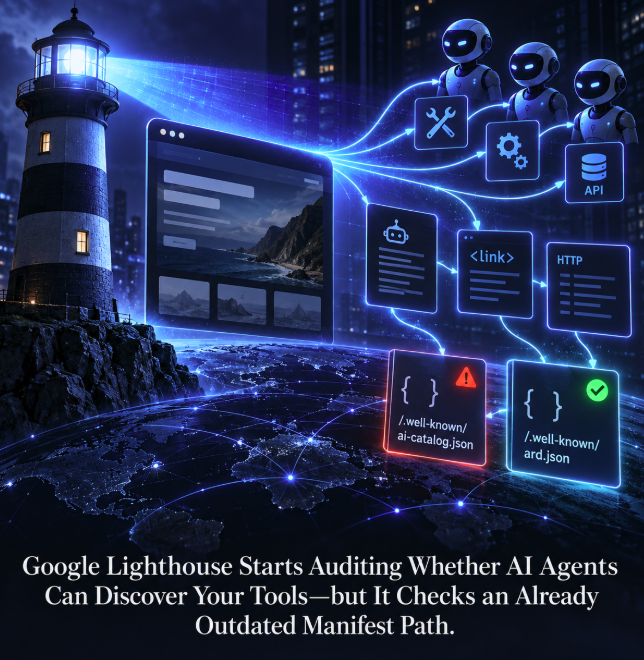

Google Lighthouse is beginning to test a part of the web that barely existed a few months ago: whether AI agents can discover the tools, services and other callable resources a website makes available. Lighthouse 13.5 introduces a new Agentic Resource Discovery audit, moving agent discoverability from an emerging protocol discussion into a mainstream web-quality tool used by developers. The twist is that the implementation arrives while the underlying specification is still changing, and Lighthouse currently falls back to a manifest filename that the latest ARD proposal has already replaced.
The official Lighthouse 13.5 release, published on September 18, lists a new ard-schema audit and groups ARD with llms.txt under agent discovery. Google says the release is expected to ship with Chrome 156 DevTools and reach PageSpeed Insights within two weeks. That makes the addition notable for developers and technical SEO teams, but it should not be confused with a new Google Search ranking signal: the release describes the functionality as part of Lighthouse's agent-oriented auditing, not as a Search requirement.
Lighthouse is testing whether agents can find a site's capabilities
Agentic Resource Discovery, or ARD, is an open proposal for describing and discovering resources that AI systems can call, including MCP servers, A2A agents, skills, APIs and other services. The idea is broader than helping a model read a page. Instead, ARD is intended to give agents a standardized way to find capabilities published by an organization and, through registries and trust metadata, determine what resources are available before connecting to them.
Google introduced ARD in June as an open specification developed with contributors across the agent ecosystem. The original Google announcement described a decentralized model in which organizations publish catalogs on their own domains and discovery services can index them. The project remains a proposal rather than a settled web standard, which is important context for interpreting Lighthouse's new audit.
According to a technical analysis of the Lighthouse 13.5 implementation, the audit looks for catalog references through mechanisms including an Agentmap directive in robots.txt, an HTML link relation and an HTTP Link header. If Lighthouse does not find an explicit pointer, it attempts to retrieve /.well-known/ai-catalog.json. It then validates the discovered catalog against the ARD schema; a missing catalog can result in the audit being treated as not applicable rather than automatically failing the page.
The specification moved faster than the audit
The most interesting detail is the mismatch between Lighthouse and the current ARD proposal. ARD v0.9, dated May 28, used /.well-known/ai-catalog.json and the ai-catalog link relation. The newer ARD v0.91 specification, dated August 26, instead defines /.well-known/ard.json as the well-known manifest location and rel="ard" as the current link relation.
The change is not merely cosmetic. The v0.91 specification says consumers must fetch /.well-known/ard.json and honor rel="ard", while support for the predecessor ai-catalog.json name is optional. In other words, a publisher following only the latest proposal can be conformant without serving the older path. Lighthouse 13.5, however, can miss that configuration if the site does not also expose one of the discovery mechanisms its implementation currently recognizes.
This creates an unusual but understandable transitional state: Lighthouse is encouraging experimentation with an agent-discovery standard while simultaneously demonstrating how quickly that standard is evolving. The release even adds a weekly synchronization check for upstream ARD schema and conformance changes, suggesting that the Lighthouse team expects continued movement. The catalog-location logic, however, is a separate implementation detail, so schema synchronization alone does not guarantee that every newly specified discovery mechanism is immediately recognized.
What site owners should do now
For publishers experimenting with agent-facing services, the practical lesson is not to treat a Lighthouse ARD result as a definitive measurement of whether an AI agent can discover a site. It measures the discovery paths and schema behavior Lighthouse currently implements. A site serving only the latest /.well-known/ard.json location may therefore be correctly following the current proposal while still not being detected by Lighthouse 13.5's fallback behavior.
During this transition, teams testing ARD should distinguish protocol compliance from tool compatibility. Supporting the current ard.json location is the forward-looking choice under v0.91, while temporarily exposing compatible predecessor discovery hints may improve interoperability with implementations that were built against v0.9. Any dual support should be treated as a compatibility decision rather than evidence that the older filename remains the normative ARD location.
There is also a larger SEO lesson in the release. Lighthouse increasingly contains checks related to the agentic web, but their presence inside a familiar Google tool does not automatically turn them into Google Search signals. ARD is about discovery of callable resources, whereas traditional search crawling, indexing and ranking solve different problems. Developers should evaluate the audit because agent ecosystems may increasingly need machine-readable ways to find tools, not because Lighthouse 13.5 establishes a new shortcut to higher Google rankings.
A small audit with a bigger implication
The immediate feature in Lighthouse 13.5 is modest: discover a catalog, validate it and report the result. The broader implication is more significant. Web infrastructure is beginning to accommodate software agents not only as readers of pages but as clients looking for structured capabilities they can discover and invoke. ARD is one proposal for building that discovery layer, and its inclusion in Lighthouse gives the experiment substantially more visibility among web developers.
For now, the mismatch between ai-catalog.json and ard.json is a useful warning against treating early agentic-web conventions as settled standards. Lighthouse has made AI-agent discoverability auditable, but the target is still moving. Teams that experiment today should follow the ARD specification itself alongside Lighthouse rather than assuming the audit alone represents the latest version of the protocol.