

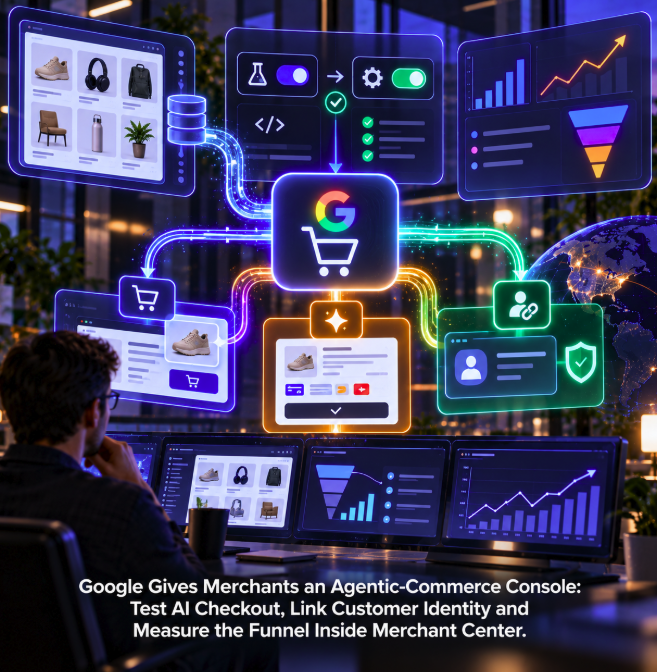

Google is turning Merchant Center into an operational console for agentic commerce. A new Universal Commerce Protocol integration hub gives participating merchants one place to configure, test and validate the infrastructure that lets AI-assisted shopping journeys create carts, hand those carts back to retailer websites, complete purchases inside Google and connect a shopper’s merchant identity to loyalty benefits and authenticated checkout.
The official UCP integration guide, last updated September 16, documents a Merchant Center workflow spanning technical setup, sandbox testing and production validation. The hub is rolling out gradually in the United States, with Australia and Canada scheduled to follow early next year.
Google’s September 16 shopping announcement positioned the update as part of a wider agentic-commerce push for the holiday season. The company said merchants using the UCP integration hub can enable cart transfer back to their own sites and use enhanced checkout-flow testing, while the current developer documentation also describes an Analytics area for visibility into UCP checkout funnels and key performance metrics.
The important shift is operational. Agentic commerce is moving from a protocol specification and a collection of APIs into a Merchant Center workflow where commerce teams can see which capabilities they support, simulate transactions, validate production endpoints and increasingly measure what happens after an AI shopping experience starts acting on a user’s behalf.
Merchant Center now has a dedicated UCP integration hub
Google says eligible merchants can find the new hub under Settings → UCP integration in Merchant Center. The interface is organized around an Overview tab for setup, testing and validation, with current developer documentation also listing an Analytics tab designed to show the UCP checkout funnel across agentic buy flows.
This makes Merchant Center the administrative layer between a retailer’s existing commerce infrastructure and Google’s agentic shopping surfaces. Product feeds already tell Google what a merchant sells. UCP adds the transaction capabilities needed when an AI system moves beyond recommendation and begins creating carts, initiating checkout or recognizing a customer’s existing merchant account.
The console does not eliminate development work. Merchants still need to implement the relevant UCP APIs and publish a UCP profile describing the capabilities their systems support. What changes is that Google now provides a guided environment for testing and validating those pieces rather than leaving integration entirely to external developer tooling.
Merchants can choose different agentic-commerce paths
The integration hub adapts its validation process to the capabilities a merchant selects. Google documents three principal paths: transfer to merchant cart, native checkout on Google and identity linking.
Cart transfer allows a shopper to assemble items through a Google experience and then move that cart to the merchant’s own website to complete checkout. Native checkout keeps the purchasing flow inside Google and requires the merchant to implement the core checkout endpoints for session creation, updates and completion. Identity linking connects the shopper to an existing merchant account through OAuth 2.0 so loyalty benefits and authenticated checkout can carry into the agentic journey.
These are not interchangeable features. Google says identity linking becomes selectable only when native checkout is enabled, reflecting the fact that account-aware benefits are part of the Google-hosted transaction flow. Merchants can support native checkout, cart transfer or both depending on how much of the purchase they want Google to handle.
That flexibility is strategically important because agentic commerce does not require retailers to surrender every checkout to the platform. NetContentSEO recently covered how Google expanded UCP so agents can hand a populated cart back to the merchant’s own website, preserving a path to retailer-controlled checkout even when discovery and product selection begin inside an AI experience.
The sandbox can simulate real cart and checkout operations
The UCP console includes a sandbox environment where merchants can test their implementation without putting live transactions at risk. Google asks merchants to provide the location of their /.well-known/ucp profile and, when required, credentials for the test environment.
For cart transfer, the sandbox can simulate creating a cart and optionally retrieving, updating or cancelling an active cart session. That lets engineering teams verify that an agentic shopping surface can hand state to the retailer correctly rather than merely sending a conventional product-page referral.
Native checkout testing goes further into the purchase lifecycle. Google documents simulations for creating a checkout, updating an existing checkout when details such as shipping information change, and completing the transaction. Requests can be entered in a JSON editor and sent against the merchant’s test implementation.
Google requires separate API keys for staging and production and says it encrypts and stores the domains and associated keys supplied for the integration. This separation matters because the console is not simply previewing a front-end checkout page; it is validating the server-to-server infrastructure an AI commerce system will call.
Production validation checks what the merchant actually claims to support
After sandbox testing, merchants can start a production validation process inside the hub. The first step is selecting the UCP capabilities the business wants activated. Merchant Center then shows a preview of the relevant consumer experience.
The merchant provides the location of its published UCP profile, and Google checks the capabilities declared there against the capabilities selected in Merchant Center. If a retailer says it supports identity linking, for example, the published profile must advertise that capability as well.
The final validation checklist depends on the selected path. A cart-transfer-only implementation gets a streamlined process focused on Merchant Center configuration and Cart API validation. Native checkout requires additional work, including validating the core checkout endpoints, configuring order-status webhooks and agreeing to the UCP Program Addendum.
If identity linking is enabled, Google also validates the merchant’s OAuth 2.0 flow and published metadata. Once the checklist is complete, Google Support reviews the implementation and tells the merchant whether the account is ready to go live or still has configuration problems.
Identity linking makes the agentic funnel customer-aware
A generic AI shopping system can compare public prices and product attributes, but it may still make the wrong commercial decision if the shopper belongs to a loyalty program. A signed-in customer could have member pricing, free shipping, exclusive inventory or other benefits that change which offer is genuinely best.
UCP identity linking is designed to carry that relationship into the agentic checkout flow. Google says merchants implement OAuth 2.0 endpoints and publish the required metadata so a shopper can connect an existing merchant account.
That changes the nature of AI product discovery. The agent is no longer choosing only from public catalog information; it can potentially operate in a customer-specific commerce context where the correct price and benefits depend on identity.
For merchants, this also means loyalty infrastructure becomes part of AI readiness. Product feeds can make an item discoverable, but identity systems determine whether an agent can reproduce the benefits a customer would receive after logging into the retailer’s own site.
The Analytics tab begins to expose the agentic purchase funnel
Google’s September 16 launch post said analytics and additional UCP capabilities were coming soon. The current developer guide now describes an Analytics tab in the Merchant Center integration hub that gives visibility into the UCP checkout funnel across agentic buy flows and tracks key performance metrics.
That evolution is worth distinguishing from the original announcement timing. Google initially presented analytics as part of the roadmap, while the live developer documentation now treats the Analytics area as part of the hub’s interface. Availability can still depend on the gradual rollout and account eligibility.
Measurement is essential because an agentic commerce funnel contains more stages than a conventional ecommerce referral. A shopper can encounter a product through an AI recommendation, build a cart, transfer that cart to the merchant, initiate native checkout, link an identity and complete—or abandon—the purchase.
Without funnel reporting, merchants would see the final order but struggle to understand which part of the agentic journey failed. A validation console tells the retailer whether the APIs technically work; analytics can tell it whether shoppers actually progress through those flows.
Merchant Center is becoming both an AI visibility and transaction console
The UCP hub is arriving alongside another major Merchant Center expansion: AI Performance Insights. Google made those insights generally available in Australia, Canada, India, New Zealand and the United States, allowing eligible retailers to examine how brands and products are discovered across AI Mode and AI Overviews.
NetContentSEO has documented how Merchant Center now reports share of voice and product visibility across Google’s AI shopping surfaces. UCP adds the transaction layer beneath that discovery data.
Together, the two systems point toward a much broader role for Merchant Center. It can tell merchants whether products are appearing in AI-driven discovery and also help them configure what happens when a shopper wants the AI system to act on that discovery.
That turns Merchant Center from a product-feed administration tool into something closer to an AI-commerce control plane: catalog quality at the top, visibility measurement in the middle, and agentic cart and checkout infrastructure at the bottom.
Testing matters because agentic checkout is stateful
Traditional product discovery can tolerate a relatively simple handoff. A search engine sends a URL, the browser opens a page and the merchant takes over. Agentic commerce carries more state between systems.
The agent may already know which variant the shopper selected, how many units are wanted, what shipping information has been supplied or which loyalty account is connected. Cart and checkout APIs need to preserve that state correctly as the user moves through the transaction.
A failure can be more damaging than a broken referral link. An incorrect cart quantity, stale price, failed identity token or checkout update can undermine trust at the moment of purchase. The Merchant Center sandbox gives retailers a place to reproduce those operations before live shoppers depend on them.
Google’s separate validation paths also recognize that different merchants face different complexity. A retailer that only wants to accept transferred carts does not need the full native-checkout checklist, while a merchant keeping the transaction inside Google must validate a larger set of APIs and order-status behavior.
The rollout remains geographically limited
The new integration hub is not globally available. Google’s developer documentation says it is gradually rolling out in the United States, with Australia and Canada to follow early next year. The September announcement gives the same regional sequence.
Merchants outside those markets should therefore distinguish the UCP protocol itself from access to this particular Merchant Center onboarding interface. A global retailer may be technically interested in agentic commerce without yet seeing the integration hub in every account or country.
The gradual rollout also means screenshots and feature availability can differ between merchants during the transition. The current documentation describes the target workflow, but individual accounts may receive access at different times.
Google is reducing the operational barrier to AI checkout
Agentic commerce has often been discussed as a future in which AI systems negotiate with merchant APIs, build carts and complete purchases autonomously. The Merchant Center integration hub makes that concept considerably more concrete.
A retailer can now work through a recognizable deployment process: implement UCP, test it in a sandbox, choose supported capabilities, publish the profile, validate production endpoints and monitor the commerce funnel. Native checkout, merchant-site cart transfer and customer identity are no longer disconnected technical ideas; they are selectable parts of one onboarding system.
That does not make UCP implementation trivial. Retailers still need secure APIs, correct product identifiers, reliable checkout logic, OAuth infrastructure where identity linking is used and operational systems for order updates. Google is simplifying the integration workflow, not eliminating the underlying engineering.
The next ecommerce dashboard may start before the website visit
The larger implication is that ecommerce measurement is moving upstream. A traditional analytics funnel begins when a visitor reaches the merchant website. An agentic funnel can begin inside AI Mode, Gemini or another UCP-compatible surface before the retailer receives a conventional session.
That changes what merchants need to monitor. Product visibility, recommendation, cart creation, cart transfer, identity connection and native checkout can all happen partly outside the merchant’s front end. If those stages are not measurable, the retailer is optimizing only the portion of the customer journey it can still see directly.
Google’s Merchant Center strategy is increasingly designed around that new reality. It is building visibility reports for AI discovery while giving merchants tools to test and validate the transaction infrastructure that follows.
The UCP integration hub therefore matters less as another Merchant Center menu item than as evidence of where commerce administration is heading. When AI agents become shoppers’ interfaces, merchants need a console not only for what products they sell, but for what those agents are allowed to do, how the APIs behave and where customers drop out of the machine-mediated purchase funnel.