

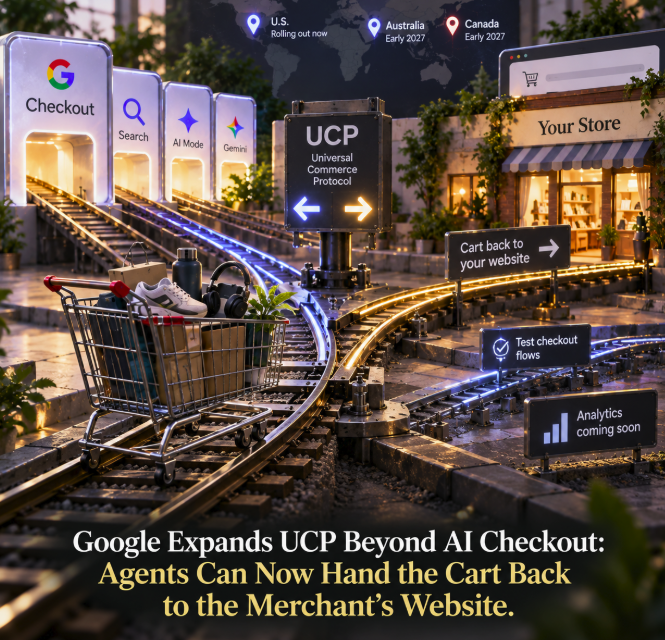

Google is expanding the Universal Commerce Protocol integration hub in Merchant Center beyond native checkout. Merchants using the hub for UCP-powered commerce can now enable capabilities including cart transfer back to the merchant’s own website and enhanced checkout-flow testing, while Google says analytics and additional features are coming next.
The update was announced in Google’s September 16 agentic commerce release and is also documented in the company’s Merchant Center UCP onboarding guide. The new integration experience is rolling out gradually in the United States, with Australia and Canada scheduled to follow next year.
The important change is architectural. UCP is not being positioned only as a way for an AI shopping experience to complete a transaction inside Google. The protocol can also preserve the agent-assisted shopping journey while returning the shopper and the assembled cart to the retailer’s own site for checkout.
UCP can now route the cart back to the merchant
Google’s Merchant Center documentation explicitly lists cart transfer to a merchant site as one of the capabilities available through the UCP integration hub. Merchants can select it alongside native checkout on Google and identity linking.
That means an agentic shopping flow does not have to end with Google controlling the final checkout interface. A shopper can discover products through a Google surface, build purchase intent with AI assistance and then move the cart to the retailer’s website to finish the transaction.
This distinction matters for merchants that want to participate in agentic commerce without moving every transaction into a platform-native checkout. The protocol is becoming a handoff layer as well as a checkout layer.
The cart can cross the boundary between an AI agent and a retailer website
A conventional referral often sends a shopper from a discovery surface to a product page and leaves the retailer to reconstruct the purchase journey from there. Cart transfer is more stateful: the shopping context can include products already selected before the handoff.
Google introduced this concept with Universal Cart in May. Its Universal Cart announcement explained that shoppers could either check out with Google Pay for supported brands or transfer items to the merchant’s site and buy there. In both cases, Google said the brand remains the merchant of record.
The Merchant Center update now gives retailers a more explicit integration and validation path for that second route.
Merchant Center becomes the operational hub for UCP onboarding
Google is simplifying UCP onboarding through Merchant Center rather than requiring retailers to treat the protocol as a disconnected developer project. Merchants still need to complete the technical implementation described in the UCP developer guide, but selected participants can then use the Merchant Center onboarding experience to configure and validate the integration.
Google says Merchant Center remains the central place where merchants prepare product data for ads and listings across Google. During UCP onboarding, it can also alert merchants when feed attributes, return information or account configuration require attention.
This makes Merchant Center increasingly important to Google’s agentic commerce stack. It is not only supplying product information to discovery experiences; it is also becoming the administrative interface where retailers connect their commerce infrastructure to AI-assisted transactions.
Google added a sandbox for more advanced checkout testing
The new onboarding flow includes access to a sandbox environment where merchants can validate their UCP implementation. Google specifically lists the merchant’s UCP profile, cart transfer to the merchant site and native checkout APIs among the components that can be tested.
The September announcement describes the update as enabling enhanced checkout flow testing. That is important because agentic commerce introduces more possible transaction paths than a conventional product-page checkout.
A merchant may need to verify what happens when the shopper checks out natively, when a populated cart is transferred to the retailer, when identity is linked or when the underlying product data changes. A dedicated validation environment gives merchants a way to test those flows before treating them as production commerce paths.
Analytics are coming, but Google has not detailed them yet
Google says analytics and more capabilities are coming soon to the UCP integration hub. The company has not yet published a complete description of the metrics that will be available.
That leaves an important measurement question open. Once an AI system can discover a product, assemble a cart and hand that cart to a merchant website, retailers will need to distinguish several stages of the journey: AI discovery, cart creation, transfer, checkout initiation and completed purchase.
Until Google documents the analytics layer, it would be premature to claim exactly how those interactions will be attributed or reported. The confirmed point is that analytics are part of the announced roadmap for the Merchant Center hub.
The rollout is gradual in the U.S.
The integration hub is not universally available yet. Google says the Merchant Center onboarding experience is rolling out gradually in the United States. Merchants may see the UCP integration hub appear in their accounts as that rollout progresses.
Google’s September announcement says Australia and Canada will follow in early 2027. The current Merchant Center help documentation uses the broader wording “next year,” so the September announcement provides the more specific timing for those two markets.
Participation also requires technical preparation and selection. Google instructs interested merchants to complete the UCP implementation, submit an interest form and wait to be notified when they are selected for the Merchant Center onboarding experience.
UCP supports both Google-native checkout and merchant-controlled checkout
The expansion makes the flexibility of the protocol easier to see. Merchants can support native checkout on Google, transfer a cart to their own website or implement other UCP capabilities such as identity linking according to the experience they want to provide.
Google’s UCP checkout documentation describes the protocol as an open standard designed to let agents and systems work together throughout the commerce journey, from discovery and buying through post-purchase support.
That framing is broader than a Google checkout button. UCP is intended to provide a common language between consumer surfaces, businesses and payment providers, while merchants choose which capabilities they support.
Search, AI Mode and Gemini can feed the commerce journey
Google says retailers already using UCP-powered checkout can sell through Google surfaces including Search — with AI Mode — and the Gemini app. In its September announcement, Google cited Tapestry, owner of brands including Coach and Kate Spade, as a retailer that integrated UCP-powered checkout on Google for the holiday season.
The wider Google shopping architecture also includes Universal Cart. Google introduced it as a cart spanning merchants and services, initially across Search and Gemini, with YouTube and Gmail planned as additional surfaces.
The result is a commerce model in which discovery can begin in several Google environments while UCP provides a standardized way to carry purchase state toward checkout.
Cart transfer preserves a direct retailer endpoint
For retailers, the merchant-site handoff is strategically different from a fully platform-native purchase. The agent can assist with discovery and cart building, but the retailer’s website can still become the final transaction environment.
That can preserve familiar retailer-controlled elements of checkout and the direct customer experience, subject to the merchant’s implementation and Google’s UCP requirements. Google also states that the brand remains the merchant of record regardless of whether the purchase is completed through supported Google checkout or on the merchant’s site.
This does not mean the retailer controls the entire upstream journey. Discovery and product selection may still happen inside Google’s AI experiences. But the protocol no longer implies that agentic shopping necessarily ends inside the platform where the agent began.
Agentic commerce is becoming a routing problem
The UCP hub increasingly resembles a routing layer between AI discovery and transaction infrastructure. A shopper may start with a conversational request, encounter products in AI Mode or Gemini, add items to a cart and then follow one of several supported paths toward purchase.
Some paths can remain inside Google through native checkout. Others can hand the cart back to the merchant. Identity linking can preserve relevant membership or loyalty context where supported. The merchant’s technical integration determines which capabilities are available.
This is a more flexible architecture than treating AI commerce as a single “buy inside the chatbot” flow.
The protocol itself is also expanding
Google’s UCP work has continued beyond checkout. In March, the company announced optional protocol capabilities for multi-item carts, real-time catalog information and identity linking. Agents can use catalog capabilities to retrieve selected information such as variants, inventory and pricing, while identity linking can allow shoppers to receive eligible loyalty or membership benefits on integrated platforms.
Those additions show why Merchant Center onboarding matters. As the protocol gains more capabilities, retailers need a practical place to configure, test and monitor how their systems participate rather than treating every new agentic feature as an isolated integration.
The merchant website is not disappearing from Google’s agentic model
Agentic commerce is sometimes described as though AI assistants will inevitably absorb the entire shopping journey and make merchant websites secondary. Google’s own UCP architecture is more nuanced.
Native checkout is one supported route, but cart transfer explicitly creates another: the agent can do part of the shopping work and then return the shopper to the retailer with the cart already assembled.
For NetContentSEO, that is the most important part of the Merchant Center update. The optimization question is not simply whether a product can be discovered by an AI agent. Retailers increasingly need to think about whether their product data, APIs, identity systems and checkout infrastructure can participate in a journey that begins outside their website and arrives with more state than a traditional referral.
UCP is becoming the bridge between AI discovery and merchant commerce
Google’s September update moves the Universal Commerce Protocol another step away from being perceived as a checkout feature and toward its broader role as commerce infrastructure. Merchant Center now provides a growing integration hub where retailers can validate native checkout, cart transfer and related UCP capabilities, with analytics still to come.
The U.S. rollout remains gradual, and Australia and Canada are next rather than currently fully onboarded through the new hub. But the direction is clear from Google’s documented product architecture.
An AI shopping agent no longer has to choose between merely recommending a product and completing the entire transaction inside Google. With UCP cart transfer, it can help build the purchase and then hand the cart back to the merchant’s own website — making the boundary between AI discovery and retailer-controlled commerce considerably more flexible.