

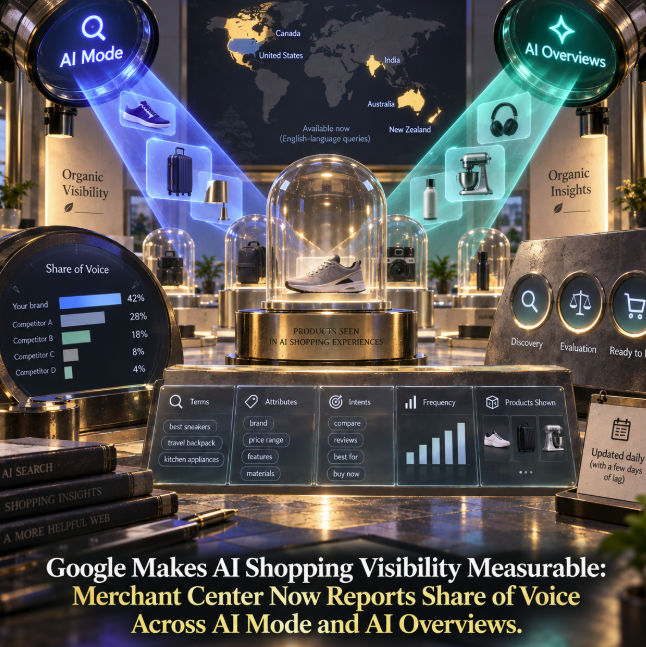

Google has turned a difficult AI-search measurement problem into a first-party Merchant Center report. AI performance insights are now generally available to eligible merchants in Australia, Canada, India, New Zealand and the United States, giving retailers a direct view of how their brands and products appear for conversational shopping queries across AI Mode and AI Overviews.
Google confirmed the broader availability in its September 16 shopping update. The accompanying Merchant Center documentation shows how far the report goes beyond a simple impression count: retailers can benchmark share of voice against competitors, inspect frequency and products showing, study terms and attributes, and break visibility down by the shopper's stage of the buying journey.
For AI visibility measurement, this is a notable development because the data comes from Google itself. Retailers no longer have to rely entirely on manually sampled prompts or third-party monitoring to understand whether their products are appearing in Google's conversational shopping experiences.
The report covers organic AI shopping visibility
The first boundary is important: AI performance insights currently measure organic AI traffic, such as free listings. Google explicitly says paid Ads traffic is not included in this report.
The documented scope focuses on conversational queries with shopping intent across AI Mode and AI Overviews. Earlier rollout documentation also discussed Gemini, but Google's current generally available Merchant Center help page specifically describes the report around AI Mode and AI Overviews. For current measurement claims, that narrower live documentation is the appropriate scope.
This gives ecommerce teams a cleaner analytical category. Paid campaign performance can remain in advertising reports, while Merchant Center's AI performance view measures how products and brands surface organically in Google's generative shopping layer.
Share of voice turns AI visibility into a competitive metric
The central metric is share of voice. Google defines it as the proportion of AI impressions captured by the merchant's brand or products compared with the total impressions generated by that merchant and its defined Merchant Center competitors for related queries.
The report also provides the competitors' average share, allowing a retailer to compare its visibility against the competitive set Google has identified for the account.
This is materially different from knowing that a product appeared in an AI response once. A share-of-voice metric introduces competitive context: the retailer can see how much of the available AI shopping exposure it is capturing relative to brands appearing for similar conversational demand.
There are limitations. Merchants cannot manually change the competitor set used by the report. Google also notes that an account without sufficient defined competitor data can show 100% share of voice, so that number should not automatically be interpreted as market dominance.
Google measures frequency as well as visibility
Merchant Center also reports frequency, which Google describes as a representation of how popular particular search types, search terms, intents or attributes have been.
That creates a useful second dimension. Share of voice answers how visible the merchant is within a relevant competitive set; frequency helps indicate how much consumer demand exists around the underlying conversational pattern.
A retailer might therefore discover a topic with high frequency but weak share of voice. Google's own documentation presents that combination as an optimization opportunity because the merchant is underrepresented in an area where shoppers are actively expressing demand.
Merchants can see how many products are actually surfacing
The products showing metric reports how many of the merchant's products appear for top terms, popular attributes and shopping intents. Google says the value is an exact numerical product count rather than a modeled percentage.
This helps distinguish brand-level visibility from catalog coverage. A retailer may have reasonable overall share of voice while only a small subset of its catalog is being surfaced for the conversational themes that matter. Conversely, broad product coverage may reveal that Google understands and retrieves a larger portion of the merchant's feed across different shopping needs.
The report maps visibility to three shopping stages
One of the strongest features is the shopping-stage scorecard. Google classifies conversational shopping queries into Discovery, Evaluation and Ready to buy.
Discovery covers early exploration, when shoppers are still looking broadly at possible products. Evaluation captures the middle of the journey, including comparisons, specifications and research. Ready to buy covers later-stage intents that are closer to a transaction.
Merchant Center provides share-of-voice information across those stages and also exposes search types within them. A retailer can therefore move beyond asking, “Do we appear in AI Mode?” and ask a more useful question: “At which stage of the conversational shopping journey do we appear, and where are competitors capturing more visibility?”
Terms reveal the language shoppers use in AI conversations
The report surfaces top search terms associated with conversational shopping activity. That matters because AI shopping behavior does not necessarily resemble a traditional list of short ecommerce keywords.
Users can describe requirements, use cases, preferences and constraints in natural language. Google itself frames AI performance insights as a response to the shift from keyword-based searches toward longer and more complex conversational shopping paths.
Term-level reporting gives merchants a first-party view into some of that demand. It can help reveal the language Google is seeing around products and where a merchant's visibility is strong or weak.
Product attributes become a measurable AI-discovery surface
Google also reports popular product attributes. These can include specifications and characteristics shoppers use when describing what they want — for example, features, materials, styles or other structured product properties.
This is particularly important because conversational shopping queries often express needs through attributes rather than exact product names. A shopper may describe a desired material, use case, fit, compatibility requirement or feature combination and expect the AI system to identify suitable products.
Merchant Center can highlight missing attributes, and Google's current recommendations explicitly tell merchants to populate relevant missing product attributes. The implication is practical rather than speculative: better product-data completeness gives Google's shopping systems more structured information to work with when matching products to conversational demand.
Intent reporting connects product data with what shoppers are trying to do
The report also groups activity around search intents and search types. Google gives examples such as searching by category, researching product specifications and looking for reviews.
This makes the report more than an AI impression dashboard. It begins to describe the relationship between the merchant's catalog and the tasks shoppers are performing while they research a purchase.
For a retailer, that can expose gaps that are difficult to see in conventional aggregate traffic data. A product may be discoverable for broad category exploration but largely absent when shoppers begin comparing specifications. Another brand may perform strongly during evaluation but lose visibility in ready-to-buy contexts.
The data is refreshed daily, with a lag
Google says historical AI performance data is available and is updated daily with a few days of lag. This is therefore not a real-time monitoring system.
The lag matters when teams compare Merchant Center data with live prompt testing or recent product-feed changes. An optimization made today should not be expected to appear immediately in the report, and sudden day-to-day observations from manual AI Mode testing may not align perfectly with the reporting window.
For ongoing measurement, however, daily refreshes provide a substantially more systematic signal than occasional screenshots or manually repeated prompts.
The rollout is limited to five countries and English-language queries
General availability is still geographically constrained. Google's current documentation lists Merchant Center accounts in Australia, Canada, India, New Zealand and the United States, and the report is currently available for English-language queries.
Merchants outside those markets should not assume that the report is globally available simply because their products can appear in Google's AI experiences. The reporting feature has its own eligibility boundaries.
Country is also available as a report filter, but only for countries where the merchant is eligible for AI performance insights.
Google moved from “coming soon” to generally available in four months
The feature was announced earlier in 2026 as an upcoming Merchant Center capability. In Google's May 20 retailer update, AI performance insights were described as rolling out to Australia, Canada, India, New Zealand and the U.S. in the coming months.
By September 16, Google was describing the feature as now available across those markets. That progression matters because it moves the report from product roadmap to an operational measurement tool merchants can actually use.
Google is also telling merchants what to do with the data
The Merchant Center help page does not stop at reporting. Google recommends using the insights to improve product data, including adding relevant popular search terms to product titles and descriptions and filling missing attributes.
Those recommendations need to be interpreted sensibly. They are Google's own suggested actions for this Merchant Center report, not evidence that mechanically inserting terms guarantees visibility in AI Mode or AI Overviews. The report can reveal opportunities, but Google does not publish a deterministic formula that turns a feed edit into an AI appearance.
The most defensible use is diagnostic: identify high-frequency areas where share of voice is weak, examine the terms and attributes associated with those areas, then improve product information where it is genuinely incomplete or unclear.
Merchant Center is becoming an AI visibility console for ecommerce
Historically, ecommerce teams could use Merchant Center to manage product data, diagnose listing issues and analyze shopping performance. AI performance insights add another role: measuring how a catalog participates in generative shopping experiences.
That is particularly significant because AI Mode can organize product discovery differently from a conventional search-results page. Google's conversational shopping systems can interpret complex needs, synthesize guidance and surface products within generated responses. Standard rank tracking is poorly suited to that environment because there may not be a stable numbered position to monitor.
Share of voice, products showing, frequency and stage-level visibility are better matched to a generative interface where the core question is not simply “What position did this URL rank?” but “How often did this brand or product become part of the answer set?”
First-party AI visibility data changes the measurement conversation
AI visibility tools have emerged partly because publishers and brands have had limited first-party reporting from the major answer engines. Teams often have to construct prompt sets, repeat queries and monitor citations or product appearances externally.
Google's Merchant Center report does not solve AI measurement universally. It applies to a specific commercial dataset, specific markets, English-language shopping queries and Google's own AI surfaces. It also does not expose every prompt or provide a complete explanation of why one product was selected over another.
But within those boundaries, it is first-party reporting from the platform generating the AI shopping experience. That makes it a meaningful reference point for retailers trying to distinguish actual visibility trends from anecdotal prompt checks.
AI shopping optimization now has a feedback loop
The most important consequence is the creation of a measurable loop. Merchants can inspect where their products appear, compare their share with competitors, identify high-frequency terms and attributes, see which products are showing and examine performance across discovery, evaluation and ready-to-buy intent.
They can then improve product data and return to the report after the reporting lag to see how visibility evolves. That still does not establish simple causality — many factors can change simultaneously — but it creates a far more structured process than optimizing product feeds without any direct AI-surface feedback.
Google has made AI shopping visibility measurable inside Merchant Center. For eligible merchants, AI Mode and AI Overviews are no longer only surfaces that can be manually observed from the outside. They now produce a first-party organic visibility report built around the metrics that matter in conversational commerce: share of voice, demand frequency, products shown, terms, attributes and shopping intent.