

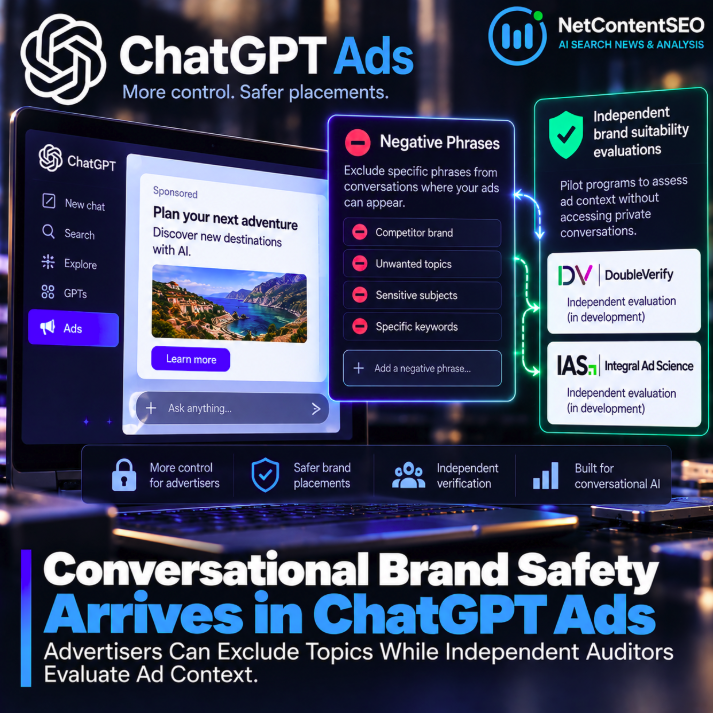
OpenAI is adding a new layer of advertiser control to ChatGPT Ads with Negative Phrases, while DoubleVerify and Integral Ad Science work on independent assessments of the platform's brand-suitability protections.
The changes, announced on October 5, 2026, address a challenge that is specific to conversational advertising: advertisers are no longer deciding only which pages, videos or keywords are suitable environments for their brands. They also need controls for the context of an evolving AI conversation.
Negative Phrases let advertisers exclude conversational contexts
OpenAI says eligible advertisers can now provide specific phrases that they do not want associated with conversations in which their ads appear.
The system is designed to help advertisers prevent placements in contexts they consider unsuitable for their brand, adding advertiser-defined exclusions on top of OpenAI's existing ad placement safeguards.
This resembles the strategic role of negative keywords in search advertising, but the environment is fundamentally different. ChatGPT Ads operate inside conversations, where meaning develops across multiple turns rather than around a single search query.
Conversational brand safety is a new classification problem
In traditional search advertising, suitability can often be evaluated from the query, keyword, landing page and surrounding search results.
In a conversational interface, the same phrase can appear inside very different discussions. The system therefore needs to interpret context rather than simply detect a word.
Negative Phrases give advertisers a way to express contexts they want to avoid, while OpenAI's placement systems determine whether the current conversation is appropriate for an ad.
DoubleVerify and IAS are developing independent assessments
OpenAI also says it is working with DoubleVerify and Integral Ad Science (IAS) as they develop independent brand-suitability assessments for ChatGPT Ads.
The important privacy detail is explicit: these evaluations are being designed so the independent providers can assess OpenAI's placement protections without receiving access to users' private conversations.
That creates a technically unusual verification problem. Third parties need enough information to evaluate whether advertisements are being placed appropriately without exposing the underlying private conversation used to determine that context.
The independent evaluations are still in development
Advertisers should not interpret the DoubleVerify and IAS work as a fully deployed universal verification product yet.
OpenAI describes these capabilities as being developed with the two measurement and verification companies. Negative Phrases, by contrast, are already available to eligible advertisers.
The distinction matters because brand-safety controls and independent verification are at different stages of availability.
Why this matters for ChatGPT Ads
Advertising inside an AI assistant introduces a trust problem that does not map perfectly onto conventional web advertising.
A conversation can shift rapidly from a broad commercial question to sensitive personal, financial or other unsuitable contexts. Placement systems therefore need to understand not only what an advertiser wants to reach, but also when an otherwise relevant advertisement should not appear.
Negative Phrases give advertisers more direct input into that decision.
Independent evaluation, meanwhile, is intended to provide evidence that the platform's own suitability controls are working as intended.
Brand safety becomes part of the AI retrieval and placement stack
From an AI Search perspective, this is another example of machine classification happening between a user's conversation and the content ultimately displayed.
Before an advertisement appears, the system can evaluate relevance, eligibility, advertiser exclusions and contextual suitability.
That means conversational advertising is developing its own selection stack — one that resembles retrieval systems in some ways but adds commercial and brand-safety constraints.
Negative Phrases are not a visibility guarantee
The new control should also not be confused with targeting.
Excluding a phrase tells the platform where an advertiser does not want an ad associated. It does not imply that the advertiser can force placement around other specific phrases or conversations.
OpenAI continues to control ad eligibility and placement under its own policies and product systems.
Privacy is central to third-party verification
The DoubleVerify and IAS work is particularly significant because independent auditing normally depends on observing the environment in which an advertisement appeared.
With ChatGPT, that environment can contain private user content.
OpenAI's stated approach is therefore to enable independent assessment without handing private conversations to the verification providers. How that methodology is implemented and validated will be important as the pilot work develops.
The NetContentSEO takeaway
ChatGPT Ads is beginning to build the infrastructure expected of a mature advertising platform, but adapted to a conversational environment.
Negative Phrases give eligible advertisers more control over unsuitable conversational contexts. DoubleVerify and IAS are working toward independent assessment of OpenAI's brand-suitability protections. And OpenAI says those assessments can be developed without exposing private conversations.
For AI discovery, the broader lesson is that conversational visibility will increasingly be governed by multiple classification layers: relevance, policy, safety, commercial eligibility and advertiser-specific exclusions.
Being contextually relevant may therefore be only the first requirement. In conversational advertising, a placement must also survive an increasingly sophisticated brand-suitability decision layer.