

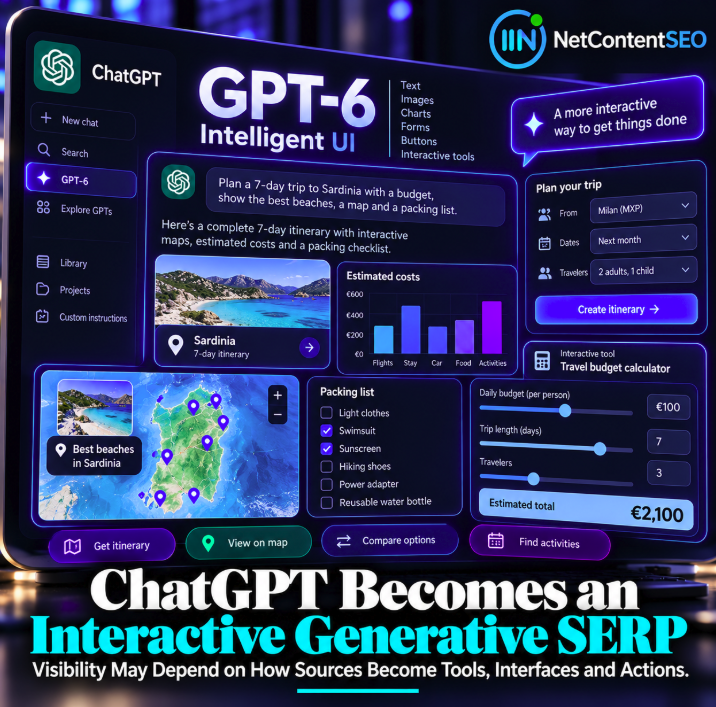
ChatGPT is no longer limited to generating an answer inside a stream of text.
On October 7, 2026, OpenAI began rolling out GPT-6 with Intelligent UI, a new ChatGPT capability that lets the model compose responses from text, visuals and interactive components — including graphics, charts, tappable buttons, forms and tools that users can operate directly inside the conversation.
For AI Search and GEO, the important change is not simply that answers look better. ChatGPT can now decide what interface should exist around the information it retrieves and generates.
GPT-6 can compose the answer as an interface
OpenAI says GPT-6 has been trained to choose how text, visuals and interactive elements should fit together according to the user's question.
A comparison can become a side-by-side interface. An explanation can become an interactive diagram. A task can produce a calculator, form or other purpose-built tool.
And when plain text is the best format, ChatGPT can still return a conventional text response.
Intelligent UI is generated according to the task
This is different from attaching a fixed widget to every answer.
OpenAI built a library of native, streamable components and a compiler that processes the interface while GPT-6 generates it.
The model has been trained not only on answer quality but also on decisions involving layout, visuals, organization and interactivity.
In practical terms, ChatGPT is being given control over part of the presentation layer.
Responses can include forms and controls
OpenAI explicitly lists tappable buttons, forms, charts, graphics and interactive experiences among the available response elements.
A user can change an input, operate a control or interact with a tool without leaving the conversation.
Examples from OpenAI include savings calculators, bill splitters, games, visual learning experiences and interfaces that adapt information to a user's task.
ChatGPT can now create a tool at answer time
One of the more consequential examples is tool creation.
A user can ask for a calculator or another small interactive experience and ChatGPT can generate it directly in the conversation.
This moves the response beyond “here is information about how to do the task” toward “here is an interface you can use to perform the task.”
For publishers and software businesses, that distinction deserves attention.
The answer can start before reasoning is finished
GPT-6 also changes how responses are delivered.
OpenAI says ChatGPT can begin answering while the model continues thinking or using tools, then progressively add findings without requiring another user prompt.
Intelligent UI itself can stream progressively as the response is generated.
The result is an experience closer to a dynamically assembled application than a static completed document.
Why this resembles a generative SERP
Search result pages have traditionally been interfaces assembled by the search engine from indexed information: links, images, maps, product modules, knowledge panels, calculators and other vertical features.
Intelligent UI pushes ChatGPT toward a similar role, but with a crucial difference.
The interface does not have to be selected only from a fixed SERP template. GPT-6 can choose and compose components according to the individual question.
That makes ChatGPT increasingly resemble an interface-generating answer engine.
A citation may become only the first layer of visibility
AI visibility measurement today focuses heavily on whether a domain is cited, whether a brand is mentioned and where it appears in the answer.
Those metrics remain useful.
But Intelligent UI creates another possible layer: how source information is transformed into the interactive answer.
A source might provide data used in a chart. Product information might contribute to a comparison interface. Structured information might help populate a form or calculator. Location data might become a map experience.
Not every Intelligent UI component will necessarily correspond to an external source, and OpenAI has not documented a new ranking system that rewards particular formats. But the output surface has clearly expanded beyond prose.
Source visibility and interface visibility are not necessarily identical
A website could theoretically be cited while contributing little to the most prominent interactive element.
Conversely, information derived from a source could become central to a chart or structured comparison while the user pays relatively little attention to the citation itself.
This suggests a future measurement problem for GEO tools.
Counting citations alone may not capture the visual or functional prominence of information inside a generated interface.
Structured data becomes strategically interesting — but not a guaranteed ranking factor
Intelligent UI naturally raises questions about structured information.
Clear product attributes, locations, prices, specifications, dates and other machine-readable facts are easier to transform into comparisons and interactive experiences than ambiguous prose.
However, OpenAI has not said that adding Schema.org markup or any particular structured-data format guarantees inclusion in Intelligent UI.
The correct SEO interpretation is therefore cautious: machine-readable, internally consistent information can improve the clarity of a site's entities and facts, but there is no documented “Intelligent UI ranking factor.”
Original data may gain a new presentation surface
Publishers with proprietary datasets have traditionally used charts and tables to make that information understandable on their own websites.
Generative interfaces create the possibility that an AI system can recompose useful data into its own chart or interactive explanation.
This increases the importance of data provenance, citation, freshness and clear source attribution.
If the interface becomes the user's primary experience, publishers will want to know whether the underlying source remains visible and whether that visibility produces meaningful downstream value.
Interactive answers can reduce the need for another website step
There is also an obvious traffic implication.
If ChatGPT can provide the calculator, comparison, checklist, map or other task interface directly inside the answer, some informational visits that previously required an external tool may no longer be necessary.
That does not mean every interactive query becomes zero-click. Users may still need original reporting, products, services, transactions, deeper analysis or authoritative first-party information.
But Intelligent UI expands the set of tasks that can potentially be completed inside ChatGPT.
The competitive question moves from “Are we cited?” to “What role do we play?”
For brands, there may soon be several levels of AI visibility.
A brand can be absent. It can be mentioned. It can be cited. It can be recommended. Its data can become part of a comparison. Its product can become an actionable choice. Its information can help power an interactive tool.
Those are not equivalent outcomes.
The evolution of ChatGPT's interface makes that distinction increasingly important.
Intelligent UI also changes content design
Content built exclusively as long-form prose may still be valuable, but AI systems increasingly benefit from clearly identifiable facts, comparisons, steps, entities and relationships.
For publishers, the goal should not be to manufacture artificial “AI-friendly” markup.
It should be to make useful information explicit: label data clearly, maintain consistent entities, expose methodology, distinguish facts from interpretation and keep important information current.
Those practices help both humans and machines understand what a source actually contributes.
The rollout is global and progressive
OpenAI began the global rollout on October 7 for ChatGPT Plus, Pro, Business and Enterprise users in the Chat experience.
Free and Go users begin receiving GPT-6 on October 8.
Paid Chat tiers use GPT-6 Sol, while Free and Go use GPT-6 Luna. Both support Intelligent UI.
Enterprise availability can depend on workspace administrator settings.
Not every GPT-6 experience gets Intelligent UI
OpenAI documents several important boundaries.
Intelligent UI is available in Chat from Instant through Extra High reasoning levels.
The Pro reasoning option, powered by GPT-6 Astra, does not support Intelligent UI. The October 7 release also does not change the models powering Work and Codex.
OpenAI's Help Center additionally says Intelligent UI is not currently available in Voice or the Work tab.
This is an interface shift, not a documented SEO ranking update
There is no evidence in OpenAI's announcement of a new publisher ranking factor, citation algorithm or optimization requirement tied specifically to Intelligent UI.
Publishers should therefore avoid treating the launch as proof that a particular markup implementation will produce interactive placement.
What is official is the output change: GPT-6 can now construct richer interactive experiences from the information and tools available to it.
What AI visibility teams should start measuring
Traditional citation tracking remains necessary, but Intelligent UI suggests several additional questions worth monitoring.
Does the brand appear in the most visually prominent component? Is its data used in comparisons? Does an interactive recommendation lead toward the brand or a competitor? Is attribution visible when information becomes a chart or tool? Does the interface create an action that sends the user to an external property?
These are early measurement questions rather than established industry standards, but they follow directly from the new response architecture.
NetContentSEO take
GPT-6 Intelligent UI turns ChatGPT from an answer generator into something closer to a generative interface engine.
For SEO and GEO, citations remain important, but the output surface is becoming richer than the citation card itself.
The next visibility battle may involve not only whether a source is retrieved, but what the model does with that source once it has it: summarize it, chart it, compare it, turn it into a control, or use it to support an action.
ChatGPT is becoming an interactive generative SERP. AI visibility measurement will eventually need to understand the interface, not just count the links.