

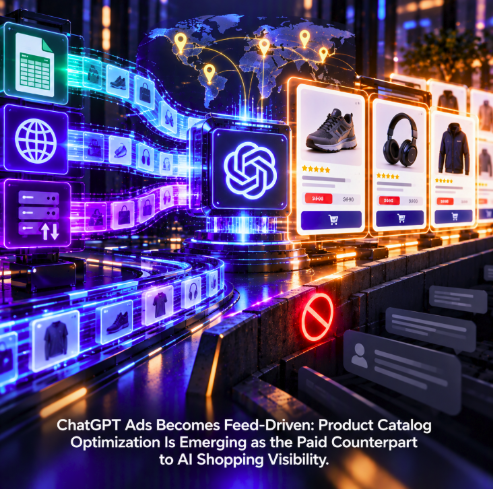

OpenAI has turned the product catalog into a first-class campaign input for ChatGPT Ads. Retail advertisers in Ads Manager Beta can now upload or connect structured product feeds, filter the catalog into advertising sets and use those sets to generate product ads at scale rather than constructing each product placement manually.
The capability is documented in OpenAI’s newly updated official product-feed campaign guide. OpenAI says feed-based campaigns are intended for retailers with large or frequently changing catalogs and that ads created from product feeds have been among the strongest-performing ads in the advertising program to date.
The update matters beyond campaign convenience. ChatGPT Ads now has a structured catalog layer with its own eligibility fields, product grouping metadata, freshness requirements and automated creative inputs. Feed optimization is becoming a paid AI-discovery discipline—while OpenAI is simultaneously drawing a clear boundary between products submitted for advertising and products eligible to surface organically in ChatGPT.
Retailers can bring a catalog into Ads Manager three ways
OpenAI currently supports three import routes inside Ads Manager: manual CSV or TXT upload, a stable hosted HTTPS URL and an SFTP connection for automated server-to-server delivery. The company positions manual uploads as useful for occasional updates, while hosted URLs and SFTP are better suited to catalogs that need continuous synchronization.
That gives ChatGPT Ads the familiar architecture of a mature retail advertising system. Instead of treating every SKU as a standalone creative asset, the retailer supplies structured inventory and lets the campaign layer select from it.
For larger integrations, OpenAI’s developer documentation describes full-snapshot SFTP feeds as the supported delivery model and recommends refreshing them at least daily. Supported production formats include Parquet as the preferred format, along with compressed JSONL, CSV and TSV.
Products expire if the feed stops updating
Feed freshness is not optional indefinitely. OpenAI says items imported through the Ads Manager workflow expire after two weeks, which is why it recommends a hosted URL or automated SFTP updates rather than relying on a one-time manual upload.
This creates a direct operational relationship between catalog maintenance and advertising eligibility. A retailer can have a correctly configured campaign but gradually lose the underlying products if its feed pipeline stops refreshing.
OpenAI’s developer specification reinforces the same principle from another angle: prices and availability should be updated when they change.
For ecommerce teams, the feed therefore becomes live advertising infrastructure rather than a setup artifact.
The feed can control which products enter each ad group
After uploading and validating a feed, advertisers create a Product feed campaign and then select the catalog inside an ad group. Product filters determine which uploaded items are eligible for that group, and Ads Manager displays the number of products passing the selected filters before launch.
OpenAI has also introduced an ads_metadata field for retailers that need more control than the built-in filters provide. The field can carry custom string labels such as a bidding tier or product line, which can then be used to construct different subsets from the same catalog.
This is strategically important because the feed is not merely describing products. It can also carry an advertiser-defined classification layer that shapes campaign structure.
ads_metadata is for product selection, not hidden audience targeting
OpenAI makes a useful distinction about custom labels. A retailer can use a value such as custom_label_0 to identify products and then filter an ad group against that value, but the label itself does not determine who sees the advertisement.
In other words, a label named after a state, customer segment or internal tier is still product metadata. Advertisers should not treat it as an undocumented targeting mechanism.
That separation keeps the catalog-selection layer distinct from campaign delivery settings. It also means feed taxonomy should be designed around useful product groupings rather than attempts to encode audience logic into arbitrary fields.
Product-feed campaigns currently use country-level geography
New product-feed campaigns have a more constrained geographic model than some other ChatGPT Ads campaigns. OpenAI says they support geographic targeting and exclusions only at country level. Existing feed campaigns with older sub-national selections may retain them, but new state, city, market or postal-code selections cannot be added to this campaign type.
That makes catalog segmentation and geographic delivery separate controls. A retailer can use the same underlying catalog to construct different product sets, but the current product-feed campaign itself does not provide the full sub-national targeting granularity available elsewhere in Ads Manager.
The creative is assembled from structured product data
OpenAI says product ads can display product images, titles, star ratings, prices, sale prices and the advertiser’s brand.
During setup, the advertiser creates an ad template for the ad group. OpenAI says the template currently requires only an image-field selection; the system then uses eligible product data to populate the product advertising format. A single template is sufficient for the group.
This reduces creative production overhead but increases the importance of catalog quality. If titles, images, prices or product descriptions are poor at the feed level, those weaknesses can propagate across a large number of ads.
OpenAI says feed advertisers are already among its strongest performers
One of the most notable statements in the new documentation is OpenAI’s performance claim. The company says advertisers using product feeds have been among the strongest performers on the platform and that ads built from feeds have been among the program’s strongest-performing ads to date.
OpenAI does not publish the underlying benchmark, sample size, vertical mix or comparative performance figures in this guide, so the claim should not be converted into a universal expected uplift. It is nevertheless a meaningful first-party signal about where the company is seeing traction inside the beta.
The explanation OpenAI offers is structural: feeds make it easier to run larger campaigns, keep product information current and connect users with relevant products while they explore, compare and decide.
The catalog can be ad-eligible without becoming organically discoverable
The most important boundary for AI visibility is explicit. OpenAI says products uploaded through this Ads Manager feed workflow are eligible only for advertisements during the beta. They do not appear in organic ChatGPT conversations as a consequence of being uploaded to the advertising feed.
OpenAI adds that it may offer that capability in the future. For now, however, paying to supply a product feed does not buy entry into ChatGPT’s organic shopping answers.
This distinction matters because structured product data can otherwise look like a single pipeline serving both paid and organic discovery. OpenAI’s own developer reference separates those concepts: Ads has dedicated eligibility controls, while checkout requires a separately enabled integration, and the advertising eligibility flag is independent of search eligibility.
Paid catalog optimization and organic AI shopping are parallel disciplines
The architecture creates two related but distinct optimization problems. Organic AI shopping visibility depends on whether a product enters the discovery systems that ChatGPT uses when answering users. Feed-based advertising depends on whether the retailer’s catalog is valid, current, ad-eligible, appropriately segmented and attached to a campaign that can compete for delivery.
The underlying data hygiene can overlap. Clear product identity, accurate descriptions, usable images, current pricing and correct availability are valuable in both environments. But the eligibility and distribution systems remain separate.
For marketers, that means “AI product visibility” can no longer be reported as one number. A retailer may be absent organically but active in paid placements, or visible organically without running ChatGPT Ads.
This expands the feed story beyond Shopify
NetContentSEO recently covered OpenAI’s Shopify integration in “ChatGPT Ads Expands Through Shopify: Product Feeds Become the Foundation of Paid AI Discovery.” That integration makes Shopify a synchronized commerce source for eligible merchants.
The new Ads Manager documentation generalizes the same feed-driven advertising model beyond a single ecommerce platform. A retailer does not need Shopify to participate: it can provide the catalog directly as a file, hosted HTTPS feed or automated SFTP delivery.
That is an important expansion. Product-feed advertising is becoming a native Ads Manager capability rather than merely a benefit of a partner integration.
Feed processing also depends on crawlable assets
A catalog can be syntactically correct and still fail operationally if OpenAI cannot retrieve the assets it references. NetContentSEO’s recent analysis of ChatGPT Ads crawler requirements documented that product-feed advertisers need OpenAI’s systems to reach product-image URLs and that infrastructure blocks can interfere with feed processing.
This turns feed optimization into a cross-functional job. Merchandising teams own catalog semantics; paid-media teams own campaign structure; engineering teams may own SFTP, hosted feeds, image delivery, CDNs and bot access.
The campaign is only as current and usable as the pipeline supplying it.
The Products tab is reporting, not a catalog inventory screen
OpenAI also warns advertisers not to misread the Products tab. It does not display every uploaded or ad-eligible item. A product appears there after an active product-feed campaign has generated delivery data and that data reaches reporting.
During setup, advertisers should instead use the product count in the ad-group creation flow to confirm how many uploaded items pass their filters. After delivery begins, OpenAI says product rows can take up to seven hours to first populate in the Products tab. Impressions, clicks and CTR typically refresh more frequently, while spend reporting can lag by roughly seven to eight hours.
This distinction matters when diagnosing campaigns. An empty reporting table does not necessarily mean the feed failed.
Catalog quality is becoming paid AI infrastructure
Product-feed advertising moves a familiar ecommerce discipline into conversational media. Search and shopping advertisers have spent years optimizing titles, variants, images, pricing, inventory and custom labels because structured catalog quality affects what advertising systems can understand and serve.
ChatGPT Ads now creates its own version of that problem. The conversation may be the demand signal, but the catalog is the supply layer from which the platform can choose products.
That makes feed governance commercially important. Stable identifiers should remain stable. Variants should be distinct. Prices and availability need to be current. Images need to resolve. Internal labels need to support useful product sets. And the update pipeline needs to run frequently enough that products do not expire or advertise stale information.
ChatGPT Ads is becoming a catalog-driven retail media system
The significance of the update is not that OpenAI invented product feeds. It is that ChatGPT’s advertising business is acquiring the infrastructure that makes retail advertising scalable.
Retailers can now connect a catalog directly to Ads Manager, keep it synchronized, filter products into ad groups, use custom ads_metadata, generate product-oriented creative and let ChatGPT Ads optimize eligible campaigns toward clicks or conversions.
At the same time, OpenAI is preserving a hard distinction between paid and organic product visibility. Feed submission can make an item available to the advertising system, but it does not currently make that item appear in organic ChatGPT conversations.
That boundary defines the emerging retail playbook. Organic AI shopping visibility is one competition. Feed-driven ChatGPT advertising is another. Both reward machine-readable product information, but only one can currently be activated directly from Ads Manager—and OpenAI’s early performance commentary suggests retailers are already finding value in doing so.