

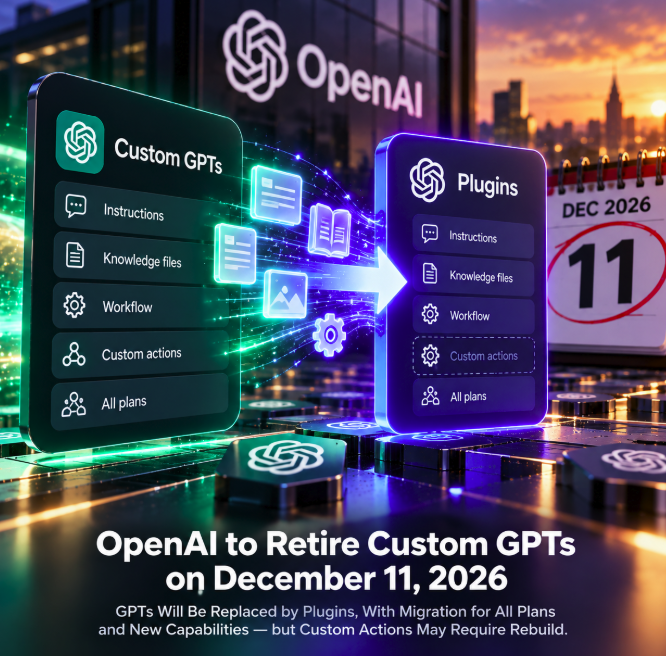

OpenAI is putting a date on the end of one of ChatGPT’s most recognizable creator formats. Custom GPTs are scheduled to retire on December 11, 2026, with OpenAI moving creators toward Plugins as the replacement architecture for reusable instructions, reference material and connected capabilities.
The company’s current official migration FAQ says the transition affects all ChatGPT plans, although migration access, plugin availability and any account-specific exceptions can vary. Existing GPTs remain usable until the retirement date that applies to the account or workspace. OpenAI’s September 11 ChatGPT release notes likewise describe the retirement as a cross-plan transition rather than an Enterprise-only experiment.
For creators who built simple GPTs around instructions and knowledge files, OpenAI is planning a migration path. For teams whose GPTs act as front ends to proprietary APIs, publishing systems or business workflows, the transition is more consequential. Custom Actions are the part that cannot simply be assumed to survive unchanged, and OpenAI’s guidance makes clear that integrations may need to be rebuilt and tested in the new plugin architecture.
December 11 is now the date creators need to plan around
OpenAI’s current FAQ says custom GPTs are scheduled to retire on December 11, 2026. The company still tells users to follow notices for their own account or workspace, because migration access and detailed timing can differ, but the retirement is no longer described merely as an abstract future direction.
Until the applicable retirement date, existing GPTs continue to work subject to their existing permissions. That gives creators a limited window to inventory what they depend on, identify who owns each GPT and decide whether the replacement needs only migrated instructions or a deeper technical rebuild.
This matters particularly for organizations that accumulated GPTs organically. A team may have public assistants, private internal tools, prototypes, workflow bots and GPTs created by employees who no longer manage the underlying process. The migration problem starts with ownership before it reaches technology.
Plugins are replacing the wrapper, not necessarily the workflow
OpenAI describes Plugins as a way to combine reusable instructions, reference files and connected apps so guidance can operate alongside the information and tools required for a task. That overlaps with what creators previously packaged inside a custom GPT, but the interaction model is different.
A custom GPT was a destination: users opened a named assistant and worked inside its configured environment. A plugin is closer to a reusable capability that can participate in the broader ChatGPT experience. Once installed, a plugin or one of its skills can be selected for a task, invoked where supported, or used automatically when ChatGPT determines that the capability matches the user’s request.
NetContentSEO previously examined this strategic shift in its first analysis of the custom GPT retirement. The latest migration guidance makes the operational consequence clearer: creators should preserve what the GPT does rather than assuming its standalone identity will remain the primary product surface.
Instructions and reference material are the easiest part to preserve
OpenAI’s migration flow is intended to carry forward the core guidance that defines a GPT. For many creators, the most valuable asset is not the GPT Store listing or chat wrapper but a carefully engineered instruction set that encodes editorial rules, domain knowledge, decision logic and workflow behavior.
Reference files are similarly important. Organizations may have spent months building knowledge packs, templates, policy documents, examples and internal guidance that make a specialized assistant useful. The migration path is designed to preserve that kind of reusable context inside the replacement plugin.
Creators should still test the migrated result rather than assuming semantic equivalence. A plugin may operate in a different orchestration environment, interact with different tools or be selected under different circumstances. Preserving the text of an instruction is not the same as proving that every complex workflow behaves identically.
Finish important edits before pressing Migrate
OpenAI warns that once a GPT is migrated, the original remains usable until retirement but becomes read-only. That makes the migration button a one-way operational milestone even though the old GPT continues running temporarily.
Creators should therefore finish essential instruction changes, clean up reference files and publish the version they actually want to carry forward before migrating. The migration should be treated more like a production release than an export operation.
This is especially important for GPTs with long system instructions that have evolved through repeated patches. Migrating a messy production configuration simply transfers the maintenance problem into the new architecture.
Custom Actions are the real technical risk
The biggest warning is for GPTs that call external APIs. A custom GPT can be much more than a prompt: it can trigger publishing endpoints, query proprietary databases, create records, retrieve customer information or execute workflow-specific actions.
Those integrations should not be assumed to migrate automatically. OpenAI’s guidance tells creators to evaluate the external functionality they depend on and rebuild it using supported integrations where necessary, including custom MCP infrastructure when appropriate.
That creates a clear dividing line between two classes of GPT. A writing assistant based mainly on instructions and files may have a relatively straightforward migration. A GPT that functions as an operational interface to a company’s backend can require engineering work, authentication review, permission design and end-to-end testing.
For businesses, that is the work that should begin well before December.
An API-backed GPT needs a migration inventory, not just a backup
Teams should document every external action their important GPTs can perform: which endpoint it calls, what authentication it requires, what arguments it sends, what data comes back, what confirmation rules exist and what happens when the external service fails.
The purpose is not merely disaster recovery. The inventory becomes the specification for rebuilding the capability inside the plugin ecosystem.
A publishing GPT, for example, might research a topic, generate an image, construct an article, prepare SEO metadata and finally call a private endpoint that creates an editorial proposal. Migrating the instructions preserves only part of that workflow. If the final API action disappears, the assistant can still write the article but can no longer complete the business process.
That is why sophisticated creators should judge migration success by completed outcomes, not by whether the replacement plugin appears to contain the same prompt.
MCP could become the bridge for proprietary workflows
OpenAI’s broader plugin architecture increasingly treats external systems as connected capabilities rather than bespoke features embedded inside a single assistant. For custom business workflows, Model Context Protocol infrastructure can provide one path for exposing tools and data in a reusable way.
That architecture can be more work initially than a narrow GPT Action, but it can also make the integration less dependent on one assistant wrapper. The same backend capability can potentially participate in multiple workflows rather than being trapped inside a single custom GPT.
Creators should not assume that rebuilding an Action through MCP will reproduce every behavior automatically. Tool schemas, authorization, approvals, error handling and data boundaries all need to be tested in the new environment.
The migration is therefore an opportunity to redesign brittle integrations rather than blindly recreate them.
Creators also need to migrate access, not just functionality
A technically successful plugin is useless if the people who depended on the GPT cannot access it. OpenAI’s guidance emphasizes that plugin availability, installation and permissions can vary by account or workspace.
Teams should identify who currently uses each GPT, whether those users are internal or public, which workspace policies apply and what connected services require separate authorization. A plugin does not inherit magical access to an external system simply because the old GPT could call an Action.
This is particularly important in managed organizations where administrators control which plugins can be installed or which external services can be connected.
Migration planning therefore needs an audience map alongside the technical map.
The old GPT can remain as a temporary fallback—but not an editable one
Once migrated, the original GPT remains usable until retirement but becomes read-only. That creates a useful transition period in which creators can compare the old and new implementations.
A team can run familiar prompts through both versions, compare outputs and identify missing tools, instruction regressions or permission problems before directing everyone to the plugin.
The read-only state also prevents the two implementations from drifting through parallel edits. After migration, maintenance should move to the replacement rather than continuing to evolve the GPT that is scheduled to disappear.
The practical objective is to make December 11 irrelevant operationally because users have already moved before the old assistant stops running.
The most important test is the hardest real workflow
A migrated assistant should not be validated with “hello” or a trivial writing prompt. Teams need to test the workflow that combines the most instructions, files and external capabilities.
If a GPT exists to research, transform data, call an API and produce a finished deliverable, the migration test should execute that entire chain. Tool failures often appear only after several steps, when context has accumulated and the model needs to select the correct integration with the correct arguments.
Creators should also test failure states. What happens if the connected service is unavailable? Does the plugin explain the failure rather than pretending the action succeeded? Does it request approval at the right moment? Does it preserve the organization’s existing safeguards?
The closer the test is to real production usage, the more useful the migration window becomes.
Public GPT creators face a discovery problem as well as a migration problem
Custom GPTs created a recognizable distribution model around named assistants and the GPT Store. Users could browse, search, follow a link and intentionally open a specialized GPT.
Plugins move the center of gravity toward capabilities that can be used inside the broader ChatGPT experience. That may change how creators think about naming, descriptions and discovery.
A plugin description needs to make the capability legible not only to humans but to the system that may decide when it is relevant. Clear scope, trustworthy permissions and predictable behavior become part of discoverability.
Creators who built a brand around a GPT should therefore plan for more than technical conversion. They need to explain to users what replaces the GPT and how to access the new capability.
This is big news because it changes ChatGPT’s creator model
The retirement of custom GPTs is not simply another interface cleanup. GPTs were one of OpenAI’s most visible attempts to let users package specialized AI assistants without building standalone software.
Moving those workflows into Plugins changes the unit of customization. Instead of maintaining many isolated assistants, ChatGPT can increasingly operate as the common conversational layer while specialized instructions and connected capabilities are brought into the task when needed.
For simple GPT creators, the migration may eventually feel like a format conversion. For businesses that turned GPTs into operational software, it is closer to an application migration.
That is why the December deadline deserves attention now rather than in the final week.
The migration checklist is simple to describe and easy to underestimate
Every important GPT needs four things identified before migration: the instructions that define its behavior, the files that provide reusable knowledge, the people who need access and the external actions that make the workflow operational.
The first two are the pieces OpenAI is making easiest to carry forward. Access needs to be deliberately recreated and verified. Custom Actions deserve the deepest technical review because they may require a new integration rather than a direct transfer.
Once migration becomes available, creators should finish edits, publish the intended version, migrate, configure the replacement, test real workflows and move users before the old GPT disappears.
December 11 is the retirement date. The practical deadline for serious GPT creators should be much earlier.
Custom GPTs are ending, but the valuable part does not have to disappear
The reassuring part of OpenAI’s announcement is that it is not asking creators to abandon specialized workflows. It is changing how those workflows are packaged and invoked.
Instructions can become reusable capabilities. Reference material can continue grounding specialized behavior. Connected services can become tools available to the plugin. Even bespoke API workflows can survive if teams rebuild the integration deliberately.
What cannot survive automatically is complacency. A GPT with a giant prompt and no external dependencies may migrate with relatively little friction. A production assistant connected to private APIs needs an engineering plan.
OpenAI has now given creators the date. The next step is to separate what can be migrated from what must be rebuilt—and make sure the capability still works after the GPT wrapper is gone.