
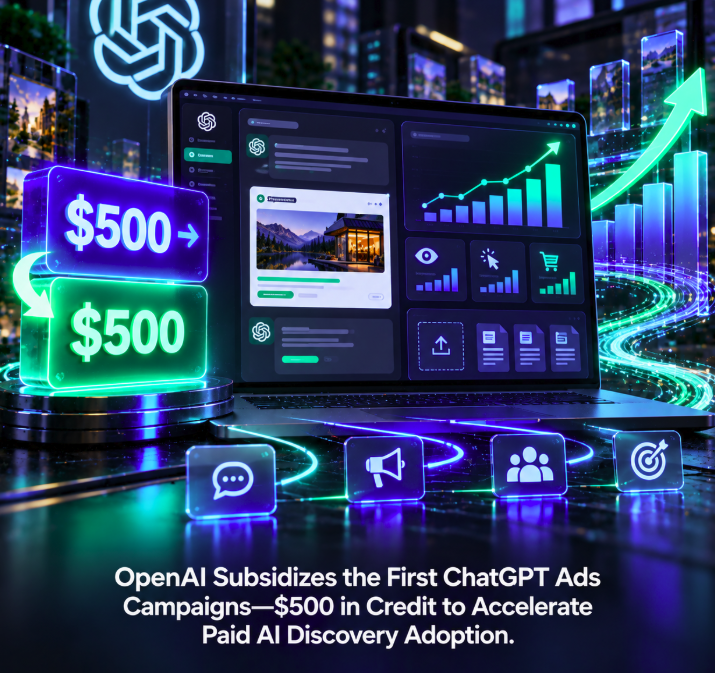
OpenAI is putting its own money behind advertiser acquisition. New businesses signing up for ChatGPT Ads before September 30 are being offered $500 in advertising credit after spending $500, effectively subsidizing the second half of an advertiser’s first $1,000 of eligible media spend and lowering the cost of learning how paid discovery works inside a conversational interface.
The promotion appeared on OpenAI’s official ChatGPT Ads advertiser page, which stated that advertisers new to ChatGPT Ads could sign up before September 30 to receive $500 in ad credit when they spend $500. OpenAI did not attach a publication date to the promotional message, so September 26 should be treated as the date the offer was observed rather than a confirmed launch date.
The credit is an acquisition incentive for the advertising platform itself
The economics are familiar from mature advertising platforms: reduce the financial risk of the first campaign so more businesses generate enough activity to learn the interface, collect conversion data and decide whether the channel deserves recurring budget. What is unusual is the product being subsidized. ChatGPT Ads is still establishing what paid discovery means when the advertising environment is a conversation rather than a conventional search-results page or social feed.
OpenAI’s promotion requires an initial commitment rather than giving away impressions with no advertiser spend. The advertiser spends $500 before receiving the matching $500 credit. That structure encourages a campaign to accumulate enough delivery for the business to evaluate performance while giving OpenAI more real-world auction, creative and conversion data from new accounts.
The public promotion does not establish how much incremental adoption the incentive will generate, and OpenAI has not published a forecast tied to the credit. Its strategic purpose can nevertheless be understood as a standard platform-growth mechanism: lower the effective cost of the advertiser’s first meaningful experiment.
ChatGPT Ads has moved well beyond a small managed pilot
The offer arrives after a rapid expansion of OpenAI’s advertising infrastructure. In May, OpenAI introduced a beta self-service Ads Manager, CPC buying and expanded measurement. In August, it expanded ChatGPT Ads into 31 European markets and subsequently opened self-service access there. On September 16, the company announced another wave of advertising products, including Sponsored Agents, prompt-based ad creation through ChatGPT Work, new AI creative tools and integrations with HubSpot and Shopify.
That sequence matters because a promotional credit is most useful once an advertiser can actually onboard, build campaigns and measure them without a bespoke sales engagement. OpenAI’s current advertiser page sends new customers directly into Ads Manager, where they can create an account, set campaign budgets and goals, build ads and access Help Center guidance.
The $500 offer therefore looks less like an experiment in whether businesses want ChatGPT advertising at all and more like an attempt to accelerate adoption of an increasingly self-service advertising system.
Bulk upload signals that OpenAI wants existing paid-media teams
The advertiser page also makes clear that ChatGPT Ads is being designed for workflows beyond manually creating one ad at a time. OpenAI shows campaign creation tools that include bulk CSV uploads and explicitly tells advertisers they can bulk-upload ad details or create them directly inside the interface.
That is a small product detail with an important operational implication. Bulk workflows make it easier for agencies and larger advertisers to translate existing campaign structures into the new platform. The less manual reconstruction required, the easier it becomes to allocate an experimental budget to ChatGPT alongside established search and social channels.
The platform still has its own campaign logic, auction and contextual matching system, so importing assets does not make ChatGPT Ads interchangeable with Google Ads or Meta Ads. But bulk creation reduces one of the practical costs of testing a new channel: campaign setup time.
The measurement stack now looks recognizably performance-oriented
OpenAI’s current Ads Help documentation says Ads Manager reports impressions, clicks, spend, click-through rate, average CPC, average CPM and conversions. Advertisers can configure conversion measurement inside Ads Manager and add static tracking parameters such as UTMs to landing-page URLs for analysis in their existing analytics systems.
The platform supports impression- and click-based billing, while campaigns can optimize toward supported conversion events. OpenAI says conversion-optimized campaigns using oCPC are billed for valid clicks rather than conversions. It also recommends starting CPC campaigns with a maximum bid of $3–$5 per click, while Ads Manager can indicate whether a bid is likely to be competitive.
Those mechanics place ChatGPT Ads firmly inside performance marketing rather than treating sponsorship as a branding-only product. The advertiser can launch, observe measurable outcomes and optimize campaign settings, which makes the $500 matching credit directly useful as learning budget.
The targeting primitive is conversation context, not just a keyword
The more distinctive part of ChatGPT Ads is how relevance is established. OpenAI says advertisers can provide contextual suggestions at the ad-group level describing conversations, topics or keywords where their products or services may be relevant. These suggestions guide matching but are not exact-match keywords and do not guarantee placement in a specific conversation.
OpenAI’s advertiser page frames this as going beyond keywords with richer context signals. A person can describe what they are trying to accomplish, compare alternatives and articulate constraints across multiple turns. That gives the advertising system a potentially richer representation of intent than a short query alone.
For marketers, this changes the creative problem. The winning ad may need to align not only with a topic but with the stage of decision-making expressed in the conversation. A user researching options, comparing tradeoffs and preparing to take action can represent different commercial moments even when the product category is the same.
Paid AI discovery remains separate from the answer
OpenAI continues to draw a hard product boundary between advertising and ChatGPT’s generated responses. Its official advertising documentation says ads do not influence ChatGPT’s answers, run on systems separate from the chat model and are clearly labeled as sponsored. The current advertiser page likewise emphasizes that ads remain distinct from ChatGPT responses.
That distinction is fundamental to how marketers should understand the channel. Paying for ChatGPT Ads does not buy a recommendation inside the assistant’s answer or alter how a company ranks in organic AI citations. It buys a separate sponsored placement selected by the advertising system.
The difference creates two parallel discovery disciplines. GEO and AI-search optimization attempt to make a brand or source useful enough to be retrieved, cited or incorporated organically. ChatGPT Ads creates a paid path into the same broader decision environment without allowing the advertiser to purchase the answer itself.
The promotion can accelerate learning before it accelerates scale
For a new advertising platform, the first strategic value of a matching credit is experimentation. An advertiser can test contextual suggestions, creative, landing pages, bids and conversion tracking with a lower effective media cost. OpenAI, meanwhile, gets more campaigns flowing through the auction and more evidence about which advertising experiences users find useful.
That learning loop matters because conversational advertising does not yet have decades of standardized playbooks behind it. Search marketers know how to organize keyword campaigns; social teams understand audience and creative testing. ChatGPT Ads asks them to learn how commercial relevance behaves when users express intent through dialogue.
The $500 subsidy can therefore be viewed as customer-acquisition spend for OpenAI’s own ads business. It pays part of the cost of teaching advertisers how to use the platform while increasing the number of businesses contributing to the marketplace.
The deadline makes the incentive unusually immediate
The offer’s September 30 signup deadline creates a short acquisition window. Because the official advertiser page did not provide a publication date for the promotion, it is unclear how long the incentive had already been available when it was observed on September 26. Advertisers should also verify the current terms during signup rather than assume the promotion will remain unchanged after the stated deadline.
The timing nevertheless aligns with OpenAI’s recent expansion. Self-service access across 31 European markets became available at the end of August, and OpenAI’s September product updates added new creation and integration capabilities. A matching-credit campaign gives newly eligible advertisers another reason to move from curiosity to a funded test.
ChatGPT is building a paid layer beside organic AI visibility
The larger significance is that AI discovery is developing the same dual structure that shaped web search: an organic visibility layer and a paid acquisition layer, governed by different mechanisms. Brands can work to become relevant to generated answers while separately bidding for sponsored visibility around conversations where their products may be useful.
The two should not be collapsed into one metric. Organic citations, referral traffic, ad impressions and paid conversions describe different ways a brand can appear in an AI-mediated journey. OpenAI’s insistence that advertising remains separate from answers makes that measurement distinction especially important.
What the $500 promotion changes is the cost of entering the paid side of that market. OpenAI is no longer merely inviting advertisers to watch conversational commerce develop. It is subsidizing their first meaningful campaign so they can learn the channel while the channel itself is still being defined.