

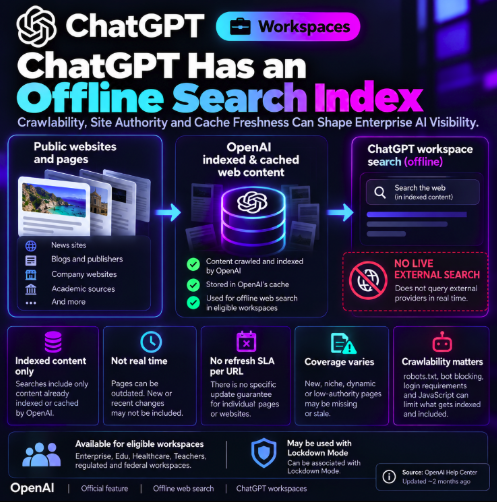

OpenAI has officially documented an offline web search configuration for eligible ChatGPT workspaces that searches OpenAI's own indexed and cached web content instead of querying a live external search provider at request time.
The feature creates a distinct search environment for organizations with stricter governance, compliance or data-handling requirements — and it has direct implications for publishers trying to understand how their content becomes visible inside enterprise ChatGPT deployments.
ChatGPT can search OpenAI's indexed and cached web content
When offline web search is enabled, ChatGPT retrieves information from pages already available in OpenAI's index or cache. It does not perform live external web search for each request.
If a page is absent from that index or cache, ChatGPT cannot retrieve it through offline web search. OpenAI explicitly warns that coverage and freshness vary by site, page, language, region and content type.
New and niche pages can be missing or stale
OpenAI says offline search should not be treated as a complete copy of the public web. Pages may be missing, incomplete or older than their live versions.
The documentation specifically identifies new, rarely accessed or low-signal pages as potential gaps. Long-tail and niche sites may also be missing, stale or only partially represented.
This creates an important AI visibility distinction: publishing a page on the open web does not guarantee that the page is immediately discoverable inside every ChatGPT search configuration.
Crawlability directly affects offline visibility
OpenAI lists several technical reasons why content may be unavailable or outdated, including robots.txt restrictions, CDN or bot-blocking behavior, login requirements, personalization, heavy JavaScript or dynamic loading, and site structures that make deeper pages difficult to discover.
For SEO and GEO teams, these are familiar crawling problems — but the destination is now an AI search index rather than only a conventional search engine index.
There is no refresh SLA for an individual URL
OpenAI says some indexed content may update quickly, but there is no refresh SLA for a specific URL. Refresh schedules can vary depending on crawl access, caching, popularity and other technical factors.
That means a page can remain available to ChatGPT while representing an older cached version. Offline results also may not expose the exact timestamp at which a page was indexed or cached.
Available in selected enterprise and regulated environments
Offline web search is available for eligible ChatGPT workspaces, including certain Enterprise, Edu, Healthcare, Teachers, regulated and federal configurations.
Depending on the workspace, it can be configured at workspace or role level and may be used as part of Lockdown Mode. OpenAI notes that availability depends on the organization's plan, contract, configuration and administrator settings.
This is not the same as the OpenAI API
The documentation is specifically about ChatGPT web search behavior. OpenAI states that it does not describe API platform behavior, and offline web search does not automatically determine whether apps or connectors are available.
The NetContentSEO view
This documentation provides unusually direct evidence that OpenAI maintains indexed and cached web content that can independently power ChatGPT search in eligible environments.
For AI visibility, the consequence is important: discovery can depend on whether OpenAI has already crawled, indexed and refreshed a page before the user asks the question. Crawl accessibility, site structure, freshness and signals associated with how readily content enters and remains in that index therefore become measurable parts of the visibility problem.
One qualification matters: OpenAI's documentation identifies factors such as crawl access, caching and popularity, but it does not define a conventional SEO-style “site authority” ranking signal. The defensible conclusion is that index inclusion and freshness can shape visibility; the precise ranking and selection mechanisms remain undocumented.