

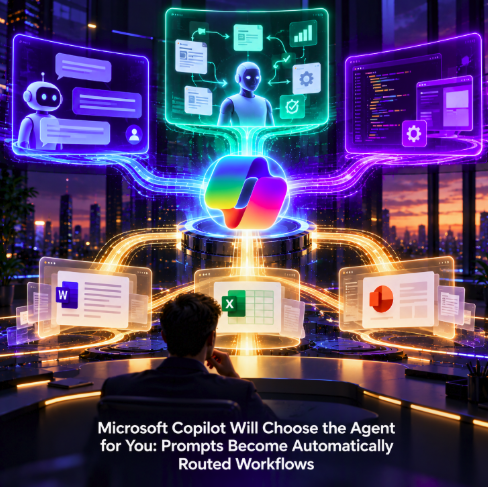

Microsoft is moving an important piece of AI complexity out of the user interface. The new Copilot Home brings Chat and Cowork into one starting point, integrates Word, Excel and PowerPoint directly into the experience, and Microsoft says a coming update will remove another choice from the user: people will simply describe what they need to accomplish, while Copilot decides whether the job belongs in Chat, Cowork or Code.
The change was announced September 25 in Microsoft’s official introduction to the new Copilot. Home and Code are beginning their rollout through Microsoft’s Frontier program, while the automatic routing capability is described as “coming soon.” That distinction matters: Microsoft has announced the routing model, but it should not yet be described as universally available. citeturn1view0
The product direction is more consequential than a navigation redesign. AI work environments have accumulated modes because different jobs require different execution systems. Microsoft’s answer is to keep those systems underneath Copilot while gradually hiding the routing decision from the person using them.
Home turns Chat and Cowork into two execution paths behind one front door
Microsoft describes Home as Copilot’s new starting point. Chat remains the fast conversational path for questions, lookups, drafting and interactive work. Cowork is explicitly designed for delegation: the user defines a task and the system runs it end-to-end to return a completed result. Microsoft gives examples including an RFP response, launch kit, customer briefing and financial close package. citeturn1view0
That is a meaningful product distinction. Chat assumes the user remains closely involved in the interaction. Cowork assumes the user is handing over a larger unit of work and expecting the system to coordinate the steps required to complete it.
Home places both patterns in the same environment. Users can review recent activity, resume work and receive suggestions without first navigating between separate AI products. The interface begins to look less like a collection of assistants and more like an operating layer that decides how much autonomy a task requires.
The next step is automatic routing
Microsoft is unusually explicit about where this design is heading. Its announcement says users will soon no longer need to choose a mode. They will state what they want to accomplish, and Copilot will route the work to Chat, Cowork or Code according to the job. citeturn1view0
That changes the function of the prompt. In a conventional chatbot, the prompt primarily tells one model what to answer. In an automatically routed system, the same instruction can also become an orchestration signal. Copilot must infer whether the request requires an immediate conversational response, a delegated multi-step job or a software-building environment.
The user therefore chooses the outcome while the platform increasingly chooses the execution architecture.
Code adds a third path: build software instead of merely answering or delegating
Copilot Code is the third major execution mode in Microsoft’s routing plan. The company says users can describe an app, tracker, dashboard, automation or workflow in natural language, after which Copilot chooses an approach and builds it. Outputs can range from persistent desktop widgets and interactive dashboards to cloud-hosted internal applications shared with a team. citeturn1view0
Microsoft says Code uses the same underlying technology as GitHub Copilot, runs in a sandboxed environment and can be hosted securely inside the organization’s tenant. Code is rolling out to Frontier, with broader availability planned in the following weeks and a preview for Microsoft 365 Premium and Pro subscribers later in the year. citeturn1view0
Automatic routing therefore will not merely choose between a short answer and a longer answer. It can decide that the correct response to a prompt is to create functioning software.
Office documents become outputs inside the same execution environment
Microsoft is simultaneously bringing Word, Excel and PowerPoint into Copilot through Office in Copilot. From Home, a user can ask for a launch brief, budget model or presentation and receive a real editable document, workbook or deck rather than a block of generated text that must be manually transferred into another application. citeturn1view0
Microsoft says the files remain synchronized between Copilot and the Office applications, including collaborative edits. That reduces the distinction between generating content and manipulating the actual work artifact.
The significance for agentic workflows is that a delegated job can terminate in an operational file rather than an explanation. An AI system can move from understanding the request to gathering context, performing the work and producing the object a team will continue using.
Microsoft is hiding architecture without eliminating it
Automatic routing can make Copilot feel like one general-purpose intelligence, but the underlying architecture remains differentiated. Chat, Cowork and Code exist because their execution requirements, cost profiles and operating environments are not identical.
Microsoft’s own pricing explanation makes that visible. Everyday AI work such as answers, drafts, summaries and analysis is covered through a user subscription model, while Cowork, Code, Autopilot and other long-running agentic capabilities use usage-based billing. Microsoft also says its Auto system weighs accuracy, speed and cost when routing ordinary requests to an appropriate model. citeturn1view0
There are therefore at least two routing layers emerging inside Copilot: selection of the model for a request and, coming soon, selection of the capability or execution environment that should handle the job.
Agent routing becomes a product decision with cost consequences
This is where the apparently simple interface change becomes an enterprise governance issue. If Copilot routes a request into Cowork or Code, the job can consume a different class of compute and usage-based resources than a conventional Chat interaction.
Microsoft is building FinOps controls around that reality. Its announcement says administrators can manage spending policies, control available model families and analyze which Cowork tasks are generating the strongest outcomes. End users can also see credit usage and remaining balances inside Copilot. citeturn1view0
Automatic routing therefore cannot be evaluated only as a usability improvement. Organizations will need visibility into how often prompts are escalated into more expensive agentic execution, whether that escalation produces additional business value and which policies constrain it.
Microsoft is not alone in collapsing mode selection
The direction resembles a broader interface shift across AI products. NetContentSEO recently covered Anthropic’s move to unify Claude Chat and Cowork in one interface, where the distinction between conversation and delegated work is also becoming less visible to the user.
The convergence suggests that explicit mode selectors may be transitional UI. Early AI products exposed modes because users needed to tell the software whether they wanted search, deep research, coding or agentic execution. More mature orchestration layers can infer some of those choices from the requested outcome.
That does not mean mode selection will disappear completely. Advanced users and administrators may still need explicit control for cost, reproducibility, privacy or risk reasons. But the default experience is moving toward outcome-first interaction.
Automatic routing raises a new observability problem
When the user selects Chat or Cowork manually, the execution choice is obvious. When Copilot chooses automatically, organizations need to know what was selected and why—particularly when the routed capability can take actions, create software or consume usage-based credits.
Microsoft’s announcement does not yet provide a detailed public specification for the future Chat/Cowork/Code router. It would therefore be premature to claim exactly which signals determine routing or how much control administrators and users will have over individual decisions.
The requirement is nevertheless predictable: invisible orchestration needs visible auditability. Enterprise teams will want to distinguish a conversational answer from a delegated task and understand when a seemingly ordinary prompt crossed into a more autonomous execution path.
Cowork turns the prompt into a job specification
The most useful way to understand Cowork is not as “slower Chat.” Microsoft defines it around completed work. The user specifies the task, while Cowork handles the end-to-end execution needed to return a result. citeturn1view0
This changes how prompts should be designed. A conversational prompt can be exploratory: ask a question, inspect the answer and refine it. A delegated prompt increasingly resembles a job specification. It needs an objective, constraints, access to relevant context and an understanding of what constitutes completion.
As routing becomes automatic, Copilot itself will have to infer when an instruction is sufficiently job-like to warrant that execution model.
Microsoft IQ supplies the context shared across those modes
Routing alone would be much less useful if every mode had to reconstruct the organization from scratch. Microsoft positions Microsoft IQ as the shared intelligence layer connecting Copilot and agents to enterprise context. The September announcement says Fabric IQ grounds Chat and Cowork today, with Code integration coming through Frontier; Dynamics 365 and Power Platform data and workflows are also being added. citeturn1view0
This is what makes a routed workflow different from simply forwarding a prompt to another chatbot. The destination can inherit governed organizational context, data connections and plugins appropriate to the work.
The architecture begins to resemble an AI operating system: one user-facing entry point, shared enterprise context, multiple specialized execution environments and a router deciding which environment should handle the request.
Plugins make routing extend beyond Microsoft’s native capabilities
Microsoft is also introducing a unified plugin registry for Microsoft, partner and custom-built plugins, with central IT management and publication across supported experiences. citeturn1view0
That expands the importance of routing because the selected agent may not simply generate a file. It can potentially use governed capabilities connected to business systems. The quality of an AI workflow therefore depends on more than the language model: the available tools, permissions and enterprise context determine what the selected execution path can actually accomplish.
For organizations building reusable agentic procedures, this is similar to the shift NetContentSEO examined in Semrush’s reusable agent skills: the valuable layer is increasingly the combination of methodology, live data, tools and execution rules rather than the prompt alone.
Autopilot sits beyond the Chat-Cowork-Code router
Microsoft’s announcement also introduces Autopilot, previously called Scout, but it should not be conflated with the coming three-way routing feature. Microsoft specifically says the future mode selection will route work to Chat, Cowork or Code. Autopilot is presented separately as a persistent, proactive agent that can continue working without waiting for another prompt. citeturn1view0
Autopilot receives its own identity, memory, computer and workspace inside the tenant. Microsoft says it can monitor channels, follow up on threads, run recurring work and resume projects days later. It is cloud-hosted and can keep operating while the user’s attention is elsewhere. citeturn1view0
That gives Microsoft a spectrum of delegation: immediate conversation in Chat, bounded end-to-end tasks in Cowork, software construction in Code and persistent proactive work in Autopilot.
The interface is becoming a router for work, not a menu of AI features
For the first generation of enterprise copilots, users learned the product architecture. They chose a model, selected a mode, opened the right application and then wrote a prompt appropriate to that environment.
Microsoft is moving toward the reverse. The user describes the outcome, and the system increasingly determines the model, execution mode, enterprise context and tools required to produce it.
That is the deeper meaning of Copilot Home. Unifying Chat, Cowork and Office is the visible interface change. Automatic routing is the architectural change underneath it.
If Microsoft delivers the experience as described, the prompt will no longer be merely a request for generated content. It will become the front door to a workflow router capable of answering, delegating or building depending on what the system believes the job requires. The next competitive question for enterprise AI will therefore be not only which assistant gives the best answer, but which orchestration layer can reliably choose the right kind of agent before the work even begins.