
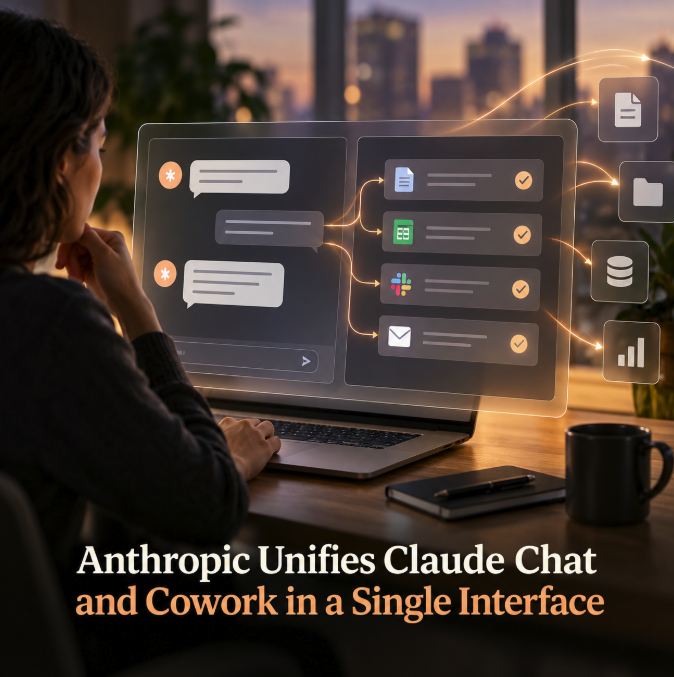
Anthropic is collapsing the boundary between asking an AI a question and handing it a job. The company is bringing Claude Chat and its more agentic Cowork experience into a single interface, a product change that reflects a broader shift in generative AI: users increasingly expect one assistant to move fluidly between conversation, creation and multi-step execution without requiring them to decide which mode or tool should handle the request.
According to TechCrunch, the redesigned Claude interface puts Chat, Cowork and Artifacts inside the same window. Claude Design, Anthropic's tool for creating websites and prototypes, can also be used throughout the experience. Rather than forcing users to switch between separate tabs depending on the nature of a task, Claude is intended to route requests to the appropriate capabilities automatically.
From choosing a mode to describing the job
The change addresses a usability problem created by the rapid expansion of AI products. As assistants have gained research tools, file access, coding environments and agent-like capabilities, their interfaces have often accumulated separate modes that expose the underlying product architecture to users. Anthropic's new approach moves in the opposite direction: the user describes what needs to be done, while the software decides how to execute it.
That distinction matters because Chat and Cowork were originally designed around different interaction patterns. Anthropic has previously described Claude Chat as an interface for research, drafting and work performed interactively with the model, while Cowork was introduced as a way to delegate more substantial, multi-step work. Anthropic's own product materials have positioned Cowork as capable of operating across local files and connected applications, coordinating tasks that may span documents, services and multiple stages.
Usage is also moving in that direction. In its June 2026 Economic Index report, Anthropic said Claude sessions were increasingly composed of long-running agentic tasks as Claude Code and Cowork grew. A unified interface therefore looks less like a cosmetic redesign and more like an attempt to make that changing usage pattern feel natural to people who do not want to think in terms of product modules.
Claude is becoming a broader work surface
The redesign arrives alongside dedicated tools for documents and presentations. TechCrunch reports that Claude can create and edit slides, present them, and export presentations as PDF or PowerPoint files. The new document experience similarly allows users to build sections collaboratively with Claude, ask questions and comment on completed material. Documents and presentations can be shared by link and edited from a phone, while work initiated on desktop can be monitored from the mobile application.
These additions expand Claude beyond the familiar chatbot model. A conversation may begin with an instruction, turn into a document or presentation, involve information from connected applications, and continue as a delegated task. Keeping those stages in one environment reduces the amount of interface navigation required and makes the distinction between “chatting” with an AI and “using” an AI application increasingly difficult to draw.
Anthropic has already been building toward this model in other areas. Its small-business offering, for example, places agentic workflows inside Cowork and connects Claude to services used for finance, sales and operations. The company describes those workflows as tasks that Claude can carry out while keeping the user involved for approvals before consequential actions such as sending, posting or paying. The unified interface provides a more general front door for that philosophy.
A product-design challenge for the AI industry
For AI companies, increasing model capability creates an unusual interface problem. Traditional software tends to make functions explicit through menus, buttons and applications. General-purpose AI can potentially infer which capabilities are necessary from a natural-language request, making some of those controls redundant. The more reliable that routing becomes, the more the interface can focus on the user's intent rather than the technical mechanism used to satisfy it.
There are trade-offs. Automatic routing needs to remain understandable enough that users know what the system is doing, particularly when an agent can interact with files or external services. Clear permissions, progress indicators and approval points become more important as the assistant moves from generating text toward taking actions. Simplifying the front end does not eliminate that complexity; it shifts more responsibility to the product's orchestration and safety layers.
Anthropic is initially rolling out the new experience to Claude Pro and Max subscribers across web, desktop and mobile, with TechCrunch reporting that free and team tiers are expected to receive it later. The phased launch gives Anthropic an opportunity to test whether users actually benefit from having the product decide how requests should be handled rather than selecting a mode themselves.
The interface is catching up with the agent
The significance of Anthropic's redesign is not simply that two tabs have become one. It is that the interface increasingly treats Claude as a single system capable of shifting between answering, creating and executing. That is closer to the promise behind AI agents: people specify outcomes while the assistant chooses the tools and steps needed to reach them.
If this interaction model proves effective, separate “chat” and “agent” modes may eventually feel like a transitional stage in AI product design. The difficult work will happen behind the interface, where models, tools, permissions and connected services are orchestrated. For users, the experience Anthropic is aiming for is considerably simpler: tell Claude what needs doing, and let the system determine how to get there.