

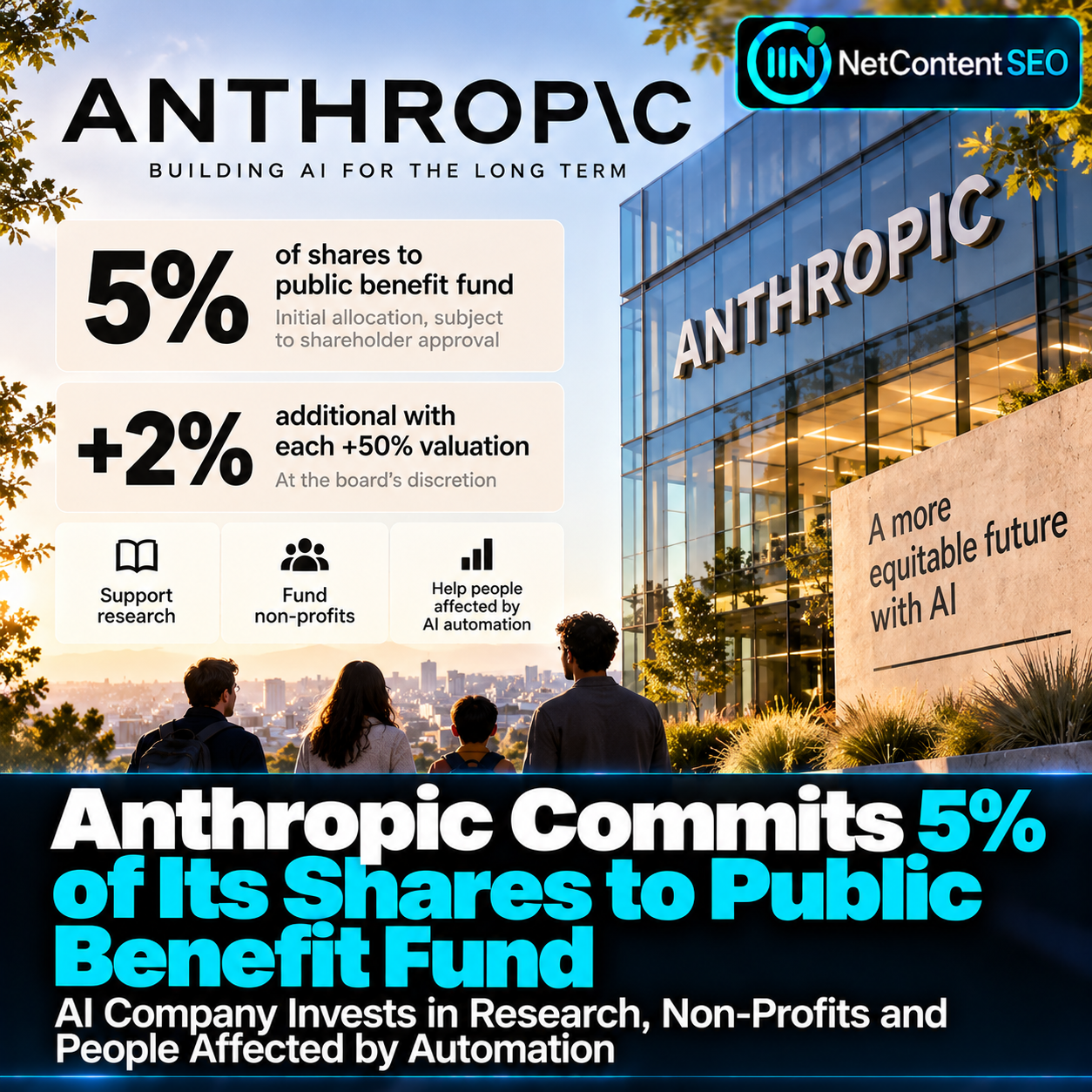

Anthropic has announced plans to establish an Anthropic Public Benefit Fund, with an initial allocation equivalent to 5% of the company's shares, subject to shareholder approval. The initiative, outlined in an October 18, 2026 announcement, is intended to direct a portion of the value created by artificial intelligence toward public-benefit work.
The move comes as AI companies face growing questions about who benefits from automation, who bears its costs, and how developers of increasingly capable systems should contribute to the wider economy.
What Anthropic announced
Anthropic says the new fund will be structured as a subsidiary and will support public-benefit initiatives, including nonprofit organizations, research and work addressing the effects of AI-driven economic change. The company proposes an initial allocation of 5% of its equity to the fund. Importantly, that starting allocation still requires shareholder approval and should not be described as a completed transfer.
Anthropic also describes the possibility of adding another 2% of equity for each 50% increase in company valuation, at the board's discretion. Those potential increases are not automatic or guaranteed.
How the fund fits Anthropic's wider commitments
Anthropic states that, when the proposed fund is considered alongside existing commitments from founders and employees, approximately 20% of the company's shares would be dedicated to public-benefit purposes. That broader figure includes previous commitments; it does not mean the new fund alone will immediately own 20%.
The company has separately announced a $200 million commitment to studying and responding to AI's effects on work. These initiatives indicate an emphasis on the distribution of AI's economic gains, although the long-term impact will depend on governance, funding decisions and measurable outcomes.
What the money could support
According to Anthropic, the fund is designed to support nonprofit activity, research and interventions that benefit people affected by AI. The company says the fund will not use its shareholdings for political donations or lobbying. Further details on governance and valuation thresholds are expected in the coming months.
There are still important open questions: which organizations will receive support, how priorities will be set, what independent oversight will exist and how the fund's effectiveness will be measured. An equity commitment can become significant over time, but the amount ultimately available for grants or programs depends on the structure and value of the holdings.
Why AI job disruption is central to the debate
Generative AI is increasingly used for software development, customer support, research, content production and administrative workflows. In some cases, it helps employees perform tasks faster; in others, it may reduce demand for particular kinds of work or change the skills employers need.
Those effects will vary by occupation, company and region. It would be premature to treat any single estimate of AI job losses or gains as a settled outcome. The case for public-benefit investment is that the organizations building and commercializing advanced AI may also have a role in supporting research, adaptation and access to opportunity.
What this means for SEO and AI Search
The announcement does not introduce a new Claude Search feature, crawling policy, citation mechanism or search-ranking change. There is no documented immediate effect on organic traffic or AI referral visibility.
For SEO and digital professionals, the relevance is indirect but real. Search marketing, content operations, analytics and development are among the fields where AI tools are changing workflows. Funding independent research on AI's labor-market effects could help businesses and policymakers better understand how those transitions unfold. That is a potential future benefit, not an SEO outcome claimed by Anthropic.
Public-benefit commitments need measurable accountability
The scale of the proposal makes it noteworthy, but governance will matter as much as the headline percentage. Observers should watch for the final shareholder decision, legal structure, board oversight, transparency requirements, beneficiary selection and the actual deployment of funds.
Potential future allocations tied to valuation growth also need careful interpretation: they depend on both valuation milestones and discretionary decisions, and should not be added to the initial 5% as if already granted.
NetContentSEO assessment
Anthropic's proposal is an AI-industry governance story rather than a product or search update. Its importance lies in a concrete attempt to link the value of an AI company to public-benefit investment while automation reshapes work. Whether the plan becomes a model for the sector will depend less on the announcement itself than on the eventual approval, execution and transparency of the fund.
Primary source: Anthropic — Investing in the public benefit (October 18, 2026).