

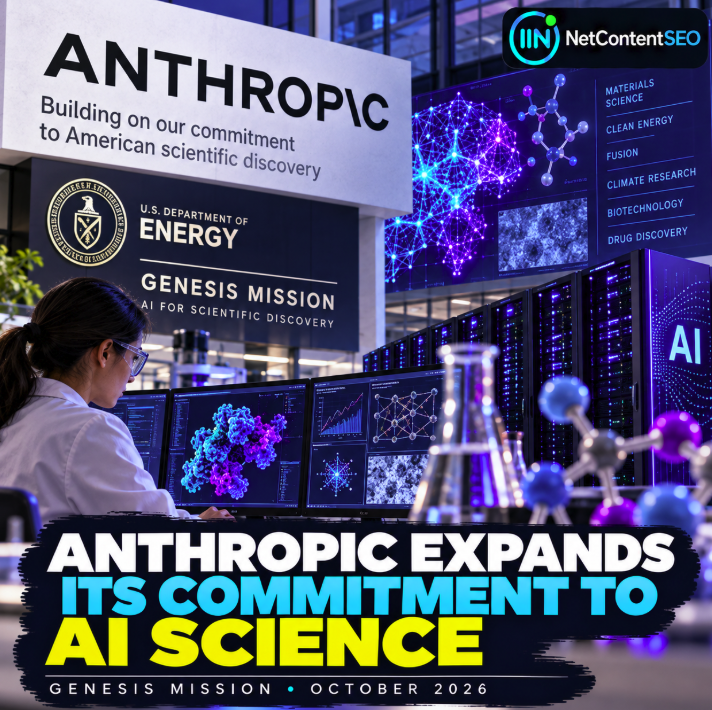

October 8, 2026. Anthropic has published an announcement titled Building on our commitment to American scientific discovery, linking its scientific AI work to the US Genesis Mission. The development comes amid fresh announcements from the Department of Energy (DOE) about research awards and training opportunities. Anthropic's new announcement page could not be independently retrieved during preparation of this report; consequently, any new Anthropic-specific funding amount, allocation or operational commitment remains unverified here.
What is the Genesis Mission?
Launched by a November 24, 2025 executive order, the Genesis Mission is a US government initiative to accelerate scientific discovery through AI, federal scientific datasets, advanced computing and research collaboration. Its stated ambitions include scientific foundation models and AI agents that can help test hypotheses and automate parts of research workflows. Those are program objectives, not evidence that every promised capability is already operational.
Anthropic's existing role is documented
In December 2025, Anthropic announced a multi-year partnership with the US Department of Energy focused on energy, biological and life sciences, and scientific productivity. The company described opportunities to use Claude alongside national laboratory research and accumulated scientific information. Anthropic has also described itself as a core Genesis Mission partner in its science communications.
What changed on October 8?
The DOE announced 12 Phase II Genesis Mission awards totaling $159 million and additional Phase I selections on October 8, 2026. The department also announced a graduate fellowship pilot focused on AI and scientific expertise. Contemporary reporting describes broader industry commitments to the initiative. These are contextual developments: they should not be presented as funds specifically committed by Anthropic unless the company or government identifies an Anthropic-specific amount.
What it means for SEO
There is no announced Google ranking factor or direct SEO algorithm change tied to Anthropic's Genesis Mission participation. The more relevant editorial implication concerns how scientific information is published and verified. Organizations producing AI-assisted research should make authorship, institutional affiliation, source datasets, methodology, limitations and publication dates clear. Research pages should offer stable URLs, readable summaries, descriptive metadata and links to underlying evidence where appropriate.
What it means for AI Search and citations
AI systems increasingly encounter technical documents, research datasets and institutional sources. Well-documented provenance may make a source easier for people and retrieval systems to interpret, but it does not guarantee citation by Claude, ChatGPT, Google AI Overviews or any other assistant. AI-generated summaries can also omit caveats, making primary-source access and clear methodological descriptions particularly important.
Recommendations for scientific publishers
- Publish original research with identifiable authors, affiliations and dated updates.
- Provide accessible methodology, dataset provenance and limitations.
- Use relevant structured data accurately without assuming it changes rankings.
- Maintain canonical, stable URLs for papers, project pages and supporting material.
- Distinguish announced partnerships, allocated funding and demonstrated scientific outcomes.
- Monitor AI citations for factual fidelity rather than treating mentions as proof of authority.
Scientific AI is also a governance question
The initiative raises questions about public research funding, access to compute, independent verification and the role of private AI providers in government-supported science. Supporters emphasize potential gains in discovery speed and research infrastructure; critics have questioned how increased industry participation intersects with changes to traditional research funding. These debates should be assessed separately from technical claims about Claude's capabilities.
The NetContentSEO takeaway
The Genesis Mission illustrates a shift toward AI systems operating on scientific workflows, not just answering public questions. For SEO and AI Search, the practical opportunity is not a new optimization trick. It is publishing verifiable, well-attributed scientific knowledge that both readers and AI systems can trace back to authoritative evidence.
Sources: Anthropic, October 8, 2026 announcement (page not independently retrievable at drafting); Anthropic, December 18, 2025 DOE partnership; US Department of Energy, October 8, 2026 awards; White House, November 24, 2025 executive order.