

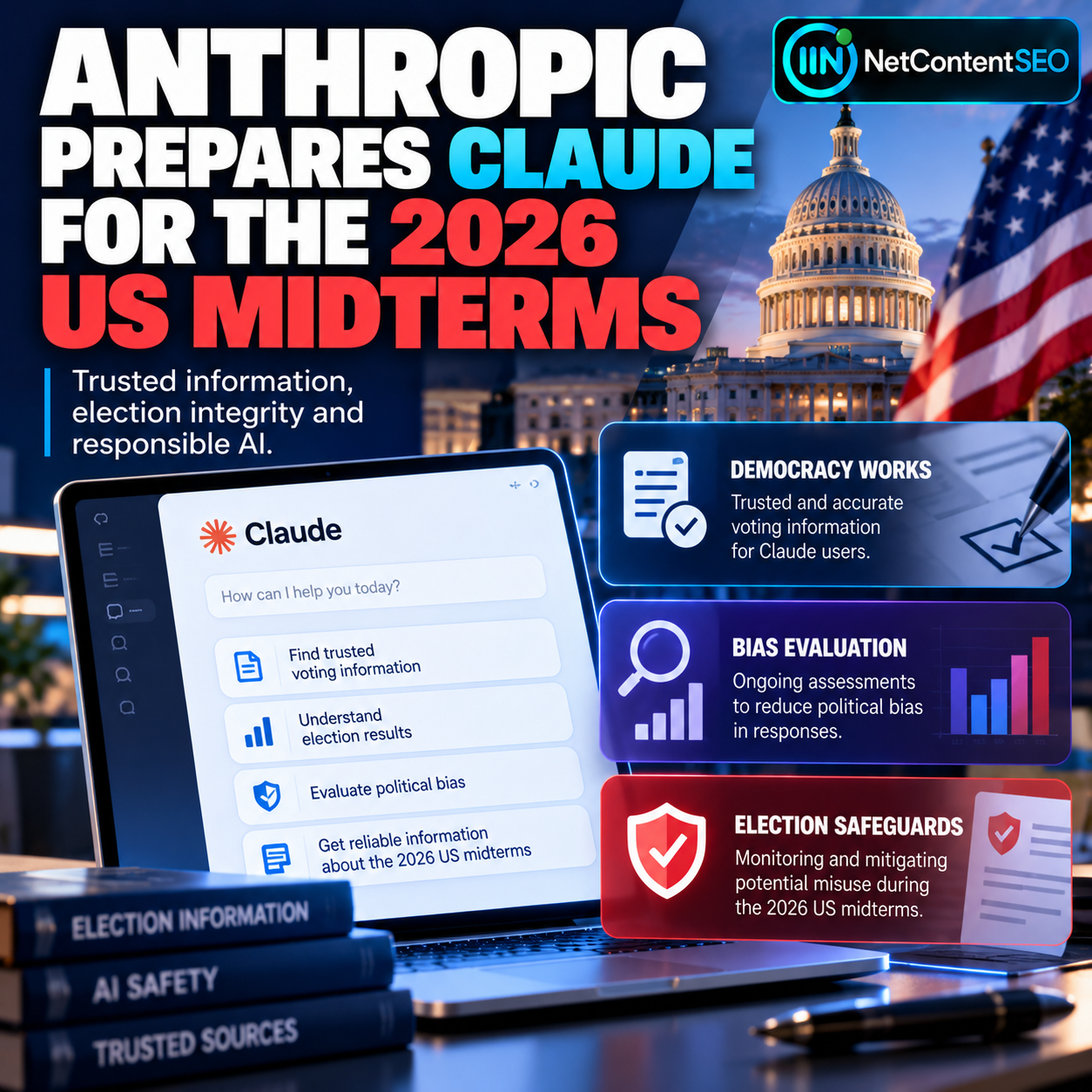

Anthropic has outlined new safeguards for Claude ahead of the 2026 US midterm elections, including official voting information from Democracy Works, up-to-date election results, expanded political-bias evaluations and stronger detection of coordinated misuse. In its 14 October 2026 policy update, the company also shared an analysis of how people use Claude for politics and voting, and described cases in which the system was used in attempts to produce deceptive election-related content.
The announcement is relevant to AI Search because people increasingly use conversational systems to research candidates, understand policy debates and find practical voting information. Anthropic's changes focus on the reliability and safety of those answers—not on website rankings, crawler behaviour or a new search-visibility feature.
What Anthropic is changing before the midterms
Anthropic says Claude will provide two additional ways for US users to access election information directly in conversations:
- State-specific voting information: later in October, Claude.ai is set to draw official information from Democracy Works. Users asking where to vote or what identification to bring should receive information specific to their state, based on public information collected from state and local election sources.
- Up-to-date election results: on election night and in the days that follow, Claude will show current official vote counts and election results when users ask about them.
Anthropic says it will continue to display a banner linking to TurboVote, a nonpartisan resource from Democracy Works, for questions about voter registration, polling places and election dates. The new integrations are intended to make reliable information easier to access without leaving the conversation.
What Anthropic's conversation analysis found
Anthropic used its Insights analysis to examine a random sample of 250,000 US Claude.ai consumer conversations from 21–27 September 2026, using a privacy-preserving method. The company reports that:
- 5.75% of US Claude.ai conversations touched broadly on politics, public policy or social issues.
- 0.51% were specifically about elections or voting.
- 0.01% involved requests asking Claude whom or what to vote for.
- 0.002% involved requests identified as violating Anthropic's election-integrity policies, based on a separate analysis of 250,000 conversations.
These figures describe Anthropic's own sample and classification method. They should not be interpreted as a measurement of all AI use in the United States or as a prediction of how people will use AI as Election Day approaches.
Political-bias evaluation and independent reviews
Anthropic says it tests models for political bias before release and reports that Claude Opus 5.5, Sonnet 5.5 and Haiku 5.5 scored 99% on its political even-handedness evaluation. That score is the company's own evaluation result; it is not a universal certification of neutrality in every political conversation.
The company also describes reviews by three outside groups: The Future of Free Speech at Vanderbilt University, the Foundation for American Innovation and the Collective Intelligence Project. Anthropic says the reviews found that Claude generally engaged with political requests, while also identifying areas for improvement. Examples included unsolicited caveats or counterarguments in advocacy writing and uneven hedging in some matched prompts.
Anthropic says it is improving responses to direct yes-or-no questions and requests for shorter answers, refining when caveats are added, and expanding tests to cover realistic conversations, candidates and voting questions as well as policy issues.
Stronger safeguards against coordinated election misuse
Anthropic says it worked with the Institute for Strategic Dialogue and the McCain Institute to test how its protections respond to deceptive campaigning, misinformation and other election-related abuse in the US, Israel and Brazil. The tests included not only direct harmful requests but also campaigns broken into smaller tasks that could appear harmless when considered separately.
The company reports that Claude reliably refused single harmful requests in the testing, but could sometimes miss a malicious operation spread across multiple individually plausible requests. In response, Anthropic says it added classifiers designed to detect novel and multi-step misuse, including attempts to create fake social-media accounts or news sites for political discussions, financially motivated election schemes, and foreign state-linked election abuse. It also says it strengthened cyber protections for election infrastructure and campaigns.
Anthropic further reports that it identified and banned accounts involved in attempts to use Claude to create US midterm coverage promoting foreign-state narratives and fabricated news intended to generate advertising revenue. These are claims reported by Anthropic in its own policy update.
Implications for SEO and AI Search
This announcement does not describe a new ranking system, crawler change or website-citation policy. Its SEO and AI Search implications are indirect: Claude is positioning itself as a source of current civic information, which raises the importance of reliable sourcing, clear attribution and up-to-date information in topics where mistakes can affect real-world decisions.
1. Make primary election information easy to verify
Publishers covering elections should link directly to official state and local election offices, clearly identify the jurisdiction and date of the information, and distinguish official facts from analysis or opinion. This helps readers verify claims and gives AI systems clear source material to reference when retrieving information.
2. Keep time-sensitive pages current
Voting dates, registration deadlines, polling locations, identification requirements and results can change or vary by state. Pages should state when they were last checked and direct users to the relevant election authority for final confirmation. Do not present a general national summary as if it applies uniformly across every jurisdiction.
3. Separate reporting, analysis and advocacy
For political content, make it clear whether a page reports a verified fact, explains a policy, presents an opinion or advocates for a position. Accurate sourcing, transparent authorship and clear context are sound editorial practices; Anthropic's announcement does not establish them as special ranking factors.
4. Avoid publishing AI-generated election claims without verification
AI can assist with drafting, summarising public documents or organising research, but election-related claims should be checked against primary sources before publication. Avoid fabricated quotes, misleading candidate profiles, impersonation and artificial engagement. These practices can harm readers and may violate platform policies or applicable law.
5. Measure AI visibility without assuming causation
Organisations can monitor whether Claude and other AI products refer users to their election explainers or official resources, where analytics allow. A change in referral traffic or citations should be measured directly; this policy announcement does not imply that any particular site will gain visibility.
What publishers and site owners should watch next
- The rollout of Democracy Works voting information in Claude.ai later in October.
- How Claude displays official election results on election night and in the days afterward.
- Further detail from Anthropic about political-bias testing, evaluation methods and safeguards.
- Whether the company publishes the promised broader analysis of how people used Claude throughout the election cycle.
The takeaway
Anthropic's 2026 midterm preparations combine official voting-information integrations, election-night results, expanded bias testing and stronger safeguards against coordinated misuse. The company's conversation sample suggests most political queries are informational, while direct requests for voting recommendations were rare in the period studied. For SEO and AI Search teams, the practical response is to maintain accurate, well-sourced, jurisdiction-specific content and clearly separate verified information from commentary—without mistaking this policy update for a ranking or crawler change.