

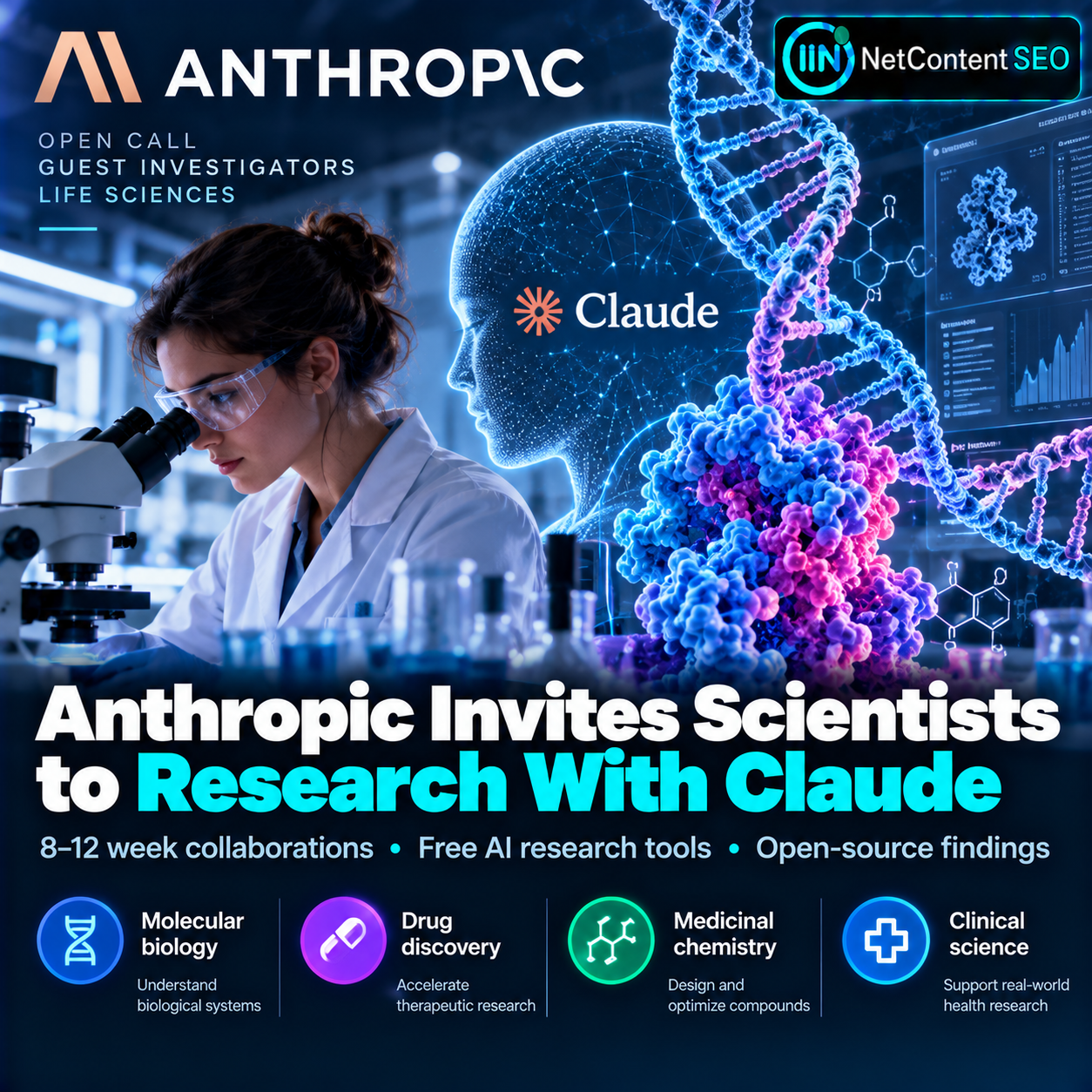

Anthropic is inviting life sciences researchers to apply for short-term collaborations using Claude and the company’s internal AI research tools. The open call, announced on October 22, 2026, seeks proposals from principal investigators and their research groups at academic institutions, nonprofit organizations and government laboratories. Selected guest investigators will work directly with Anthropic researchers for eight to twelve weeks, using the company’s models and research harnesses at no cost.
The program is designed to produce practical early-stage scientific outputs—such as analyses, preliminary discoveries, open-source datasets and research tools—rather than promise validated breakthroughs within a few weeks.
Who can apply to Anthropic’s guest investigator program?
Anthropic is looking for research groups with compelling questions in causal human biology, structural and computational molecular biology, medicinal chemistry, drug discovery and clinical science. Applicants should explain why direct collaboration with Anthropic researchers and access to internal models or harnesses would help them pursue a question that existing resources cannot easily address.
The proposal should identify a problem of interest to the wider field, establish the investigators’ qualifications, outline the potential impact and describe a feasible deliverable within the collaboration window. Anthropic acknowledges that fully validating many scientific hypotheses takes considerably longer than twelve weeks; the aim is to generate useful preliminary evidence or resources that can support future work.
Researchers can find the official application process on Anthropic’s guest investigator program page.
What selected researchers receive
Successful applicants will collaborate directly with Anthropic’s research team over an initial eight-to-twelve-week period. Anthropic will run its models and research harnesses without charging the guest investigators. Depending on the project, that could support computational analysis, exploratory modeling, evaluation workflows or the creation of reusable scientific resources.
Anthropic says it intends to work with collaborators to publish project outputs and release accompanying data and code as open source. The company also states that guest investigators retain the rights to their data throughout the collaboration, as well as rights to independent follow-on research resulting from the work.
The announcement does not guarantee publication of every proposed finding, provide an unrestricted public API grant or promise that all hypotheses will be validated. Those distinctions matter when evaluating the program’s likely scientific impact.
Application window and expected timeline
Anthropic says applications will remain open for approximately 14 days from October 22, 2026, suggesting a window ending around November 5. Because the company describes this as approximate, researchers should consult the official application page rather than treat that date as a fixed deadline.
Anthropic aims to notify selected participants by email approximately fourteen days after applications close. Some projects may be extended beyond the initial eight-to-twelve-week period.
Applicants are asked to include only publicly available information in their submissions. Anthropic explicitly says it is not asking investigators to hand over their research data either when applying or during the collaboration.
Why Anthropic is investing in life sciences
The guest investigator initiative is part of a broader push to apply capable AI systems to scientific research. Anthropic has also introduced a Life Sciences Verification Program, which provides qualified professionals with access to more capable models under specialized safeguards, and operates an AI for Science initiative that supplies Claude credits to eligible scientists.
The guest investigator program differs from a standard model-access grant because selected researchers will work directly with Anthropic’s technical team. That collaboration may help translate advanced model capabilities into domain-specific research workflows, while giving Anthropic feedback about scientific use cases, evaluation methods and the limits of its tools.
Open-source datasets and scientific discovery
One of the most notable aspects of the program is its emphasis on publishing outputs and sharing accompanying data and code. Publicly accessible datasets, analysis pipelines and reproducible tools can be valuable beyond a single collaboration, allowing other researchers to inspect methods, replicate findings or build on preliminary results.
However, the announcement does not say that a new scientific discovery has already been made through this particular program. Nor does it specify the eventual number of selected research groups or the precise licensing terms of future releases. Those details will depend on the projects and subsequent announcements.
What does this mean for SEO and AI Search?
There is no direct SEO algorithm change in Anthropic’s announcement. It introduces no new rules for crawling, indexing, structured data, rankings or source citations in Claude or other AI answer engines.
The longer-term connection is to the information ecosystem. If selected collaborations produce publicly accessible scientific papers, datasets and tools, those resources may become useful material for researchers and, where accessible and relevant, for information retrieval systems. But that is a possible downstream consequence—not a guarantee of indexing, AI visibility or citations.
For publishers and SEO teams working in health and science, this reinforces a familiar distinction: original, well-documented research is valuable because it advances knowledge, not because an AI provider has announced a new preference for a particular content format. Accurate authorship, clear methodology, provenance and transparent limitations remain sound editorial practices, but Anthropic has not announced new ranking incentives tied to this program.
NetContentSEO assessment
Anthropic’s guest investigator call is an important development for AI-assisted scientific research because it pairs frontier-model capabilities with specialist human expertise and a commitment to share useful outputs. The relatively short project duration makes the emphasis on preliminary findings and reusable artifacts especially relevant.
For the AI Search industry, the announcement is best viewed as an investment in scientific knowledge production rather than a change to retrieval or citation systems. The most meaningful results will be the research outputs that participants eventually publish—and whether those outputs prove reproducible and useful to the wider scientific community.
Primary source: Anthropic, “Open call for guest investigators in the life sciences,” October 22, 2026. Applications: Official guest investigator program.