

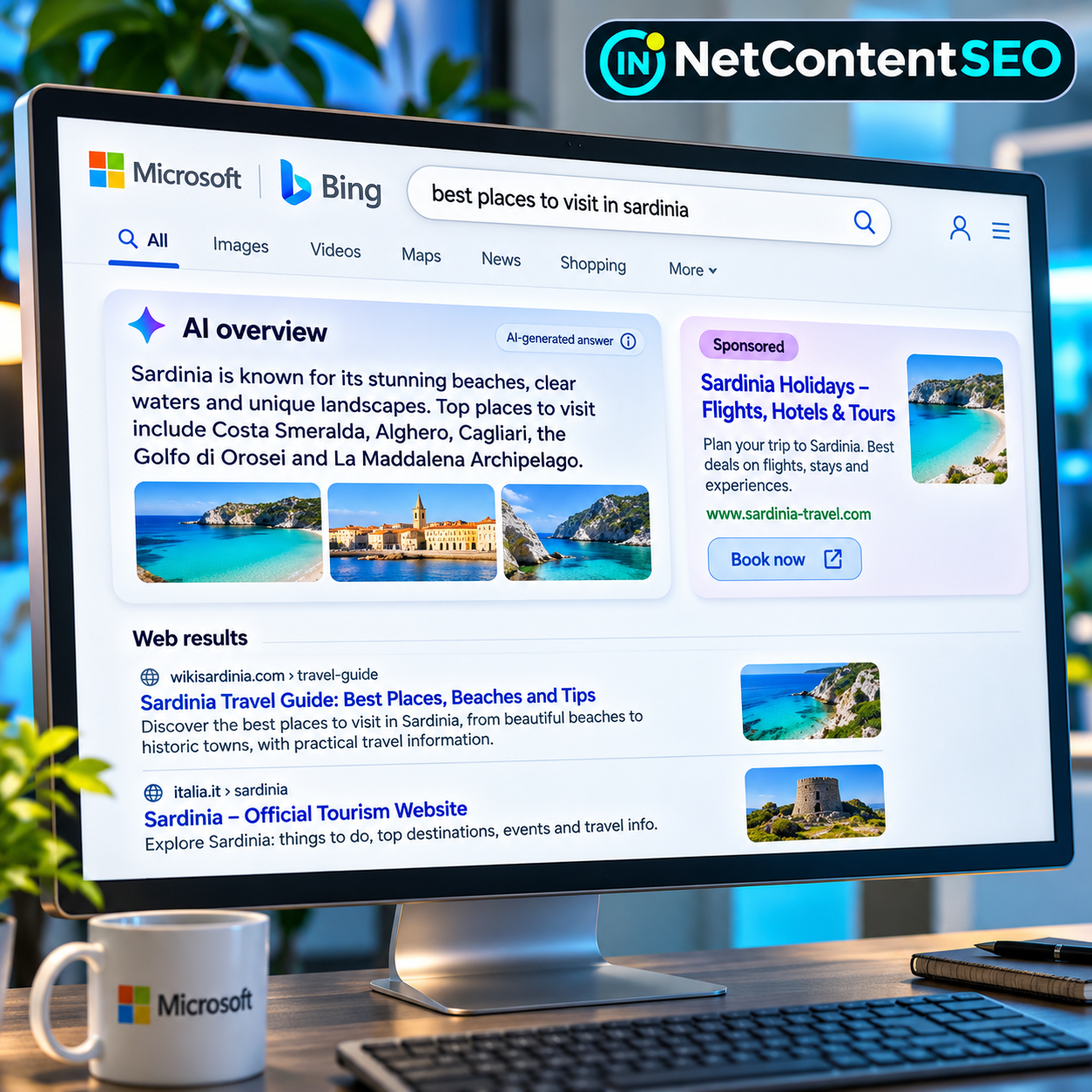

Microsoft has officially confirmed advertising alongside AI Overviews in Bing Search. In a November 19, 2026 Microsoft Advertising announcement, the company said eligible ads can appear next to AI-generated answers when an advertiser's offer is relevant. The placement is available in all markets except China and uses existing Microsoft Advertising campaigns rather than a dedicated AI Overview campaign. This marks a significant commercialization step for answer-led search, but it does not establish that organic results have already lost traffic.
What Microsoft confirmed on November 19
Microsoft's official announcement describes AI Overviews as web-sourced summaries that help users explore subjects and decide what to do next. Ads may appear beside those summaries when the advertised offer fits the user's context. Microsoft's example is a Bing question about a trip to Snowdonia National Park: a travel-oriented AI answer could be accompanied by a relevant accommodation advertisement.
Microsoft explicitly says no separate campaign setup is required. Existing campaigns, including Performance Max and AI Max, can participate. It also states that the placement is available in all markets other than China. This is an announced availability scope, not a guarantee that every eligible search, advertiser, market or account will show an ad.
The distinction between next to and inside matters. Microsoft's official example describes ads appearing next to AI-powered answers; earlier third-party screenshots reported sponsored results within AI Overviews. The placement can vary, and the company's announcement should not be interpreted as proof of a single universal layout.
Not an isolated test: observations preceded the confirmation
Search Engine Roundtable reported observations of ads within Bing AI Overviews on October 30, 2026, before Microsoft's formal November confirmation. Barry Schwartz subsequently covered the official announcement on November 19. This sequence helps distinguish a previously observed interface from a product feature Microsoft now explicitly acknowledges. Sources: October 30 observation and November 19 confirmation coverage.
Why the economics of AI search are changing
Conventional search results typically separate organic links and paid placements around a query. An AI Overview introduces a new decision surface: users can obtain a synthesized explanation and see a commercial offer in the same visual context. That creates an opportunity for advertisers to reach people who are still researching rather than explicitly shopping.
Microsoft cited a 21% increase in purchases after a Copilot interaction, based on its own data. That figure is a company-reported outcome associated with Copilot interactions; it is not evidence that Bing AI Overview ads raise purchase rates by 21%, nor does the announcement establish a causal lift for every advertiser.
What changes for organic SEO visibility?
For publishers, the key concern is attention allocation. An AI-generated summary already competes for users' reading time; an adjacent sponsored offer can create an additional path away from traditional organic listings. This could affect click-through rates for some informational or commercially adjacent searches, but the actual effect will depend on layout, intent, device, ad relevance and the placement of cited sources.
There are at least three distinct forms of visibility to measure: appearing as an organic web result, being cited as a source in an AI Overview, and appearing as a paid advertisement. They are not interchangeable. An article might receive an AI citation without a click; an advertiser might gain a conversion without occupying a top organic position; and an organic result may still attract readers who want primary evidence or a detailed comparison.
Microsoft has not published a universal estimate of organic click loss attributable to this placement. Claims that Bing's AI Overview advertising has already caused a specific percentage decline in publisher traffic would therefore be premature.
What advertisers should do now
Audit campaign eligibility and landing pages. Review existing Microsoft Advertising search, Performance Max and AI Max campaigns. Ensure destinations match the questions and needs your customers express in natural language, rather than assuming that keyword-heavy copy alone captures conversational intent.
Test controls before scaling spend. Microsoft's AI Max documentation describes search-term matching, text customization, URL expansion, reporting and controls. The November update also introduced URL inclusions for final URL expansion, helping advertisers direct eligible traffic toward selected website sections. Review the controls available in your account and monitor unintended destinations.
Measure outcomes, not just impressions. Segment performance by campaign, device, geography and intent where reporting permits. Track conversion quality, CPA, ROAS and landing-page engagement. Do not assume a standalone AI Overview placement report exists unless your account actually provides it; the public announcement does not promise universal placement-level reporting.
What SEO teams and publishers should monitor
- Build a repeatable query panel: choose informational, comparison and transaction-oriented searches relevant to the site, and log results at consistent intervals.
- Document page layouts: record whether an AI Overview appears, whether a sponsored placement is visible, whether source citations are shown and where organic links start.
- Separate desktop and mobile: the same advertisement may have a very different impact when screen space is limited.
- Compare click behavior cautiously: use Bing Webmaster Tools and site analytics to examine query-level impressions, clicks and CTR where available, accounting for seasonality and ranking changes.
- Improve answer-worthy content: prioritize firsthand evidence, accurate entities, concise explanations, source transparency and useful next steps. These support readers and source usefulness, without guaranteeing inclusion in an AI Overview.
- Watch branded and commercial searches: they may reveal different advertising dynamics from purely informational searches.
AI Search and GEO: the strategic implication
AI search monetization is moving from an experimental-looking interface to a documented part of Microsoft's advertising distribution. For GEO and AI Search optimization, that means success cannot be reduced to whether a brand appears in a generated answer. Teams must consider source attribution, organic traffic, paid presence, user trust and conversions together.
Publishers should resist a simplistic paid-versus-organic narrative. Ads may capture some attention, while a credible cited source may still influence the user's decision even without an immediate visit. The practical challenge is to determine which placements generate measurable value and which simply increase visibility without meaningful engagement.
What remains unknown
Microsoft has not established in this announcement the exact share of Bing AI Overviews that contain advertising, a universal ranking formula for those ads, a fixed format across devices, or an independently verified effect on organic CTR. Nor should the Bing announcement be treated as evidence that Google AI Overviews use identical placement or campaign rules. Those questions require platform-specific evidence and continued observation.
Bottom line
On November 19, Microsoft confirmed that AI-generated Bing answers can sit beside relevant advertising powered by existing campaigns, with announced availability outside China. The commercial opportunity is clear. The SEO consequences are still an empirical question. Brands that test campaign relevance, document AI result layouts and measure organic and paid outcomes separately will be better prepared than those relying on assumptions about either channel.
Sources: Microsoft Advertising, November 19, 2026; Search Engine Roundtable, November 19, 2026; Search Engine Roundtable, October 30, 2026; Microsoft Advertising AI Max documentation.