

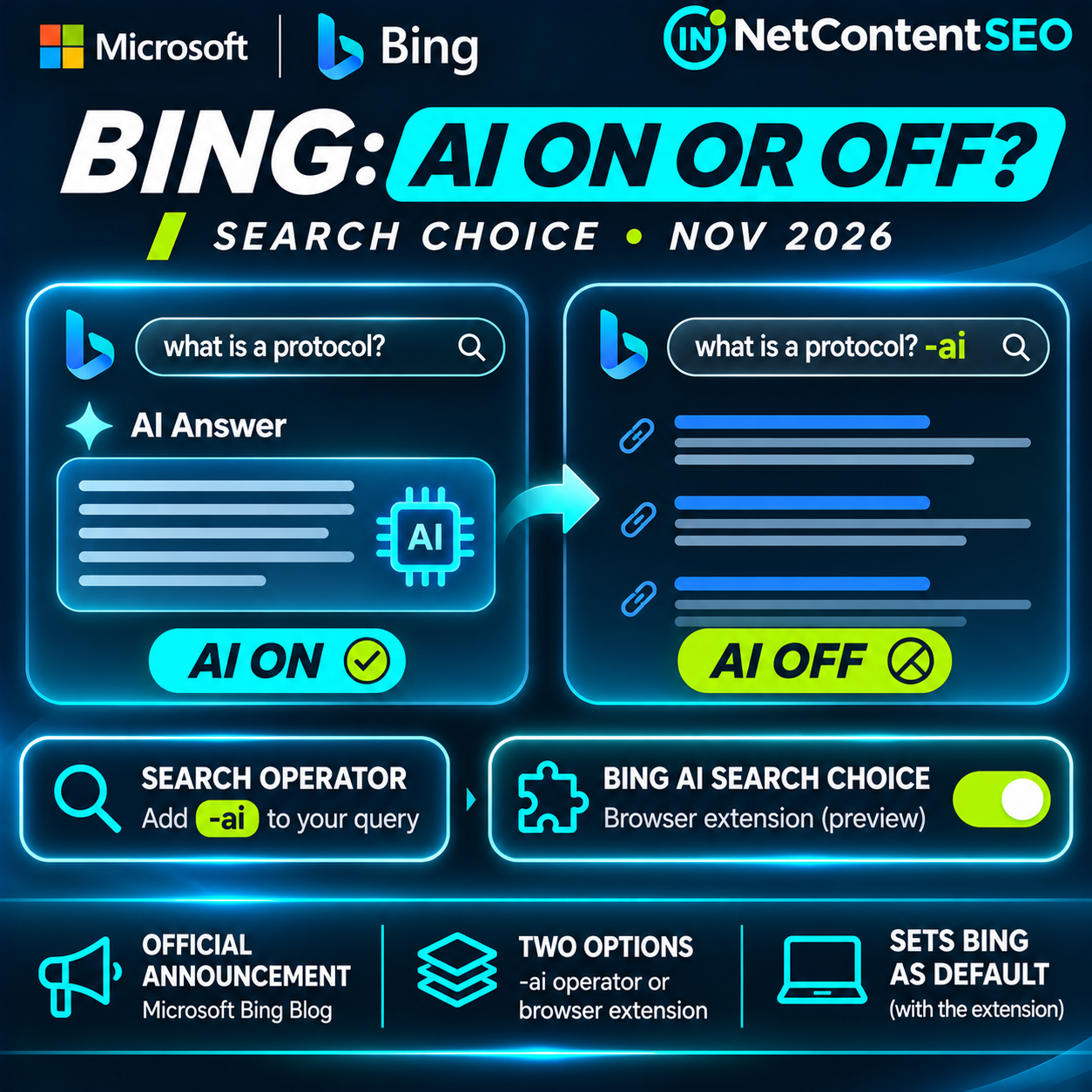

Microsoft is giving Bing users a documented way to switch off AI-generated answers without abandoning web search. In an official Bing Search Blog post dated November 11, 2026, the company described two controls: adding -ai to an individual query, or installing the Microsoft Bing AI Search Choice browser extension for Chrome or Edge and switching AI features off.
The announcement is important for publishers and SEO professionals because it makes the distinction between AI-generated answers and conventional search results a user-facing choice. But there is a crucial chronology correction: these controls were already reported in June 2026. November's development is Microsoft's new official blog explanation and promotion of existing options, not necessarily their first technical availability.
Two ways to turn off AI answers in Bing
1. Add -ai to a search query
The simplest option requires no browser installation. Append -ai to a Bing query. Microsoft's example is why is the sky blue -ai. Bing says the resulting search omits AI-generated answers. The operator must be entered again for each new search; it is not described as a permanent account preference.
This is useful for users who want to compare an AI-enhanced result with a conventional link-focused result for the same information need. It is also a simple manual research technique for SEO teams examining how AI answers change what a searcher sees. However, Microsoft's announcement does not establish that all other search-result features, ranking signals or advertisements are identical between the two modes.
2. Use the Bing AI Search Choice extension
The Microsoft Bing AI Search Choice extension is available in preview for Google Chrome and Microsoft Edge. Its toggle lets users enable or disable AI-generated answers across their Bing searches, without repeatedly typing the operator.
There is an important condition: installing the extension also sets Bing as the browser's default search engine. Anyone who wants only to test AI-off results without changing the default provider can use -ai instead. The extension remains a preview, and Microsoft says it may change in response to feedback.
The official announcement does not list Firefox or Safari versions. It also does not specify a comprehensive country-by-country availability list, explain every AI feature affected, or promise that all search interfaces behave identically.
What actually changed in November?
Some coverage frames the controls as a newly launched feature. That description needs qualification. Search Engine Roundtable reported the extension and -ai operator in June 2026, citing remarks from Microsoft's search leadership. The company subsequently published its own consumer-facing explanation on November 11.
This distinction is not pedantic. A newly introduced feature could imply a fresh change to the search experience for all users, whereas an official explanation of a previously available preview signals that Microsoft is drawing attention to user choice. Neither event proves widespread adoption of the AI-off option.
Microsoft says its research shows that some users want AI-generated summaries while others prefer to examine links and compare sources themselves. The November post does not provide the underlying survey sample, methodology, market breakdown or measured preference rates. The claim should therefore be attributed to Microsoft rather than presented as an independently established consumer trend.
Why this matters for SEO and organic click visibility
AI-generated summaries can occupy prominent space in search results and may satisfy an information need before the searcher visits a publisher's website. Conventional results present a different discovery path, with individual links more directly visible for users who want to investigate sources.
Giving users an AI-off control creates the possibility of two materially different result experiences for the same query. A website might appear as a source cited within an AI answer in one mode and as a conventional search result in another. Those forms of visibility are not equivalent, and neither guarantees a click.
However, Microsoft has not published evidence that turning off AI answers increases organic click-through rates, publisher traffic or conversions. An interface with fewer AI elements may expose links more directly, but real user behavior still depends on intent, ranking, advertisements, result design and other factors. SEO teams should not translate a visible layout difference into an invented traffic uplift.
What it means for GEO and AI citation measurement
Generative engine optimization, or GEO, commonly examines whether a brand or publisher is mentioned or cited in AI-generated answers. Bing's user choice creates a measurement challenge: a source may be present in AI mode but absent as an AI citation when the user chooses a traditional search experience. That does not necessarily mean the source has become less authoritative or less discoverable.
AI citation inclusion, organic ranking, first-screen visibility and measured visits should be tracked separately. A monitoring system that collects only one Bing interface state could misinterpret an AI-off result as a lost citation or a change in answer generation. Query-level records should therefore include whether AI answers were enabled during collection.
Microsoft has introduced AI visibility reporting in Bing Webmaster Tools, but the November announcement does not establish that its reporting can segment users who opted out of AI answers or measure the traffic effects of the new choice controls. Such segmentation should not be assumed without documentation.
Is the extension also a search-distribution strategy?
The requirement to make Bing the default search engine has commercial significance. A Chrome user who installs the extension to control AI answers is also changing the provider used for browser searches. That could give Microsoft additional search distribution, although no public figures in the November announcement show how many people install the extension or switch from another engine.
The trade-off is explicit: users receive a persistent AI toggle but also accept a change to their default search provider. The per-query operator offers a lower-commitment alternative. This is why the two options should not be treated as functionally identical, even though both can suppress AI-generated answers.
What happens to ads when AI answers are off?
Microsoft's announcement does not explain whether ad placement, ad volume or ad eligibility changes when AI answers are disabled. It also does not provide a controlled comparison of sponsored and organic visibility across the two experiences.
Advertisers should not assume that turning off AI answers means an ad-free search. Likewise, publishers should not assume that traditional results will always move into the space previously occupied by AI content. These are empirical questions that require observation and, ideally, data from Microsoft or controlled testing.
How to test Bing AI-on versus AI-off results
- Choose a stable query panel. Include informational, navigational, commercial and branded searches. Record the exact query text, language and market.
- Capture a normal Bing search. Save the visible result page, noting AI answers, citations, organic links, advertisements and other SERP features.
- Repeat with -ai. Add the operator to the same query, then capture the result page under comparable browser and location conditions.
- Record differences, not assumptions. Compare which links appear, their visible order, the amount of space used by different features and whether ads change.
- Check the extension separately. If you install it, record the toggle state and note that it changes the default search engine. Do not assume its behavior exactly matches every -ai result.
- Keep AI visibility and organic visibility separate. Count citations only when an AI answer is actually shown, and record conventional results independently.
- Repeat over time. Preview features can change. A single screenshot does not establish how frequently a result layout appears or whether it persists.
- Do not claim traffic effects from screenshots. Use analytics and search performance data to assess actual visits, while acknowledging that user adoption of AI-off mode is not disclosed.
What publishers and brands should do now
Continue making pages discoverable, technically accessible and useful to human readers. Do not build a strategy around forcing users into one Bing interface. Instead, test whether important pages are visible both as conventional results and, when applicable, as cited sources in AI-generated answers.
For publishers, the most useful immediate task is to establish a repeatable comparison of AI-on and AI-off results for their priority topics. For agencies, it is to explain that a brand's appearance in an AI answer and its position in traditional results represent different kinds of visibility. For software vendors, it is to label the interface state in collected SERP data so customers do not mistake a user-selected mode for an algorithmic change.
Organizations should also monitor whether Microsoft publishes clearer documentation on the extension's scope, market availability, interaction with AI Mode, and reporting in Bing Webmaster Tools. Until then, those areas remain open questions.
Frequently asked questions
Can you turn off AI-generated answers in Bing?
Yes. Microsoft officially documents two options: append -ai to an individual Bing search or use the Bing AI Search Choice extension for Chrome or Edge.
How do I use the -ai operator?
Add a space and -ai at the end of your query, such as why is the sky blue -ai. Microsoft says Bing then returns results without AI-generated answers for that search.
Does -ai permanently disable Bing AI?
No. The operator applies to the query where it is used. For a persistent preference across Bing searches, Microsoft offers the preview browser extension.
Is Bing AI Search Choice available for Chrome and Edge?
Yes. Microsoft links to official extension listings for both browsers. It labels the extension a preview and says the feature may evolve based on feedback.
Does the extension change my default search engine?
Yes. Microsoft explicitly says installing it also makes Bing the default search engine. This is an important consideration for people using Google or another provider by default.
Is this a completely new feature from November 2026?
No. The extension and operator were reported in June 2026. The November 11 announcement is a new official Bing blog explanation and promotion of those controls.
Does switching off AI answers remove advertisements?
Microsoft's November announcement does not say that it does. The presence and placement of advertisements should be tested separately rather than assumed.
Will publishers get more clicks when Bing AI is turned off?
That has not been established. The feature changes how users can view results, but Microsoft has not released controlled evidence of a publisher click-through or traffic uplift.
Does the extension disable every Copilot feature?
The official announcement describes turning AI-generated answers on or off and refers generally to AI features in Bing. It does not provide an exhaustive feature-by-feature specification across all Copilot and Bing interfaces.
Can SEO tools detect which mode a searcher used?
A tool can record the mode it used during its own tests, but Microsoft's announcement does not promise access to individual users' mode choices or a publisher analytics report segmented by AI-off usage.
The bigger implication: search choice becomes part of visibility measurement
Microsoft's announcement highlights a strategic tension in AI search. AI summaries may help users complete information tasks faster, but some searchers still want to inspect source links directly. Bing is making that preference actionable through a query operator and a preview extension, while also using the extension to set Bing as the default provider.
For SEO and GEO, the conclusion is practical rather than ideological: the same query can now produce different visibility experiences depending on a user's choice. Teams need to measure conventional search presence, AI citations and actual visits as distinct outcomes. The option to switch AI off is real; its impact on publisher traffic is still an unanswered question.
Sources
- Microsoft Bing Search Blog — Your choice: Turn AI answers on or off in Bing, November 11, 2026.
- Search Engine Roundtable — Bing Gives Searchers A Way To Disable AI Copilot Answers, June 2026.
- PPC Land — Bing's AI-off switch for Chrome also makes Bing the default search engine, November 12, 2026.
- Chrome Web Store — Microsoft Bing AI Search Choice.
- Microsoft Edge Add-ons — Microsoft Bing AI Search Choice.