

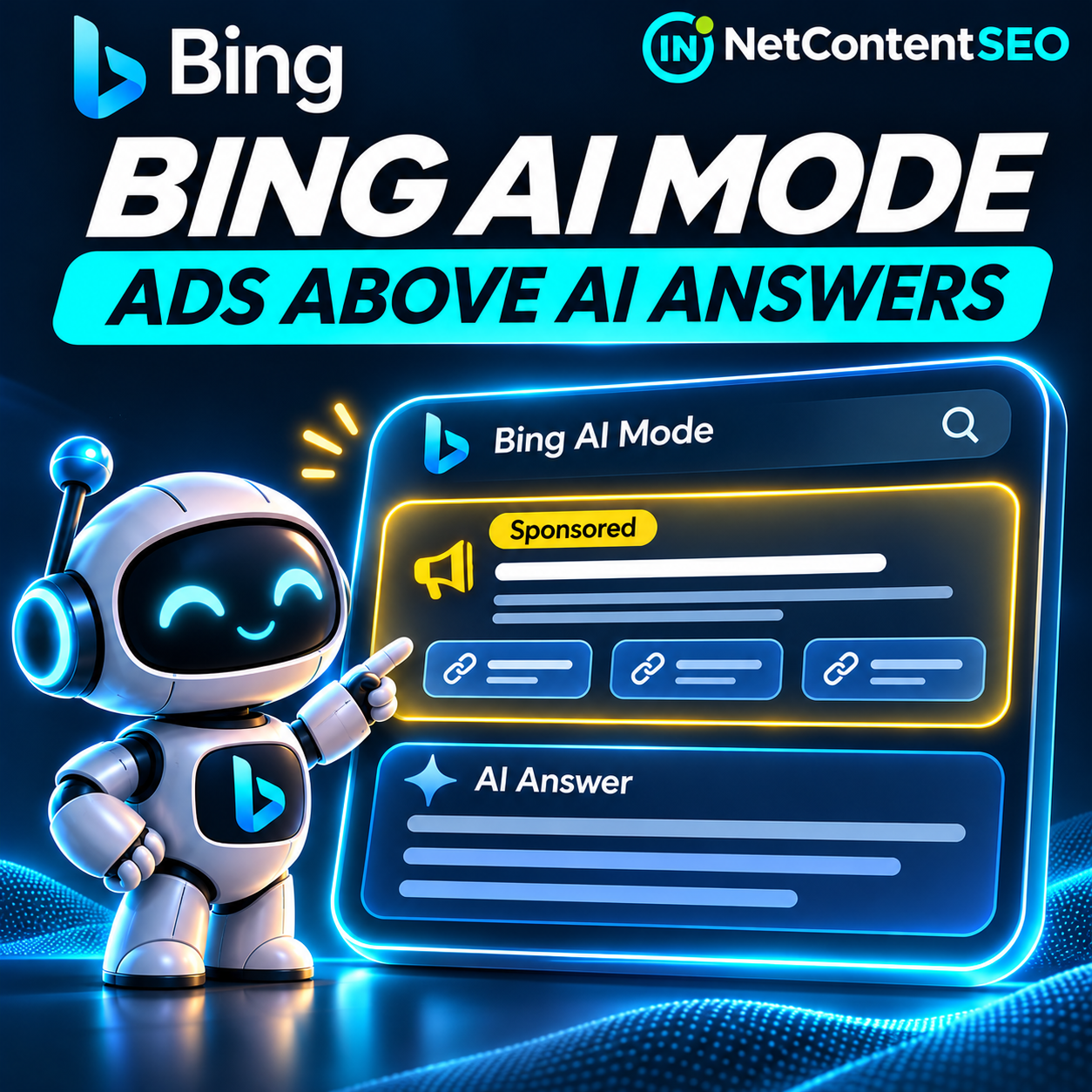

November 9, 2026. Bing's AI-powered search experience has been observed displaying a sponsored result with sitelinks at the top of an AI-generated answer. The placement was documented in a November 6 Search Engine Watch report and follows earlier sightings of ads inside Bing's AI Overviews reported by Search Engine Roundtable on October 30.
The new observation is significant because placement matters. An advertisement at the top of an AI answer may be encountered before a user reads the model's explanation or considers cited sources. That could affect how paid and organic visibility compete for attention, but the available screenshots do not establish a broad rollout, a new auction model or measurable changes in click-through rates.
What was spotted in Bing AI Mode?
Search Engine Watch reported seeing a sponsored advertisement with sitelinks positioned at the top of Bing AI Mode's answer interface. Sitelinks are additional links associated with an ad, allowing users to navigate to more specific destinations. The observation adds to a growing collection of reported ad formats inside Microsoft's AI-powered search surfaces.
In late October, Barry Schwartz reported a screenshot shared by search marketer Khushal Bherwani showing a sponsored result within a Bing AI Overview powered by Copilot. Schwartz explicitly noted that he had not personally been able to trigger the format. The distinction matters: an observed interface is evidence that a presentation has appeared in at least some circumstances, not evidence that every Bing user can see it.
The user-supplied Search Engine Roundtable article on Bing ads at the top of AI Mode results was not independently retrievable during preparation. This analysis therefore relies on the accessible Search Engine Watch observation and earlier Barry Schwartz reporting, rather than attributing unverified details to the newer article.
Why the top of an AI answer is a valuable ad position
Traditional search results distinguish sponsored listings from organic results through labels and layout. AI interfaces introduce a more complicated reading path: users may encounter a generated summary, supporting links, follow-up prompts and paid placements in one conversational surface.
A sponsored result above the answer could attract attention before the reader reaches the supporting sources. The presence of sitelinks can also provide several potential click destinations within one ad. This creates an opportunity for advertisers, but it raises measurement questions for publishers: a decline in clicks on cited pages might reflect changes in interface placement, query intent or advertising exposure rather than a loss of organic relevance.
None of the observations reviewed here establishes that the top position necessarily wins more clicks or conversions. That requires controlled exposure and performance data.
Is this a confirmed Microsoft rollout?
Not on the evidence currently available. The reports document screenshots and individual observations. They do not establish an official Microsoft announcement that the exact top-of-answer format is universally available, nor do they provide a public schedule for expansion.
It is useful to classify the development as REPORTED / OBSERVED TEST. A screenshot can confirm that a UI variant appeared in a particular session. It cannot, by itself, reveal geographic availability, targeting rules, ad auction mechanics, frequency or advertiser controls.
How this compares with Google AI Mode
Google is also expanding advertising in AI Mode. In an October 28 official announcement, Google said it was extending AI Mode ads to ten additional countries and introducing multiturn ads for follow-up queries in the United States. Google said ads would be clearly labeled as Sponsored and that it would continue testing formats.
Search Engine Roundtable separately reported screenshots of up to four ads in a Google AI Mode response on November 4. The appearance of multiple ads in one answer is an observation, not a guarantee that all users or queries receive that quantity.
Search Engine Watch characterized Bing's observed top-of-answer format as distinct from the Google AI Mode placements it had generally seen lower in the interface. That is a comparison of observed examples, not a fixed platform rule. Google and Microsoft may vary placement by query, market, device and experiment.
AI search monetization is still evolving
During Alphabet's October 2026 earnings discussion, Google executive Philipp Schindler acknowledged that AI Mode queries were generating lower monetization than traditional search queries, while expressing confidence in the direction of the advertising experiments. Barry Schwartz covered the remarks on October 29. This provides business context for experimentation with ad placements, but does not prove why Microsoft chose a particular layout.
As AI interfaces become more conversational, advertisers may want to reach people during research and comparison rather than only at the final purchase step. Platforms are testing ways to make paid placements useful without blurring the distinction between a model's answer and sponsored content.
What this means for SEO and GEO
For publishers and brands, the important distinction is between being cited by an AI answer and buying placement near that answer. A paid sitelink is not an organic citation, and an organic source link is not a sponsored recommendation. They may appear in the same visual environment but follow different selection and measurement systems.
If sponsored units become more prominent, AI visibility reporting will need to account for interface real estate as well as mentions and citations. A brand could appear in the answer while receiving little attention if other elements occupy the first screen. Conversely, an advertiser could gain exposure without appearing in the generated explanation.
There is no evidence from this observation that buying Microsoft Advertising placements improves organic Bing rankings, causes Copilot to cite a website or changes the model's source-selection criteria.
How advertisers should evaluate the new format
Businesses should avoid reallocating budget based solely on a screenshot. Instead, start with the Microsoft Advertising controls and reporting actually available in their accounts, and document whether any AI-specific inventory or placement segmentation is exposed.
- Check availability: inspect relevant queries on Bing and record country, language, device, date and whether the ad format appears.
- Preserve evidence: capture the entire interface, including Sponsored labels, the ad, sitelinks, AI answer and citations.
- Review campaign reporting: check impressions, clicks, costs and conversions, but do not assume the account can isolate this exact AI Mode placement.
- Audit sitelinks: ensure destinations are relevant, load correctly and lead to useful pages for the user's intent.
- Measure outcomes: compare qualified leads, sales and revenue per click rather than interpreting impressions alone as success.
- Wait for official controls: avoid claiming precise targeting or bidding capabilities for the observed format until Microsoft documents them.
How publishers can monitor organic impact
Publishers should maintain a repeatable set of Bing queries and capture the order in which sponsored placements, generated answers and source links appear. Record whether the organic source is visible without scrolling and whether the citation is a direct link to the publisher.
Where Bing Webmaster Tools provides AI visibility or performance reporting, compare the available metrics over time, but do not treat them as a complete accounting of all ad exposure or AI-driven visits. Also monitor server logs and analytics for identifiable Bing referrals, recognizing that some AI interfaces and tracking systems may not expose a distinct referrer.
If clicks change, first test alternative explanations such as seasonality, query mix, indexing issues, ranking shifts, UI experiments and changes in ad density. A screenshot of a top ad is not enough to attribute a traffic decline.
Sponsored labels and user trust
The visible Sponsored label is important because it helps users distinguish paid placements from the answer and its sources. The closer advertising appears to generated content, the more essential clear labeling becomes.
For brands, a paid appearance can buy attention but does not establish that independent sources support the advertiser's claims. For publishers, organic citations can indicate that a source was used or referenced in a particular answer, but they do not guarantee clicks or commercial outcomes. These should remain separate KPIs in any AI visibility dashboard.
Frequently asked questions
Is Bing showing ads at the top of AI Mode answers?
Search Engine Watch reported an observed sponsored result with sitelinks at the top of a Bing AI Mode answer on November 6, 2026. The exact availability and rollout scope have not been established.
Did Barry Schwartz report Bing ads in AI answers?
Yes. On October 30, Search Engine Roundtable reported a screenshot of a sponsored result within Bing AI Overviews. Schwartz said he could not personally reproduce that earlier example.
Is the top-of-answer format available to every advertiser?
There is no verified universal availability announcement for this specific presentation in the evidence reviewed. Check current Microsoft Advertising documentation and account controls.
What are sitelinks in a sponsored result?
Sitelinks are additional navigation links associated with an advertisement, potentially directing users to more specific pages than the main ad destination.
Does paying for a Bing AI ad improve organic AI citations?
No such causal relationship has been demonstrated. Paid ad placement and organic source selection should be evaluated separately.
How is Bing's format different from Google AI Mode?
The reported Bing example placed an ad with sitelinks above the answer. Google has been observed using other placements and is officially expanding AI Mode advertising. The examples do not establish permanent, universal placement rules for either platform.
Can advertisers see AI Mode ad performance separately?
That depends on the reporting and controls available in their Microsoft Advertising account. The screenshot does not prove that this exact placement can be isolated in reporting.
What should SEO teams track?
Record paid placement, answer position, organic citations, link visibility and identifiable referrals separately. Repeat observations across comparable queries and dates.
The bigger picture: the first screen of AI search is becoming contested
Bing's reported top-of-answer sponsored format illustrates how AI search interfaces are becoming commercial environments, not just answer engines. The immediate finding is narrow: a sponsored ad with sitelinks was observed above an AI answer. The larger question is whether paid placements will increasingly occupy the most visible space while organic sources move deeper into the experience.
That possibility deserves monitoring, not premature certainty. Until Microsoft provides broader rollout details and measurable performance data, the sound approach for SEO and PPC teams is to document what appears, separate paid and organic outcomes and test whether the new layout changes actual customer behavior.
Sources
- Search Engine Roundtable — Bing Ads at the Top of AI Mode Results (user-provided link; page not independently retrievable).
- Search Engine Watch — Bing AI Mode now shows sponsored ads with sitelinks at the top of answers (November 6, 2026).
- Search Engine Roundtable — Bing Showing Ads Within AI Overviews (October 30, 2026).
- Google — Ads in AI Mode expand to new markets (October 28, 2026).
- Search Engine Roundtable — Google AI Mode Now With Up To Four Ads (November 4, 2026).
- Search Engine Roundtable — Google: Ads In AI Mode Earning Less Than Traditional Search Ads (October 29, 2026).