


Artificial intelligence is changing how people interact with search engines, moving beyond isolated keyword queries toward conversational discovery and assistance with decisions. In an April 2025 Bing Webmaster Blog article, Microsoft summarized key ideas presented at Microsoft Advertising Accelerate, where Bing's Fabrice Canel discussed the evolution of AI-powered search and its implications for website owners.
The article is a useful historical explanation of Bing's direction, not a new October 2026 algorithm announcement. It describes strategic themes and technical foundations rather than revealing a formula for guaranteed placement in AI answers.
From keywords to conversations
Traditional search commonly begins with a short query and a list of results. Conversational AI experiences allow users to ask follow-up questions, add context and explore a topic through a sequence of interactions. For publishers, this changes how information may be requested and presented: a single search journey can include several related questions rather than one fixed phrase.
The practical implication is not to abandon keyword research. Instead, content should answer real questions clearly, cover the context readers need and make important facts easy to find. These editorial principles can support both conventional search and systems that retrieve information to build AI-assisted answers.
Anticipatory experiences and decision support
The Microsoft Accelerate recap also emphasizes search experiences that help people anticipate needs and move from gathering information toward making decisions. In this vision, AI can help users compare options, refine requirements and decide what to do next.
For businesses, this creates opportunities to publish accurate, decision-useful information such as specifications, availability, policies and explanations of trade-offs. However, the vision of anticipatory assistance should not be mistaken for a claim that every described capability is universally deployed or that any particular content format guarantees inclusion.
Smarter indexing remains a foundation
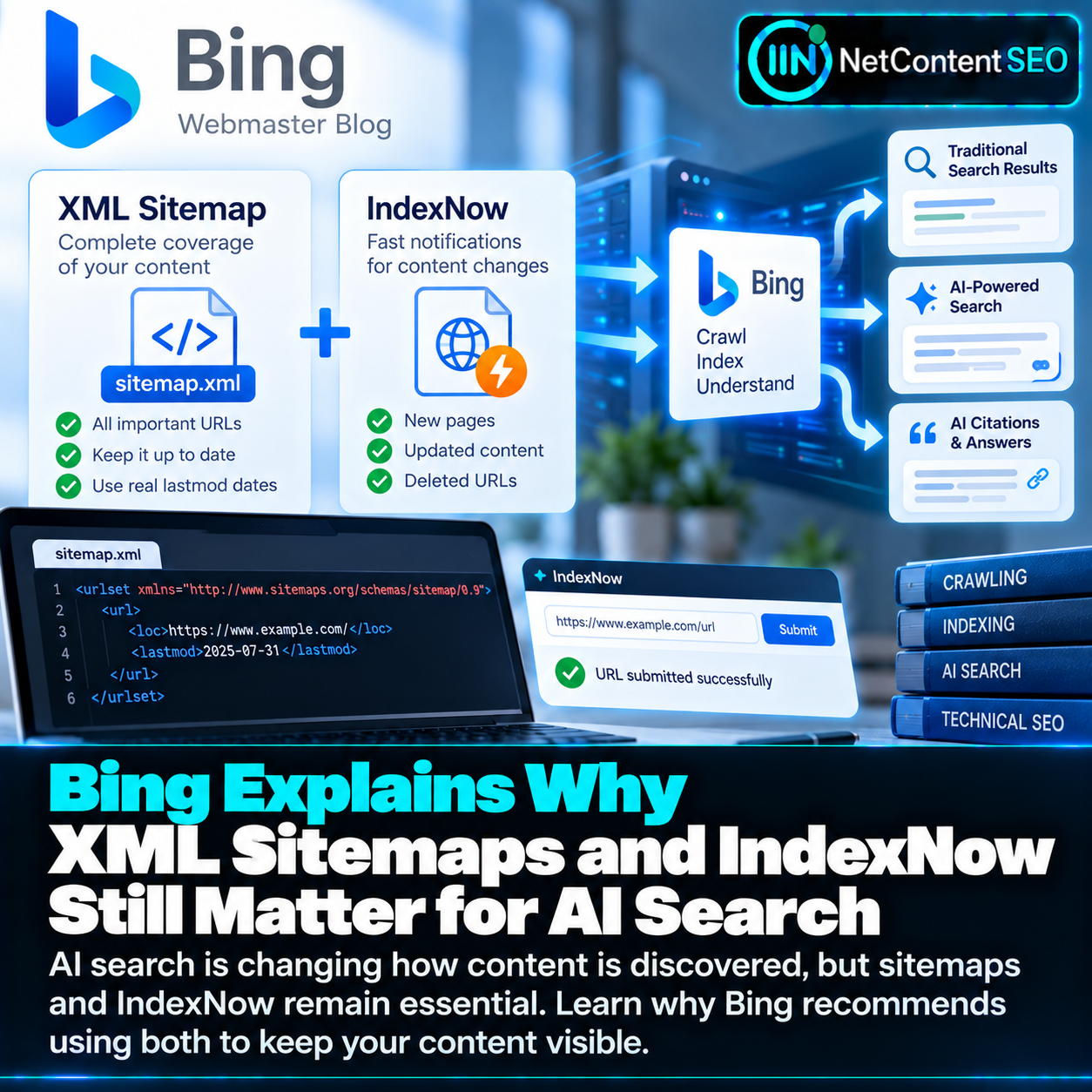
AI-generated answers still depend on systems being able to discover and process relevant information. Bing's broader webmaster guidance stresses the value of making content accessible and keeping search engines informed about important changes. Tools such as IndexNow can notify participating engines when pages are created, updated or removed.
IndexNow is a discovery notification mechanism, not a ranking boost or a guarantee of indexing. Likewise, a well-maintained XML sitemap helps search engines understand the inventory of available URLs. These tools support the technical foundation for search visibility but do not determine whether a page will be cited in an AI response.
What SEO teams can actually act on
The useful response to the shift toward AI search is to strengthen established fundamentals while measuring newer outcomes separately. Teams can make important pages crawlable, maintain consistent canonical signals, publish current and verifiable information, and organize content so its meaning is clear to both readers and automated systems.
They should also avoid collapsing several different metrics into one. A page being discovered, indexed, retrieved for a query, cited in an AI answer and visited through an AI referral are different events. Improvements at one stage do not guarantee success at the next.
How this differs from Bing's sitemap and IndexNow guidance
Bing's separate guidance on XML sitemaps and IndexNow focuses on the mechanics of URL discovery and change notification. The Microsoft Accelerate discussion is broader: it explores how AI may reshape the search experience itself, including conversational interactions and decision support.
The two themes are complementary. Technical discoverability makes content available to search infrastructure; relevance, clarity and the product's answer-generation processes influence what users ultimately see. Neither source provides evidence of a universal AI citation ranking formula.
NetContentSEO assessment
Microsoft's message at Accelerate remains useful because it connects a changing user experience with persistent technical SEO requirements. The move toward conversational and decision-oriented search is strategically important, but it should not be exaggerated into a claim that Bing has announced a new, deterministic method for ranking in AI answers. For publishers, the practical priorities are accessible pages, timely updates, helpful content and distinct measurement of AI visibility and referral traffic.
Primary source: Bing Webmaster Blog — AI Revolutionizes Search: Key Insights from Microsoft Accelerate (April 2025).