

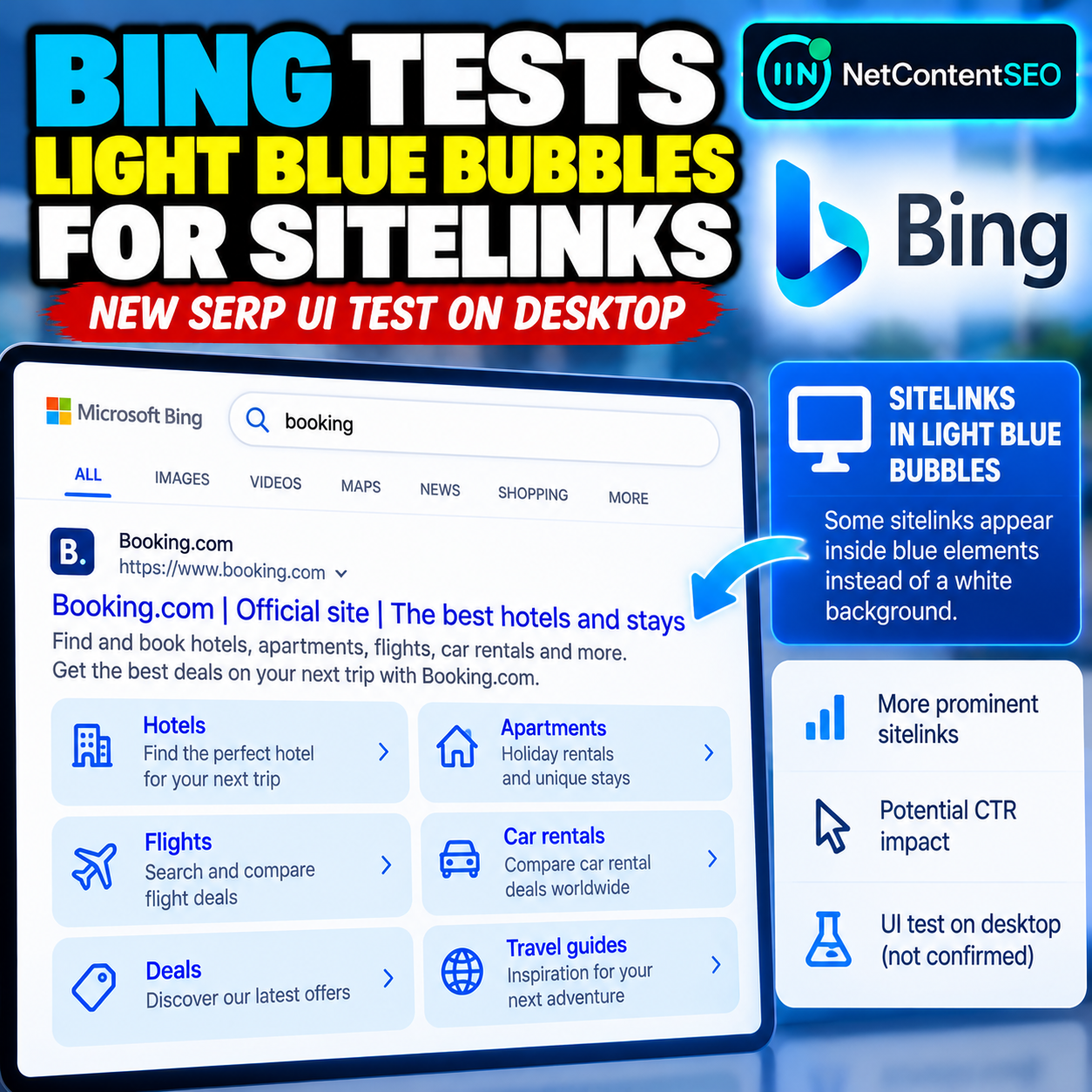

Bing is testing light-blue bubble-style backgrounds around desktop sitelinks, replacing the white background seen in the earlier presentation, according to Search Engine Watch. The report was published on October 9, 2026, and describes the change as a visual test. Microsoft has not confirmed a general rollout.
What changed in Bing's desktop sitelinks?
In the reported example, some sitelinks appear inside light-blue rounded elements rather than on a plain white background. Search Engine Watch notes that Bing recently made a similar colour change to its “People also ask” questions. The resemblance raises the possibility that Bing is applying a more consistent visual treatment to interactive elements, but the article does not establish Microsoft's design rationale.
The observation concerns desktop search results. It does not establish that the same treatment appears on mobile, for every query, or for all users.
What is confirmed—and what remains unknown?
- Observed: light-blue bubbles around some Bing sitelinks on desktop.
- Previous appearance: the sitelinks had a white background.
- Reported date: October 9, 2026.
- Source: Search Engine Watch, reporting an interface observation by Sachin Patel.
- Not confirmed: an official Microsoft announcement or a general rollout.
- Not measured: any change in click-through rate, accessibility, usability or organic traffic.
Why the visual treatment could matter
A coloured background can help links stand apart from surrounding text and may make sitelinks easier to notice. Search Engine Watch's report suggests that the new look could improve visibility, but it does not provide click data or usability testing to demonstrate an effect.
For SEO teams, the change is best understood as a SERP presentation experiment. It is not evidence of a ranking update, a change in the sitelinks algorithm or a confirmed shift in how Bing selects links.
What SEO teams should monitor
- Repeat the check: compare the same query across multiple sessions before assuming the design is consistently available.
- Record the environment: note desktop browser, query, date and market when documenting the result.
- Compare related SERP elements: observe whether the treatment appears alongside other recent Bing UI changes, while keeping each observation distinct.
- Measure outcomes separately: use available search performance data to assess clicks rather than assuming a more prominent design increases CTR.
- Avoid ranking claims: no ranking or indexing change is established by the reported visual test.
Frequently asked questions
What is Bing testing?
Some desktop sitelinks are shown inside light-blue bubble-style elements instead of on a white background, according to Search Engine Watch.
When was the test reported?
The report was published on October 9, 2026.
Has Microsoft confirmed the design?
No official Microsoft confirmation or general rollout is cited in the report.
Will blue sitelink bubbles increase clicks?
They may make sitelinks more visually prominent, but the report includes no click-through or usability data proving an effect.
Does this affect Bing rankings?
The report documents a visual presentation change only. It does not establish a ranking or indexing change.
The takeaway
Bing has been observed testing light-blue bubbles around desktop sitelinks, a small interface change that may make those links stand out more clearly. The report does not confirm a wider rollout or demonstrate an impact on clicks. For now, SEO teams should treat it as a visual SERP test and avoid interpreting it as a ranking change.
Source
Search Engine Watch — Bing tests light blue bubbles for sitelinks on desktop (October 9, 2026).