

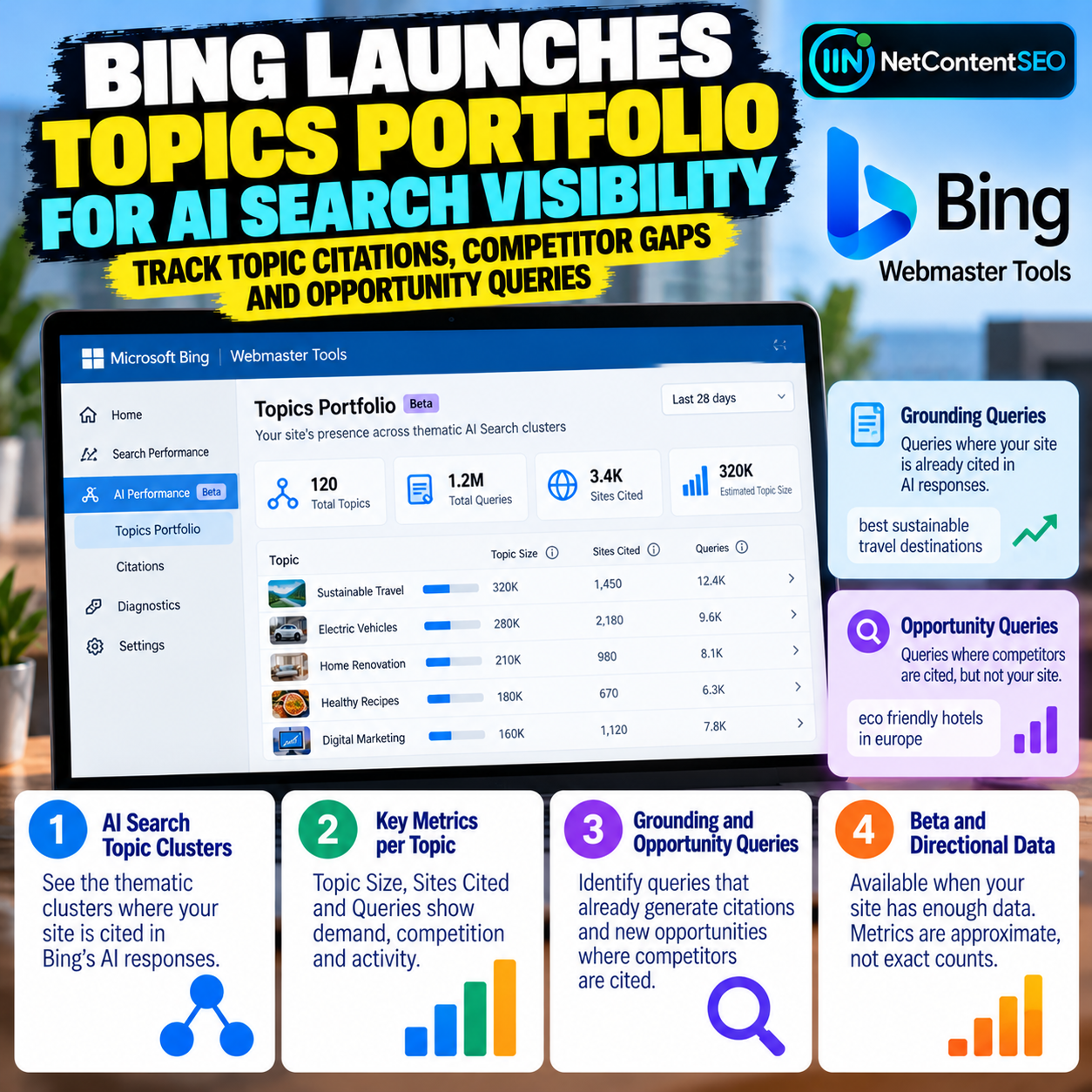

Microsoft has introduced Topics Portfolio (Beta) in Bing Webmaster Tools, adding a thematic view of a site's visibility across AI-generated search answers. Available under AI Performance, the feature groups topics into clusters and connects a high-level view of AI Search presence with query-level opportunities. Microsoft says the beta is available to sites with sufficient data.
Topics Portfolio is designed to help site owners understand which themes already generate citations and where other websites appear instead. The dashboard includes Topic Size, Sites Cited and Queries, while topic detail pages separate Grounding Queries from Opportunity Queries. Microsoft cautions that AI-generated classifications and ecosystem metrics are approximate, so the results should be used as directional guidance rather than exact counts.
What is Bing Topics Portfolio?
Topics Portfolio is a new beta feature inside Bing Webmaster Tools → AI Performance. Rather than limiting analysis to individual queries, it groups AI Search visibility into thematic clusters, helping website owners explore how their content appears across broader subject areas.
The portfolio view provides an overview of the topics associated with a site. From there, users can open a topic to inspect queries linked to existing citations and queries where competing sites are cited. This connects broad visibility analysis with more specific content-planning questions.
The three topic metrics
- Topic Size: an approximate indication of citation activity associated with a topic. It is directional, not an exact count of every citation or a universal search-volume measure.
- Sites Cited: the number of sites cited within that topic's observed ecosystem, providing context about the range of sources appearing alongside the topic.
- Queries: the query activity associated with the topic, helping users understand how much question-level activity the cluster represents.
Together, these metrics offer context about topic activity and the competitive environment. They should not be treated as precise measurements of total demand, all competitors or the complete AI Search ecosystem.
Grounding Queries: where your site already appears
Grounding Queries are queries associated with AI answers that already cite the site. Reviewing them can help teams identify the topics and user questions for which their existing content is being used as a source.
For SEO and AI visibility teams, these queries provide a starting point for examining the pages that support current visibility. They can help inform content maintenance, internal linking and the development of useful follow-up resources—but a query association alone does not establish why a site was selected or guarantee that a citation will persist.
Opportunity Queries: where competitors appear instead
Opportunity Queries highlight searches for which other sites are cited but the user's site is not. The aim is to surface potential gaps for further investigation, rather than simply report existing visibility.
An opportunity is not a promise of future inclusion in AI answers. Before creating or changing content, teams should examine the actual query, the cited competing pages, the intent behind the question and whether their own site can provide a genuinely useful answer. Some opportunities may reveal a content gap; others may reflect a different intent or a source better suited to the query.
How to use Topics Portfolio for AI Search planning
- Open AI Performance. Find Topics Portfolio in Bing Webmaster Tools. The feature may only appear when a site has enough data for the beta analysis.
- Review the topic clusters. Prioritise themes relevant to your audience, products or services rather than pursuing every topic shown.
- Inspect Grounding Queries. Understand which questions already associate your site with AI answers, then review whether the relevant pages remain accurate and helpful.
- Investigate Opportunity Queries. Compare the cited pages with your own content and determine whether there is a meaningful gap worth addressing.
- Validate before publishing. Use editorial judgement and evidence from the underlying queries; do not assume a new page will automatically earn a citation.
- Send feedback. Microsoft says the classifications and metrics are approximate. Use the built-in feedback controls to report problems and help improve the beta.
Availability and limitations
Topics Portfolio is a beta feature and is available when a site has sufficient data. AI-generated topic classifications and ecosystem metrics are approximate, so results should be interpreted as directional signals rather than exhaustive or exact measurements.
The dashboard also does not guarantee rankings, traffic or citations. A topic's size is not necessarily equivalent to conventional keyword search volume, and the number of cited sites does not by itself establish how competitive a topic is for a particular website. Use the metrics to guide investigation, then validate decisions against the actual queries and your content strategy.
Why this matters for GEO and AI visibility
Topics Portfolio gives site owners a way to move from a broad picture of AI Search presence to more specific questions about existing citations and competitor visibility. That makes it a practical planning aid for Generative Engine Optimization (GEO), especially when teams need to identify themes to protect and potential content gaps to assess.
Its value will depend on how useful the underlying data proves for each site and how clearly users understand the beta's limits. It is a new reporting view, not evidence that Microsoft's AI Search systems have changed their citation rules or that optimizing for an Opportunity Query will produce a particular outcome.
The takeaway
Bing Webmaster Tools' Topics Portfolio (Beta) brings topic-level AI Search visibility, existing Grounding Queries and competitor-focused Opportunity Queries into one workflow. Topic Size, Sites Cited and Queries provide directional context, while the query views help teams investigate where their site is already cited and where other sources appear. The feature is available to sites with sufficient data, but its approximate metrics should be validated before they guide editorial or SEO decisions.
Official source
Microsoft Bing Webmaster Blog — Introducing Topics Portfolio (Beta) in AI Performance