

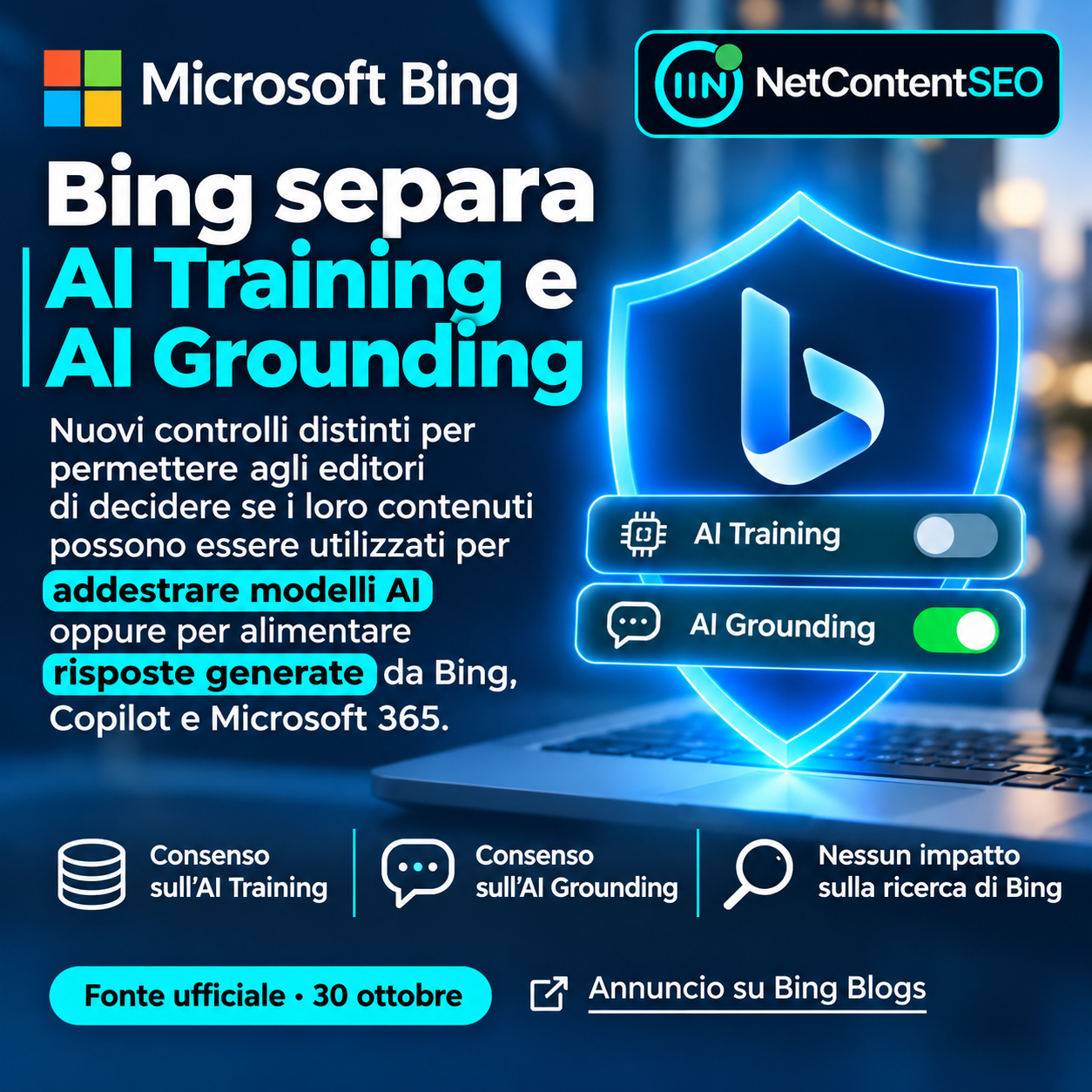

Microsoft Bing has announced a consequential change in the relationship between web publishers and generative AI. On October 30, 2026, the company introduced separate publisher preferences for AI Training and AI Grounding. The distinction allows site owners to express different choices about whether their content helps train generative models and whether it can inform answers generated by Bing, Copilot and Microsoft 365. Crucially, these preferences do not alter eligibility for traditional Bing search results.
The announcement is about control over use, not a guarantee of visibility or compensation. Microsoft's new preferences will begin being honored February 1, 2027, as Bing crawls content. The transition matters especially to publishers currently relying on older NoArchive and NoCache controls.
AI Training and AI Grounding Are Different Uses of Content
Training involves using content to modify a generative model's learned parameters. Grounding, by contrast, involves using web content as input when generating an answer. A publisher can be comfortable with its pages informing a current answer, ideally with an attribution or citation, while declining to contribute to the training of future models. Conversely, a publisher may choose to restrict both uses.
Microsoft's approach recognizes that crawling, traditional indexing, model training and answer grounding are not synonymous. It also makes a strategically important distinction for AI Search: content can remain eligible for search discovery while its owner limits certain downstream AI uses.
Three Grounding Choices: Allow, DisallowExtended and Disallow
The AI Grounding preference is expressed at page level, using a meta tag or HTTP header. Microsoft describes three options. Allow is the default and permits content to help inform generated responses. Disallow prevents grounding use. Between those positions, DisallowExtended allows grounding in Microsoft-operated experiences, including Copilot and Microsoft 365, but excludes grounding services Microsoft supplies to third parties, including Web IQ and grounding access in Foundry.
This middle option is notable. A publisher can choose to remain eligible for Microsoft's own AI answer surfaces without making the same content available for Microsoft's third-party grounding services. There is no site-wide robots.txt AI Grounding preference in the announced system; the control applies page by page.
How AI Training Preferences Work
For AI Training, Microsoft supports a shared industry preference expressed in robots.txt for an entire site or specific paths. A sample rule given by Microsoft uses User-Agent: __usage_ai-training followed by Disallow: / to express a site-wide training restriction. The company is also extending the training preference to individual pages through a meta tag or HTTP response header. A page-level training preference can override the applicable robots.txt preference.
For example, Microsoft documents the page-level meta tag <meta name="Bingbot" content="ai-training:disallow">. For grounding, the corresponding example is <meta name="Bingbot" content="ai-grounding:disallow">; Microsoft also documents ai-grounding:disallowextended. These are usage preferences rather than crawl permissions: permitting AI grounding does not override a separate rule that blocks Bingbot from crawling a page.
Can Publishers Block Training but Still Be Cited by Copilot?
Under the announced preferences, yes. Microsoft expressly provides the example of AI Training: Disallow combined with AI Grounding: Allow. That combination lets publishers express a refusal of generative training while leaving their pages eligible to inform AI-generated responses.
Eligibility should not be mistaken for performance. Microsoft says that allowing grounding does not guarantee an AI citation, traffic or payment. It also warns that selecting DisallowExtended or Disallow can reduce brand visibility in AI-generated experiences. For publishers measuring AI citations and discovery, the trade-off is therefore operational as well as philosophical.
Important 2027 Dates for Site Owners
December 15, 2026: a temporary grounding-transition option becomes available in Bing Webmaster Tools for eligible sites using the legacy NoArchive or NoCache directives.
February 1, 2027: Microsoft begins honoring the new preferences as pages are crawled; the changes are not retroactively applied to every page overnight.
March 1, 2027: publishers using the legacy directives who wish to maintain their restrictions must adopt the new settings. For continued grounding restrictions, Microsoft instructs eligible site owners to publish the page-level grounding choice and record a temporary preference in Bing Webmaster Tools.
September 30, 2027: temporary grounding preferences expire, unless a page has been recrawled earlier and its new settings discovered. Publishers should not assume the older directives will indefinitely preserve AI restrictions.
What This Means for SEO and AI Visibility
The practical SEO implication is that one binary idea of 'being indexed' is no longer sufficient to describe content availability in AI-powered search. Traditional search eligibility, model training permission and answer-grounding permission can be managed separately, at least within the Microsoft ecosystem described in this announcement.
For editorial brands, this creates a more explicit governance decision: should their content be used to improve future models, to inform contemporary answers, both, or neither? For SEO teams, that decision belongs alongside technical crawl configuration, brand visibility measurement and editorial licensing strategy. A grounding restriction may express an important policy, but it can also narrow the surfaces where a brand is referenced in AI answers.
The development also strengthens the case for auditing existing directives rather than blindly copying an 'AI bots' blocklist. A broad crawler block, a training opt-out and a grounding opt-out operate differently. Teams should document the intended policy for each content type and verify that their technical implementation matches it.
What Publishers Should Do Now
First, review whether the website currently uses NoArchive or NoCache. Second, decide training and grounding preferences independently, including whether selected content should remain available to Microsoft's own AI answers. Third, map the settings to site-wide paths and individual pages, and plan for Microsoft's crawl-dependent February 2027 rollout. Finally, monitor Bing Webmaster Tools and confirm that ordinary crawl and indexing requirements remain satisfied.
The larger change is conceptual: publishers are gaining language to distinguish being found, being used to train and being used to answer. Microsoft is not promising traffic or revenue, but it is formalizing choices that will become increasingly central to AI visibility and content governance.
Primary sources: Microsoft Bing official announcement, October 30, 2026; Bing Webmaster Tools: New AI Preferences FAQ.