

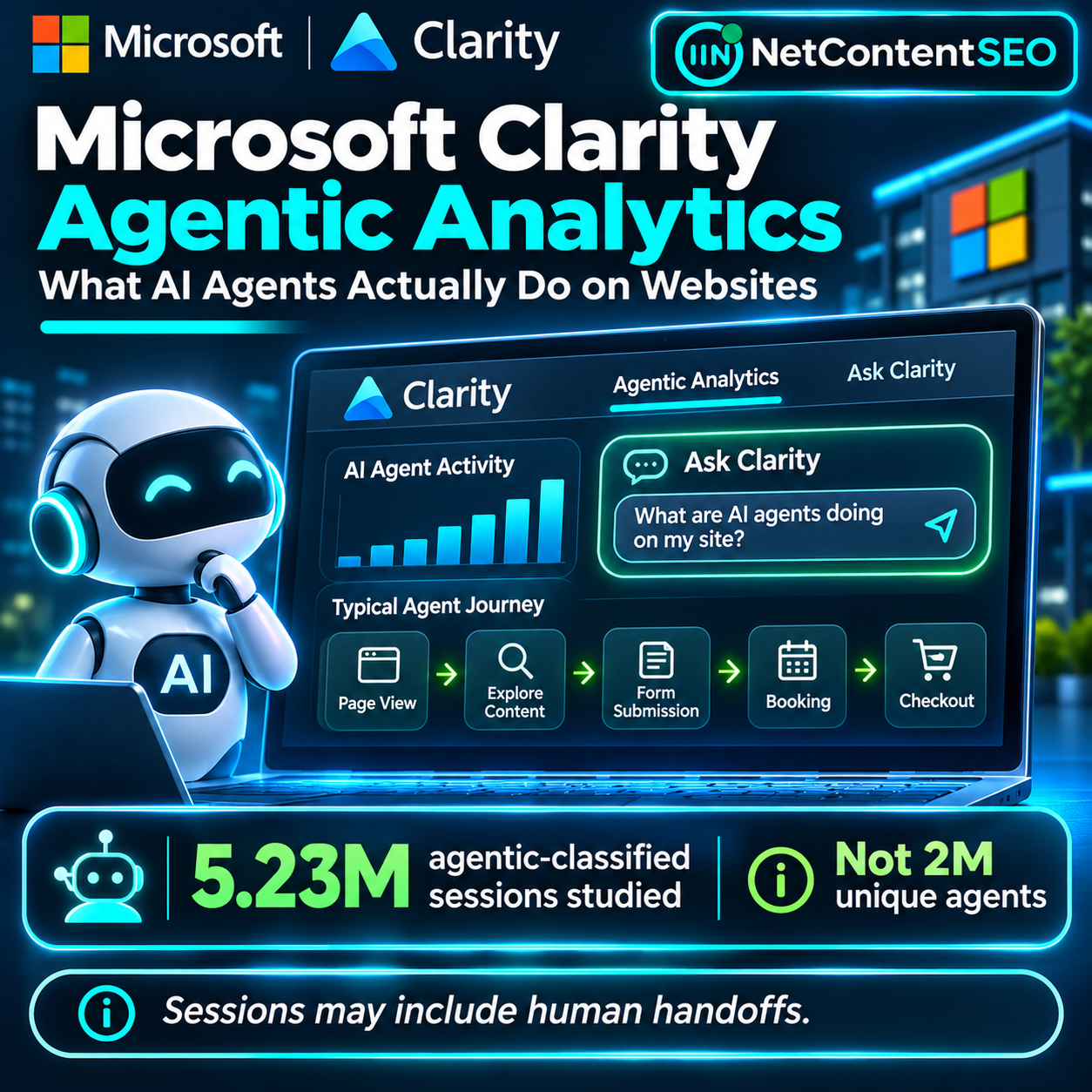

Microsoft Clarity is expanding beyond conventional website behavior analytics to observe a new kind of visitor: AI agents that navigate websites and attempt tasks on behalf of people. On November 4, 2026, Microsoft announced Agentic Analytics, Ask Clarity and an expansion of Brand Agents, positioning the free analytics platform around three journeys: people browsing, AI systems recommending and agents taking action.
The announcement is important for Agentic SEO because it moves the measurement conversation beyond whether a bot crawled a page. The new question is whether an AI agent can successfully search, navigate, complete forms, book appointments and reach checkout. But the headline numbers require care: Microsoft's “almost 2 million” refers to weekly agentic-classified sessions, not two million distinct AI agents or autonomous purchases.
What Microsoft announced on November 4
Microsoft's official Clarity announcement introduced three connected initiatives. Agentic Analytics provides an Agent Activity dashboard showing which supported AI agent operators visit a site, how their activity changes over time and which events occur during those sessions. Simulation assessments test whether agents can complete important tasks and identify points of friction. Ask Clarity lets users ask natural-language questions about website behavior and receive findings tied to supporting session recordings. Brand Agents extends product and service discovery into Microsoft's AI ecosystem and supports local-business lead capture and bookings.
Barry Schwartz also covered the launch in Search Engine Land on November 4. The products have different availability and eligibility rules, so the announcement should not be interpreted as every feature being instantly available to every account.
Almost two million agents? No: nearly two million weekly sessions
Microsoft says weekly sessions involving detected AI agents nearly doubled in three weeks. The underlying Clarity research, published October 29, analyzed 5.23 million agentic-classified sessions across 230,511 Clarity projects between August 13 and September 9, 2026. Within that portfolio, observed weekly session volume increased by 88% over the three-week period, reaching almost two million sessions per week.
These are sessions, not unique agents, distinct users or verified end-to-end autonomous transactions. Clarity identified sessions using detected agentic browser providers in the OpenAI, Google and Anthropic ecosystems. The study expressly notes that an agentic-classified session may include a handoff to a human. Because Clarity cannot yet separate the agent and human portions into distinct sessions, an event recorded during such a session cannot automatically be attributed to the AI agent alone.
The growth figure also describes the analyzed Clarity projects during the stated window. It is not a measured census of every agentic session across the entire web.
What agentic sessions actually do
The study compared Smart Events recorded during agentic-classified sessions with events recorded in human sessions from the same cohort of projects. In its reported event breakdown, checkout appeared in 306,621 agentic sessions (25.21% of the analyzed event-bearing subset used for that table), form submission in 241,391 (19.85%) and appointment booking in 102,401 (8.42%). Search, login, outbound clicks, downloads and availability checks also appeared.
These event categories are non-mutually-exclusive and should not be read as stages of one conversion funnel. In particular, the occurrence of a checkout event is not necessarily proof that payment succeeded, an order was completed or an AI agent independently performed the entire transaction. The study's percentages should be interpreted within the relevant analyzed event subset rather than treated as rates across all 5.23 million sessions.
The interesting pattern is behavioral: sessions involving agents appear to concentrate more heavily on task-oriented events than ordinary browsing sessions. That suggests why a website optimized only for human exploration may present unexpected obstacles when a delegated agent attempts to finish a job.
Agent Activity: from crawler visibility to task visibility
Conventional bot monitoring often stops at user agents, request volume, response codes and crawl paths. Microsoft's Agent Activity dashboard instead aims to show activity after an agent reaches a website. Site owners can inspect trends by supported agent operator and see recorded events such as internal search, form submission, login, download, appointment booking and checkout.
This creates a new diagnostic layer for Agentic SEO. A website may be technically crawlable and rank well in search, yet an agent attempting to reserve a room or buy a product might get stuck on an ambiguous button, a login step, a poorly labeled form or an unsupported interaction. These problems are not captured by conventional ranking reports.
Agentic Analytics currently recognizes supported operators from Google, OpenAI and Anthropic. It should not be assumed to detect every automated browser, every agent framework or every bot on the web. Classification limitations and human handoffs should be documented when interpreting results.
Simulations: can an AI agent complete a task?
Microsoft also introduced simulation assessments that attempt defined website tasks and report whether the task was completed, how long it took, how many interactions were required and where the process encountered friction. The initial scenarios focus on commerce and travel, with plans to expand to other journeys.
For an ecommerce business, a practical test might be whether an agent can locate a product, evaluate an option and navigate toward checkout. For a travel website, it might involve finding availability and moving through a booking flow. A simulated task is not the same as evidence of a successful real-world purchase; its value lies in exposing usability and workflow problems before they affect live customer journeys.
Useful measurements include task success, number of steps, time to completion, error recovery, intervention requirements and consistency across repeated runs. Those metrics can complement SEO visibility and conversion data without replacing either.
Ask Clarity: analytics through natural-language questions
Ask Clarity allows marketers to ask questions about their own behavioral data in ordinary language. Microsoft's examples focus on session recordings, heatmaps, funnels and events. The system explores potential explanations, identifies evidence and links findings to relevant recordings so users can inspect the underlying behavior.
For example, if conversion rates decline in one market, Ask Clarity might examine recordings and behavioral patterns rather than assuming price is the cause. Microsoft describes cases where the more relevant explanation could involve untranslated pages or a delivery option that is unavailable in that region.
There is an important availability qualification: Microsoft's November announcement says the experience is currently in closed beta for retailers, with a waitlist. It also says expansion to additional use cases and data sources, including AI Visibility and advertising data, is planned. Therefore, Ask Clarity should not be described as a fully available, all-purpose AI visibility analyst today.
Brand Agents: discovery and action in the same journey
Microsoft's Brand Agents initiative addresses a related but separate problem: helping businesses surface products or services in AI experiences and assist customers once they arrive. Eligible Shopify and WooCommerce merchants can extend product discovery across Microsoft Copilot, Bing, MSN and other supported surfaces. For local businesses, Brand Agents can help visitors identify a service and move toward an appointment, with integrations involving supported scheduling and CRM providers.
This is not the same feature as Agentic Analytics. Brand Agents are customer-facing assistants and discovery tools; Agentic Analytics observes detected agent activity; Ask Clarity interprets behavioral data. Treating all three as one tracking product would obscure their different functions and access requirements.
What Agentic SEO should measure next
Traditional SEO asks whether a page can be discovered, crawled, indexed and selected for a search result. GEO adds whether a brand or source appears in an AI-generated answer. Agentic SEO extends the chain further: can a delegated agent interact with the website and successfully complete the user's intended task?
A useful measurement model separates at least five stages. First, access: can the relevant agent reach the website? Second, interpretation: can it understand the page's options, prices, availability and required actions? Third, interaction: can it operate search, navigation, forms and controls? Fourth, completion: does the intended workflow succeed? Fifth, attribution: can the business verify what happened and distinguish agent actions from human handoffs?
These stages demand different evidence. Server logs show requests but cannot prove task success. Agentic session analytics can show observed events but may not establish autonomy. Simulation tests can expose friction but do not prove live conversions. Order, booking and CRM records remain important for validating outcomes.
A practical Agentic SEO audit
Start by identifying the most valuable tasks a visitor might delegate: finding a product, requesting a quote, checking availability, making a reservation or submitting a lead form. Trace each workflow from discovery to its verified business outcome. Review whether essential information is accessible, unambiguous and consistent across the interface.
Next, check form labels, error messages, navigation states, login requirements, consent prompts and booking steps. Test what happens when an interaction fails, a field is invalid or an option is unavailable. For sites with structured data, ensure the markup reflects visible content, but do not assume schema alone makes an interactive task agent-ready.
Finally, establish separate reporting for human sessions, detected agentic sessions, simulation outcomes and confirmed conversions. Keep operator coverage and detection caveats visible. If an agentic session includes a human handoff, that is valuable information about the journey, not a reason to label the entire task fully autonomous.
The limits of today's agent analytics
Microsoft's research is a substantial observational dataset, but it is not a randomized study proving that agents convert better than humans or that every recorded event was performed by an agent. Participating Clarity projects are not necessarily representative of the entire web. Detection covers selected operator ecosystems, and event categories depend on Clarity's instrumentation and definitions.
Likewise, an 88% increase in detected sessions does not establish the growth rate of unique AI agents. One agent could generate multiple sessions, and changing provider behavior or detection coverage could affect observed counts. These limitations do not erase the trend; they define what the data can credibly support.
Why this announcement matters
Microsoft Clarity's update signals a shift in web analytics from simply counting visitors to understanding delegated activity. In the emerging agentic web, a site may win visibility yet lose the customer because an AI agent cannot finish the task. That makes workflow reliability, accessibility and verified completion increasingly relevant alongside rankings and citations.
The central takeaway for Agentic SEO is simple: visibility gets an agent to the website; usability and reliable workflows determine whether it can accomplish anything useful. Microsoft's new tools provide early ways to observe that distinction, provided the reported sessions, events and outcomes are interpreted with appropriate caution.