

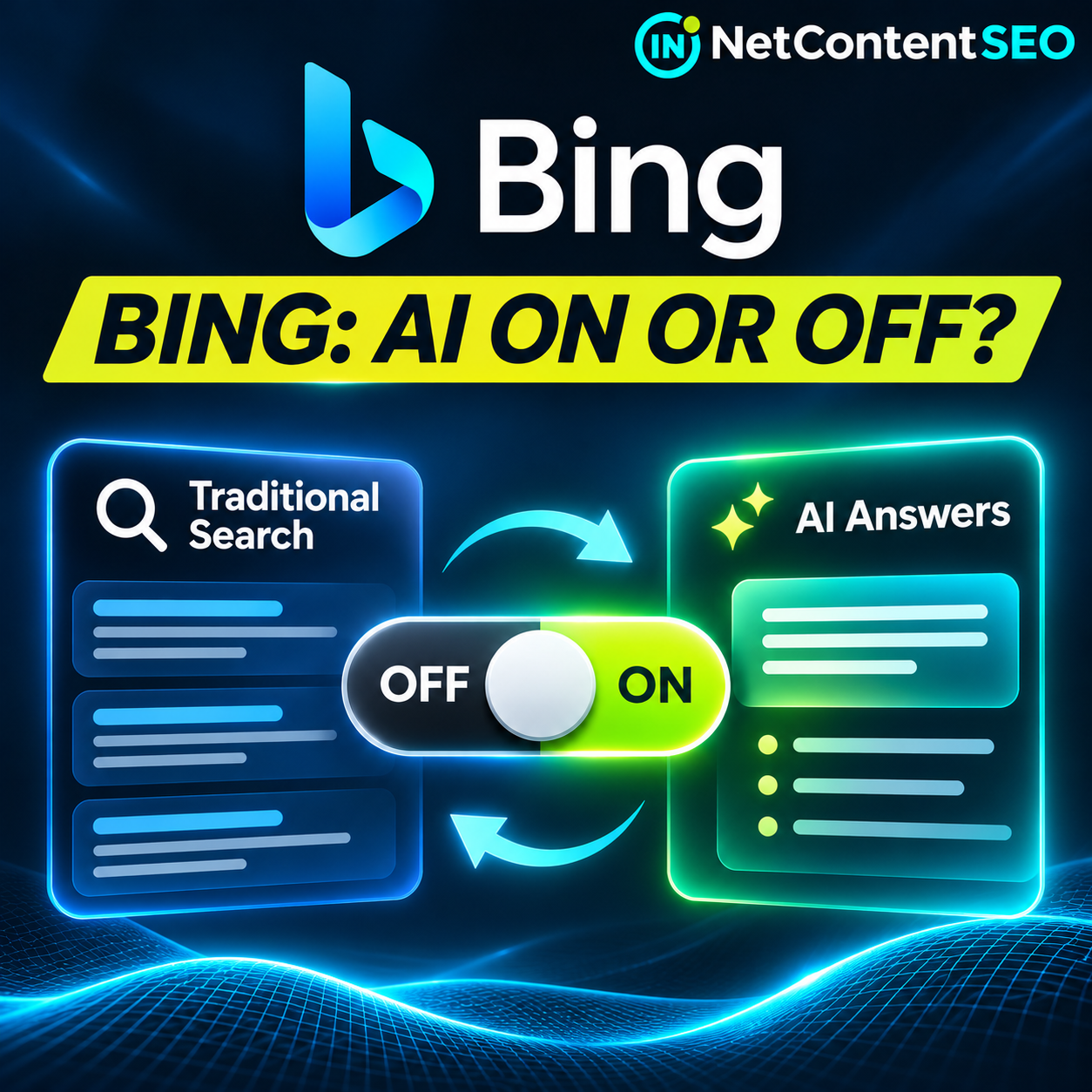

Microsoft is emphasizing a simple principle for Bing Search: users should be able to decide whether they want an AI-generated answer or a familiar list of web results. In an official Bing Search blog post dated November 11, 2026, the company highlights two ways to switch off AI answers: the Microsoft Bing AI Search Choice browser extension and the -ai search operator.
The announcement is relevant to SEO and AI Search because it makes user preference a visible part of the search experience. However, this is not a brand-new feature launched on November 11. The extension and operator were already documented in June 2026, including by Barry Schwartz at Search Engine Roundtable. The new post is an official reaffirmation and explanation of those options, not proof of a new ranking update.
Two ways to turn off Bing AI answers
1. Use the Microsoft Bing AI Search Choice extension
Bing says its preview browser extension lets users enable or disable AI-generated answers using a simple toggle. The preference applies across Bing searches rather than requiring the user to repeat a query modifier every time. Microsoft provides versions for Google Chrome and Microsoft Edge.
There is an important installation detail: Bing explicitly states that the extension also sets Bing as the browser's default search engine. Anyone considering the extension should review that change before installing. It is a preview product, so behavior and supported settings may evolve based on feedback.
2. Add -ai to an individual search
Users who do not want to install anything can add -ai to a Bing query. Microsoft's own example is why is the sky blue -ai. Bing says the operator returns search results without AI-generated answers for that query.
This is the lighter option for occasional comparisons. It does not require a persistent browser preference, extension permissions or a change to the default search engine.
What the November announcement changes—and what it does not
The November 11 blog post reinforces a product philosophy: sometimes a generated summary is useful, and sometimes users prefer to inspect original sources themselves. Microsoft argues that being able to disable AI answers is compatible with continuing to invest in AI-powered search.
But the chronology matters. Search Engine Roundtable covered the extension and -ai operator on June 8, 2026, while PPC Land reported the initial rollout that same month. Presenting November 11 as the first launch would mislead readers.
Nor does the post announce a new organic ranking factor, a new crawler, a change to Bing's AI citation selection, or a change to how publisher content is used for training. It is about the search interface and user control.
AI Overview, AI Mode and traditional results are different experiences
Microsoft's Bing AI search documentation distinguishes AI Overview, which offers a sourced summary alongside search results, from AI Mode, which supports conversational exploration and follow-up questions. Traditional search emphasizes the familiar result list and direct navigation to websites.
The new choice controls focus on AI-generated answers in Bing search results. The announcement does not establish that every AI feature in every Microsoft product is disabled, nor does it provide evidence that the setting changes how a site is indexed. Publishers should avoid treating all Bing AI surfaces as one interchangeable measurement category.
Why this matters for SEO and GEO measurement
For publishers and brands, the most important implication is that two people can search for the same topic and experience different result interfaces. One may encounter an AI-generated synthesis with cited sources; another may see a conventional list of blue links.
That difference can affect where a business is visible, how users assess sources and whether they click through to a website. But the November announcement does not quantify how many Bing users disable AI answers, how often they use the -ai operator, or whether those users click organic results at a higher rate.
It would therefore be premature to claim that the feature increases organic traffic or reduces AI visibility. It creates a testable distinction, not a demonstrated traffic outcome.
A practical comparison test for SEO teams
- Select representative queries. Include navigational, informational, commercial and local queries relevant to the business.
- Run the normal Bing search. Record whether an AI Overview appears, the visible organic links and any cited sources.
- Repeat with -ai. Use the same query with the operator and compare the page layout, organic destinations and result presentation.
- Keep test conditions consistent. Record country, language, device, browser, date and login state. Personalization and experimentation may affect results.
- Distinguish visibility from traffic. A source cited in an AI answer is not the same as an organic click, and a ranking position is not a conversion.
- Repeat over time. Do not infer a universal ranking difference from a single screenshot or test session.
For large-scale reporting, compare these observations with first-party Bing Webmaster Tools data where available. Microsoft's Bing blog has separately announced AI visibility reporting features, but the presence of a user-facing AI toggle does not itself provide a breakdown of traffic by toggle state.
Can publishers optimize for both experiences?
Yes, in the sense that publishers can create content that works as a useful destination in conventional results and as a reliable source for AI-assisted answers. That means accurate facts, descriptive page titles, accessible content, clear entity relationships, original reporting where possible and answers that address realistic follow-up questions.
However, no special -ai markup or ranking optimization has been announced. It would be inappropriate to recommend adding an invented tag or directive to make a website appear more often in the non-AI experience.
Microsoft has separately discussed controls for AI training and grounding. Those are publisher-side policies governing use of content and should not be confused with the user-side option to turn off AI answers.
Does turning off AI answers change the underlying index?
The Bing post does not claim that the extension or operator switches users to a separate web index. It describes changing the search experience shown to the user. Any observed differences in result order should be documented rather than attributed automatically to a new ranking system.
What about browser privacy and user choice?
The extension gives users a persistent preference but also changes the default search engine to Bing. The query operator offers an alternative without an installation. Those trade-offs should be explained clearly, especially in guides aimed at readers who only want to suppress AI answers occasionally.
Microsoft says the extension is in preview and invites feedback. The announcement does not specify when the preference might become a built-in Bing setting available to all users without an extension.
Frequently asked questions
Can you turn off AI answers in Bing?
Yes. Bing officially documents a browser extension for Chrome and Edge and the -ai query operator.
How do I search Bing without AI answers?
Add -ai to the end of your search, such as best hiking boots -ai, or install the preview Microsoft Bing AI Search Choice extension and turn off AI answers.
Is the Bing AI toggle new in November 2026?
No. The extension and operator were reported in June 2026. Microsoft's November 11 post explains and reinforces the existing choices.
Does the extension work in Chrome and Edge?
Microsoft links to official extension listings for both browsers.
Does installing it change my default search engine?
Yes. Microsoft says the extension sets Bing as the default search engine.
Does -ai remove AI features from every Microsoft service?
No such claim is made. The operator is documented for individual Bing search queries.
Does switching off AI answers improve organic rankings?
There is no evidence of a ranking boost. The feature changes the user-facing experience, not a publisher's eligibility to rank.
Can SEO tools measure which users have AI disabled?
The November post does not announce a public metric identifying the share of searchers using the toggle. Third-party estimates would need their own methodology and validation.
The bigger picture: search is becoming a choice of interfaces
As AI-generated answers spread across search engines, the debate is often framed as a permanent transition from links to conversations. Bing's approach suggests a more nuanced reality: users may want a summary for one task and a list of sources for another.
For SEO and GEO teams, the practical lesson is to measure these experiences separately wherever reliable data permits. A cited source, an organic listing, a referral visit and a completed business action are different outcomes. Bing's choice controls make that distinction more visible, but do not settle which experience will dominate.
Sources
- Microsoft Bing Search Blog — Your choice: Turn AI answers on or off in Bing, November 11, 2026
- Search Engine Roundtable — Microsoft Bing Gives Searchers a Way to Disable AI Copilot Answers, June 8, 2026
- PPC Land — Bing now lets you turn off AI search results with one click, June 2026
- Microsoft Bing — Search with AI, official product guide