

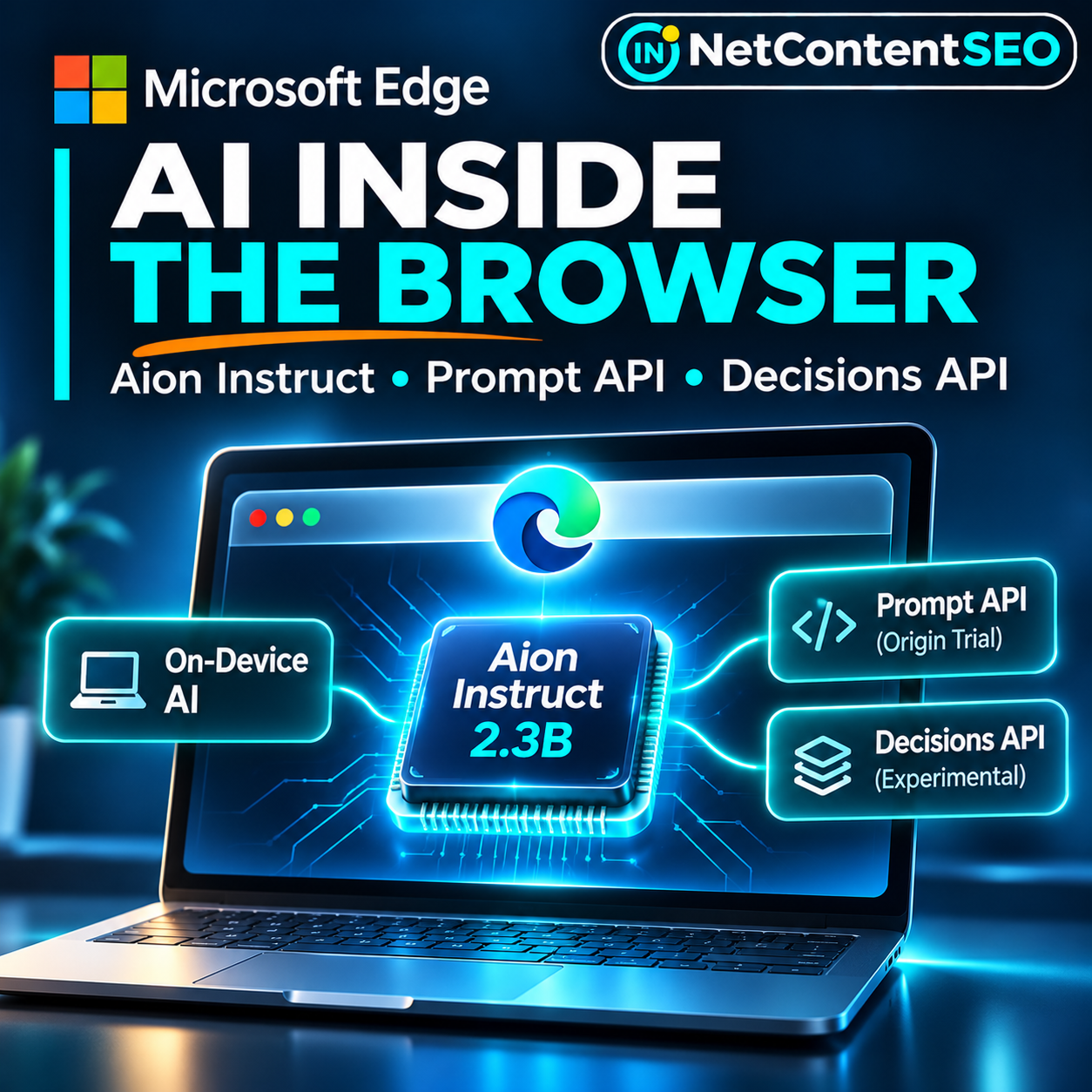

Microsoft is moving generative AI closer to the user by putting a small language model directly inside Edge. On November 19, 2026, the company announced the general availability of Aion Instruct, a 2.3-billion-parameter open-weight model that replaces Phi-4-mini as Edge's built-in small language model. It also opened an origin trial for the Prompt API on live websites and introduced an experimental Decisions API for fast structured classification. For web developers, the opportunity is to run certain AI features locally in a visitor's browser rather than sending every prompt to a remote service.
What Microsoft announced on November 19
In its official Microsoft Edge developer blog, Microsoft presented three related developments. Aion Instruct is generally available as an open-weight model on Hugging Face and as Edge's built-in model. The Prompt API is now available through an origin trial, allowing developers to experiment on public sites rather than only in Edge's preview channels. The Decisions API is a separate experimental developer preview in Edge Canary and Dev.
These are different availability stages. Aion Instruct's general availability does not make every on-device API universally supported by every browser. The Prompt API origin trial is an opt-in test, and the Decisions API remains experimental. Microsoft says Aion is also coming to Windows later in 2026, which is distinct from its present Edge availability.
Aion Instruct: a smaller model for everyday web tasks
At 2.3 billion parameters, Aion Instruct is designed for tasks such as text synthesis, summarization, instruction following and structured output. Microsoft describes it as smaller and faster than Phi-4-mini while offering comparable quality on common web tasks. That comparison is Microsoft's own characterization; developers should benchmark it on their actual workloads and target hardware.
Edge does not automatically download the model for every user. It downloads Aion when a site or feature first needs it and only on devices considered capable of running it well. Users can disable on-device AI in Edge settings, which removes the downloaded model and prevents future downloads. These details matter when designing a reliable product: developers cannot assume the model will always be installed, available or enabled.
Prompt API: AI features in a live website
The Prompt API gives web applications a way to request general-purpose language-model functionality from the browser's on-device model. Previously, Edge limited the API to developer preview use in Canary and Dev. With the new origin trial, sites can register to test it with real users on supported Edge installations.
Potential applications include drafting or rewriting text, summarizing a page, generating concise explanations and assisting with structured content entry. Because the model runs on the device when available, a website can avoid sending some input text to a cloud model for those tasks. However, this should not be interpreted as a blanket privacy guarantee: the surrounding website may still collect data through its own application logic, analytics or other services.
Microsoft recommends a hybrid architecture. A web application should use on-device AI when the model is available and suitable, and fall back to a configured cloud service when it needs broader device coverage or stronger inference. A local model may not have the latest facts or the capability to perform complex reasoning, so cloud retrieval or server-side verification may still be necessary.
Decisions API: structured answers without generating text
The experimental Decisions API approaches AI from a different direction. Rather than asking the model to compose prose, a developer can ask boolean, multiple-choice or numerical scoring questions about a text input. The API returns probabilities and confidence information in a single pass without generating an explanatory paragraph.
Microsoft demonstrates the concept with a product review: a website can ask whether the comment concerns quality, shipping or price, how satisfied the customer seems and whether a reply is needed. This could be useful for categorization, triage, intent detection and routing. The API is currently a developer preview in Edge Canary and Dev, and Microsoft explicitly warns that the interface and implementation may change.
Probabilities are not proof of correctness. Developers should validate results, calibrate thresholds, monitor mistakes and avoid using unverified model scores as the sole basis for consequential decisions.
What changes for web architecture?
Traditional AI-enhanced websites often send a user request to a server, which calls an external model API and returns the result. Browser-native inference introduces another option: the frontend can perform lightweight AI work locally while the server remains responsible for authoritative data, permissions and tasks requiring larger models.
That separation can reduce some network requests and potentially lower inference costs for suitable tasks. It may also improve responsiveness when local execution is efficient. But performance depends on the user's hardware, model-download time, browser implementation, task complexity and fallback behavior. A 2.3B model is not automatically faster than a remote service on every device.
Developers should also consider battery use, memory pressure, accessibility, transparent user controls and compatibility across browsers. The strongest implementation treats on-device inference as a capability to detect rather than a requirement every visitor must satisfy.
SEO implications: no new ranking signal
Microsoft has not announced a change to Bing's organic ranking system. Aion Instruct and the Prompt API are developer-facing browser technologies. Installing a local AI feature does not automatically improve a page's position in Google or Bing, and the release does not introduce a new AI Search citation requirement.
The potential SEO value is indirect. A website might offer more helpful on-page assistance, make large amounts of information easier to navigate or support users who need explanations in a different form. Those features could improve the visitor experience if implemented well, but any effects on engagement, conversions or organic traffic require measurement.
Conversely, relying on AI-generated browser content for essential information could create problems for discoverability and accessibility. Important editorial text, product facts, prices and navigational links should remain available in standard, accessible page content rather than existing only after an optional model download or client-side generation.
AI Search and GEO: a shift in where intelligence runs
AI Search discussions often focus on centralized assistants that retrieve websites, synthesize answers and cite sources. Edge's approach highlights another possibility: some intelligence can live inside the browser while the website supplies authoritative content and interaction logic.
For example, a travel publisher might provide a locally generated summary of a long guide while keeping official transport information and current access rules on its server. An ecommerce site might classify a visitor's product question locally before querying a live catalog. These are architectural examples, not newly announced Edge products or measured SEO outcomes.
The distinction between inference and retrieval remains essential. An on-device model can interpret text, but it does not automatically know current regulations, business opening hours or recent news. Applications that answer time-sensitive questions still need trustworthy sources, explicit freshness checks and appropriate attribution.
How to evaluate the technology safely
- Register for the Prompt API origin trial: follow Microsoft's developer documentation and confirm the browser versions and enrollment requirements.
- Detect availability: check whether the browser supports the API and whether the device can run the model, rather than assuming support.
- Choose bounded tasks: start with summarization, drafting or categorization where errors can be reviewed easily.
- Provide a fallback: preserve the site's core functionality when the local model is disabled, unavailable or insufficient.
- Protect user data: disclose relevant processing, avoid unnecessary collection and keep authorization and business rules outside the model.
- Benchmark real devices: measure first-use download delays, latency, memory use, energy impact and task accuracy.
- Keep essential content accessible: publish important information as ordinary HTML and treat AI as an enhancement, not the sole delivery mechanism.
Why independent builders should pay attention
The announcement is particularly relevant to teams developing lightweight AI products or self-hosted applications. Browser-native inference could handle selected tasks at the edge, while an independent backend supplies search, verified facts and more capable models when needed. That can create a modular design rather than forcing every interaction through one large remote model.
However, an Edge-specific origin trial is not yet a universal web standard. A production application should plan for cross-browser behavior and avoid making a critical workflow dependent on an experimental API. Developers can evaluate the technology today without assuming that its final standardized form or long-term support is settled.
What remains uncertain
Microsoft has not demonstrated that every supported device will run Aion at the same speed, nor that its model will match larger cloud models on complex tasks. The Prompt API is still being evaluated for interoperability and standardization, while the Decisions API may change substantially. No evidence in the announcement establishes a direct increase in search visibility, AI citations or organic traffic.
The bigger picture
Aion Instruct and Edge's new APIs represent a practical step toward hybrid intelligence on the web: lightweight local models for suitable tasks, backed by cloud inference and reliable retrieval when required. For SEO and AI Search professionals, the important development is not a new ranking factor but an expanding set of ways websites can help visitors understand and act on information. The best implementations will preserve trustworthy content, user control and cross-browser accessibility while using local AI where it genuinely improves the experience.
Primary source: Microsoft Edge Blog, “Hybrid intelligence on the Web: Introducing Aion Instruct and Prompt API in Microsoft Edge,” November 19, 2026.