

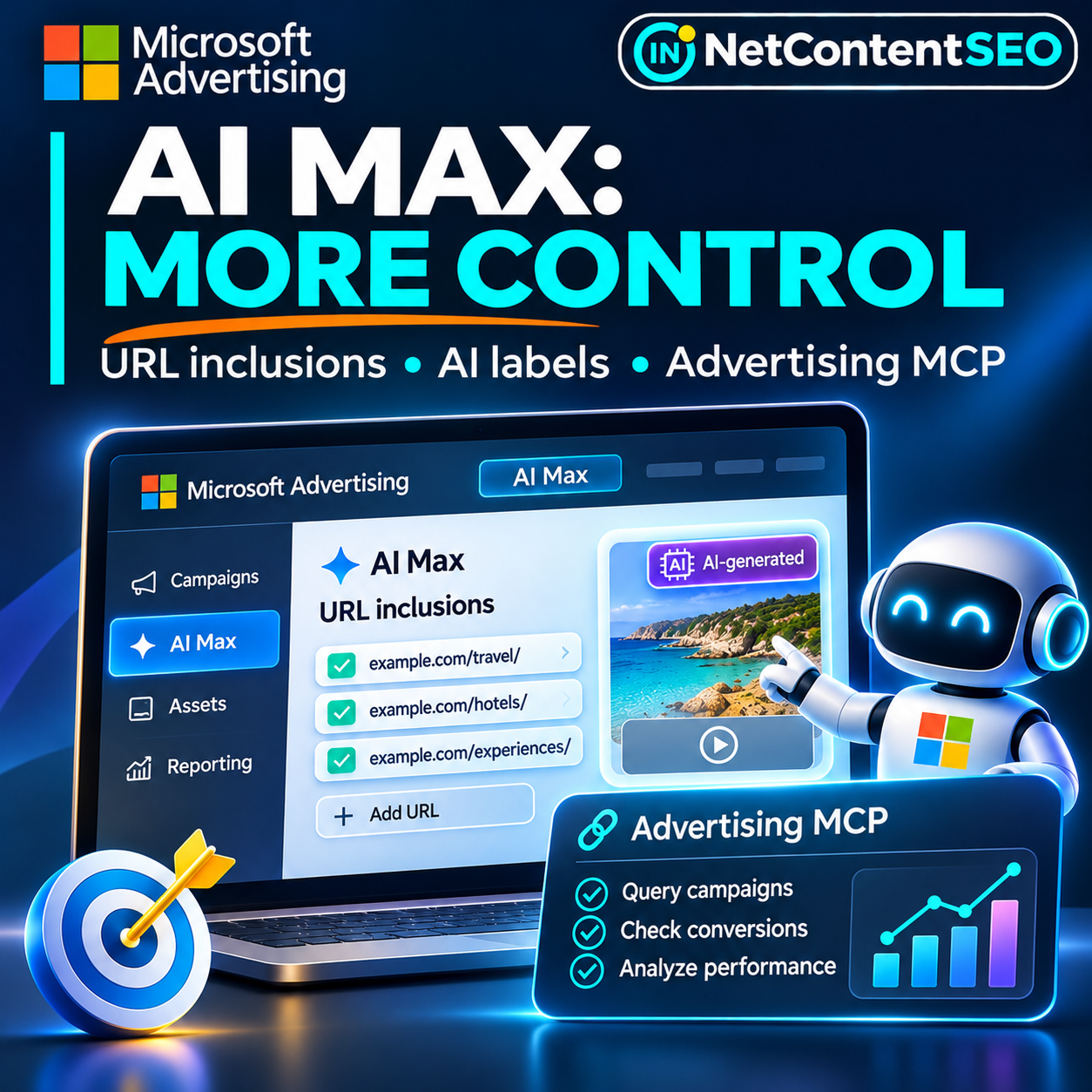

Microsoft Advertising is giving advertisers more control over AI-driven Search campaigns while expanding how AI assistants can inspect campaign performance. In its November 19, 2026 product update, Microsoft introduced URL inclusions for AI Max, made AI-content transparency controls generally available, and expanded the analytical use cases supported by its Advertising Model Context Protocol (MCP) server. The announcement concerns paid advertising, not Bing's organic search ranking algorithm.
AI Max URL inclusions: a more precise way to steer automation
The most strategically important addition is URL inclusions for AI Max's final URL expansion feature. AI Max already uses signals from keywords, ads and landing pages to match relevant searches, customize ad text and select destination pages. With URL inclusions, advertisers can specify which parts of their websites the system should use both as traffic destinations and as source material for AI-generated text and search-term matching.
Microsoft's official November update gives an example of a home-goods retailer directing holiday campaigns toward its gift guides. The pages are not merely destinations: they also help inform the ad messaging and intent matching. The feature is rolling out, rather than being confirmed as available in every account.
Why selecting the right URLs matters
Automated URL expansion can be useful when a website has many products, services or editorial landing pages. But without appropriate controls, the advertiser may want to prevent a campaign from emphasizing pages unrelated to its objective. URL inclusions offer a way to steer AI Max toward the sections that best represent the intended offer.
Consider a travel business with separate sections for accommodation, tours and general destination information. A hotel-focused campaign might benefit from directing the AI system toward relevant accommodation pages rather than every article on the domain. This is an illustrative use case, not evidence of an automatically improved return on ad spend. Performance should be measured against comparable campaigns or controlled experiments.
URL inclusions also differ from a conventional SEO sitemap or canonical tag. They are an advertising configuration that guides AI Max's campaign behavior. They do not instruct Googlebot or Bingbot how to rank organic pages, and they do not guarantee that every included URL will receive traffic.
AI-generated image and video labels become generally available
Microsoft also announced general availability for AI content transparency controls. Advertisers can declare whether an image or video contains AI-generated material and, where supported, choose a visible watermark. They can manage declarations individually or at scale through Ads Studio Library, Microsoft Advertising APIs and product feeds.
According to Microsoft, these controls apply across supported Product, Multimedia, Audience, Display and Video ads, as well as Performance Max assets. Exact behavior and watermark options vary by format, placement and workflow. Microsoft provides AI-detection signals for supported assets as a reference, but the advertiser remains responsible for accurate declarations and compliance with applicable disclosure rules.
This is a meaningful distinction: a platform's detection suggestion is not a definitive legal determination, and the presence of an AI label does not automatically establish whether a creative is misleading or compliant. Advertisers should review both the content and the relevant market requirements.
Microsoft Advertising MCP expands conversational campaign analytics
The third development concerns the Microsoft Advertising MCP server, which connects supported AI assistants such as Copilot, ChatGPT and Claude to authorized Microsoft Advertising account data. The server has been in open pilot since July 2026; the November announcement expands the types of questions and analyses that advertisers can perform, rather than marking a new general-availability launch.
Advertisers can ask natural-language questions about creative performance, conversion tracking, targeting configurations, campaign trends, policy reviews and account changes. A marketer might ask how a seasonal campaign performed compared with the previous week or whether a conversion-tracking configuration requires attention. The MCP connection provides access to account data under the applicable permissions; the assistant interprets that information for the user.
The operational benefit is potentially substantial: analysts can investigate multiple performance questions without manually navigating through every reporting screen. But AI-generated interpretations still require validation. A plausible explanation for declining conversions is not necessarily a proven cause, and campaign changes should be reviewed before execution.
What changed compared with earlier AI Max releases?
Microsoft made AI Max broadly available in August 2026, introducing AI-powered search-term matching, text customization and final URL expansion for Search campaigns. Existing controls included brand inclusions and exclusions, negative keywords, budgets and bidding settings. In October, Microsoft introduced messaging guidelines in open pilot to help advertisers guide the wording of generated ads.
November's URL inclusions extend that direction from brand messaging into page selection and source selection. Combined with campaign reporting and MCP-based analysis, the updates illustrate a shift toward automation that advertisers can guide, inspect and evaluate rather than treating as an opaque system.
Implications for paid search and AI-powered advertising
The immediate consequences are for paid search practitioners. Campaign teams now have another mechanism for aligning generated messaging and landing-page selection with business intent. Teams can also formalize how AI-generated visual assets are declared, and use authorized conversational analytics to explore campaign results.
These capabilities may be especially relevant as advertising becomes integrated into AI-assisted discovery experiences. However, URL inclusions should not be confused with guaranteed placement in AI-generated answers, and Microsoft has not announced that selecting particular pages automatically improves ad rank or conversion performance.
What this means for SEO and GEO
There is no direct organic ranking update here. AI Max URL inclusions operate inside Microsoft Advertising campaigns, not the organic Bing index. Advertising MCP retrieves authorized campaign data; it does not provide a new method for influencing AI Search citations.
There is nevertheless an indirect connection between content quality and paid-search automation. When an advertising system uses landing-page content to inform targeting and copy, accurate, specific and well-organized page information becomes operationally important. Pages should clearly communicate the offer, its conditions, pricing where relevant and the next action. Those qualities benefit human visitors as well, but any campaign-performance gains must be demonstrated with data.
For GEO practitioners, this announcement is also a reminder to separate three different outcomes: organic visibility in AI-generated answers, paid ad placement around AI experiences, and agent-assisted management of advertising accounts. They may coexist in a search journey, but they have different controls and measurement systems.
A practical checklist for advertisers
- Audit campaign landing pages: identify the site sections that genuinely match each campaign's objective, and check that the information is current.
- Test URL inclusions: when the feature reaches the account, compare landing-page distribution, query relevance, conversions and cost against a suitable baseline.
- Review AI-generated copy: ensure generated claims accurately reflect the selected pages, pricing and business policies.
- Declare AI-generated assets: use the transparency controls and verify which ad formats support visible labels or watermarks.
- Connect MCP carefully: grant appropriate account access, validate reported metrics and keep approval controls for consequential account changes.
- Measure actual outcomes: examine conversion quality, CPA, ROAS and incremental value rather than assuming more automation produces better results.
What remains uncertain?
Microsoft has not specified that URL inclusions are available in every advertiser account immediately, nor has it published independent evidence that the new control improves conversion rates. The Advertising MCP server remains in open pilot, and supported workflows may change. Transparency settings also vary across advertising formats and jurisdictions.
It is therefore premature to claim that these updates alter organic rankings, guarantee visibility beside AI-generated answers or remove the need for human review of advertising decisions.
The bigger picture: more automation, more governance
Microsoft Advertising's November release shows how AI-powered campaign management is evolving in two directions at once: systems can make more decisions automatically, while advertisers gain more explicit controls over the information, creative assets and account data involved. URL inclusions are particularly notable because they connect campaign intent to selected website content. For search marketers, the opportunity is to use that control deliberately, test the results and maintain a clear boundary between paid-media optimization and organic SEO.
Primary sources: Microsoft Advertising, November 19, 2026; AI Max launch, August 27, 2026; October 2026 campaign controls; Microsoft Advertising MCP server.