

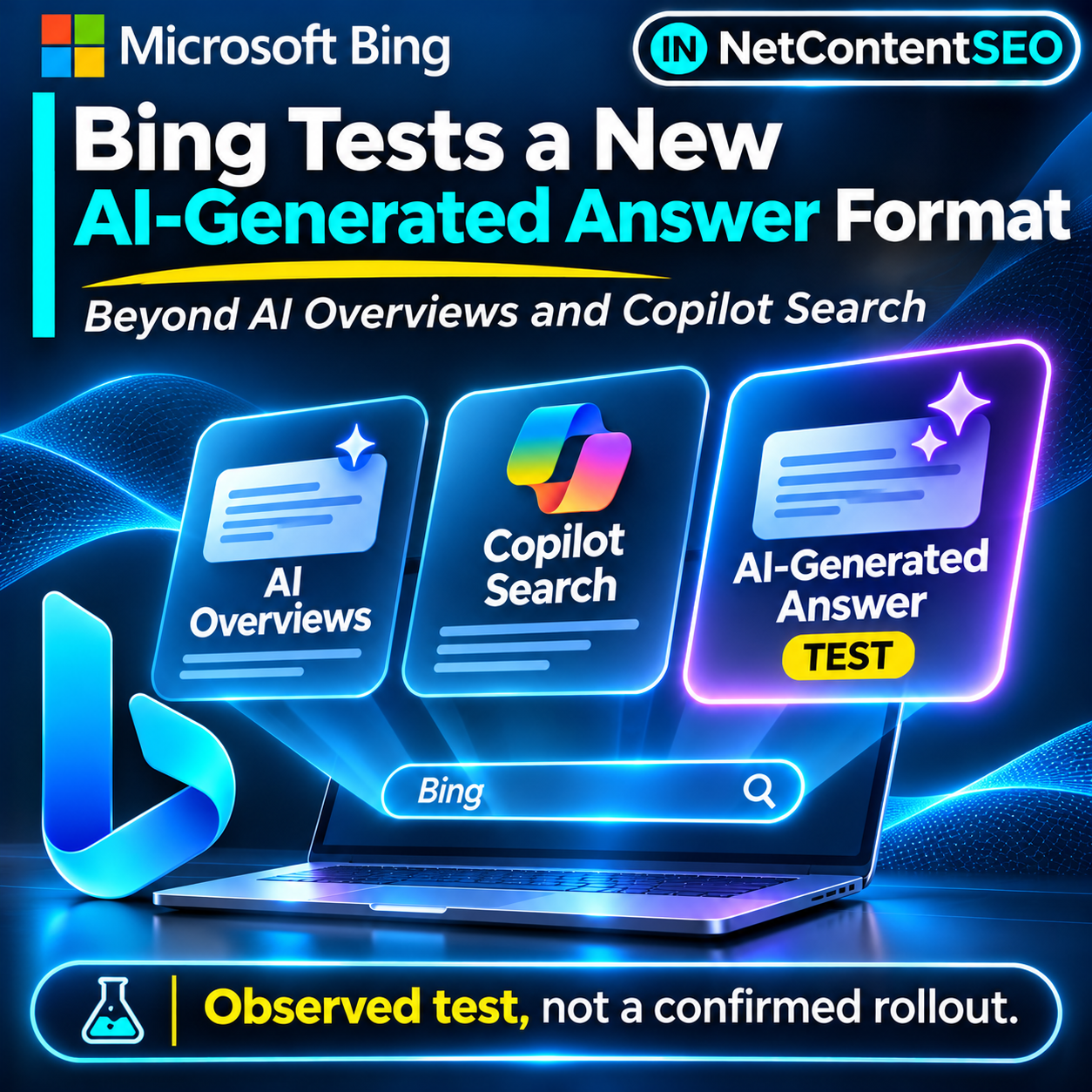
Microsoft Bing is experimenting with another presentation of AI-generated information in search results. On November 24, 2026, Barry Schwartz at Search Engine Roundtable documented a standalone answer card, reproducing the observation on mobile and desktop after an initial report by Venkat. The format appears visually distinct from existing AI Overviews and Copilot Search experiences, but Microsoft has not confirmed a separate underlying system.
What has been observed?
The card identifies the summary as AI-generated and directs readers to supporting information through Learn more links. Its independent presentation makes it worth tracking as a distinct interface variant. The available evidence does not establish how frequently it appears, which queries trigger it or whether it will become generally available.
Three presentations to monitor
Generated summaries within search results.
AI-assisted search experience.
Observed standalone summary card with source links.
TESTConceptual comparison of interface presentations, not evidence of three independent models or retrieval systems.
Why interface differences matter for GEO
A brand can be mentioned in generated text, linked as supporting evidence or displayed in conventional organic results. These outcomes are not interchangeable. Different layouts may change how easily readers notice and follow a citation even if the underlying information remains similar. Whether this experiment changes source selection or click-through rates remains unknown.
A practical measurement framework
Record the visible format alongside each sampled query, rather than treating every Bing AI answer as one homogeneous surface. The following dimensions can help separate presentation effects from other forms of variation.
| Metric | Observation |
|---|---|
| Format frequency | Share of sampled searches displaying each identifiable format |
| Citation frequency | Share of answers in each format linking to the target domain |
| Source overlap | Common linked URLs across comparable answers |
| Citation placement | Visibility and interaction required to reach supporting links |
| Referral traffic | Visits and conversions where attribution is available |
Use repeated observations across comparable devices, markets and query types. Report sample sizes and preserve the distinction between a missing AI answer and an answer that does not cite the target website. These metrics are editorial proposals, not official Bing ranking signals.
AI answers are also a user choice
In a separate November 11 announcement, Microsoft described options for users who prefer search results without AI answers, including a browser extension in preview and the -ai search operator. This creates another condition to record during testing. It does not confirm the purpose or architecture of the November 24 card.
What publishers should do now
Maintain accessible, accurate and well-structured pages that address specific information needs. Review actual source links and whether the cited material supports the associated statements. Avoid changing content strategies solely because a new interface label has appeared. There is currently no evidence of a new organic ranking factor or a required optimization technique for this card.
The bottom line
Bing's observed experiment illustrates why generative search monitoring should capture presentation as well as citations. A third visible format is not necessarily a third search engine. Until Microsoft provides further information, track it as an experimental variant and evaluate its impact using reproducible observations rather than assumed changes to ranking or traffic.