

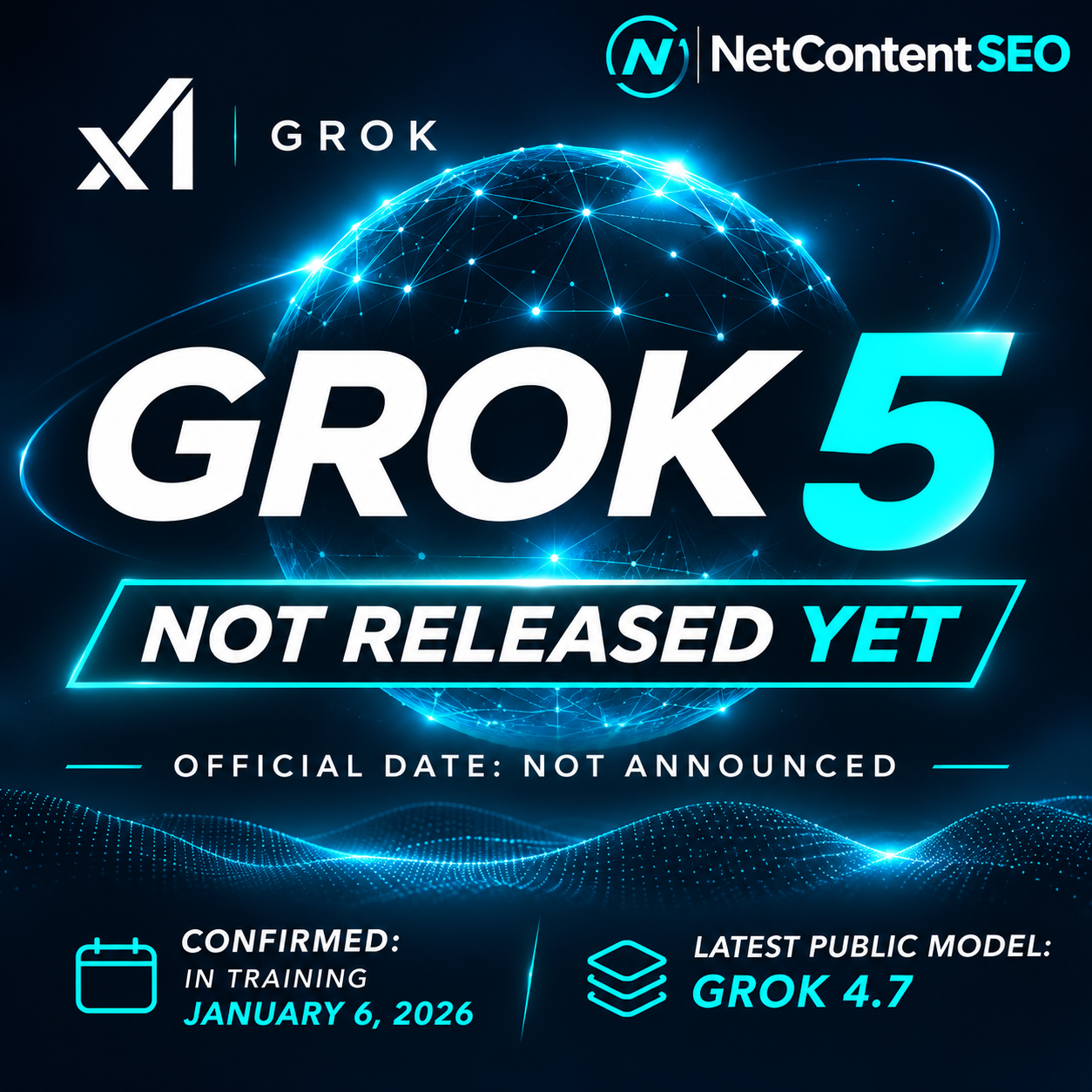

Grok 5 is not publicly released as of November 13, 2026, and xAI has not published an official launch date. That is the most important distinction in the growing volume of headlines about the next generation of Elon Musk's AI model. Grok 5 is a confirmed project, but confirmation that a model is being trained is not the same thing as an announcement that developers or consumers can use it.
The question resurfaced in a November 12 Kingy AI status report, which checked xAI's published announcements and developer documentation. Its conclusion is consistent with the official evidence: xAI has named Grok 5, but its public model catalog still identifies Grok 4.7 as the flagship model.
Is Grok 5 out yet?
No public Grok 5 release is documented as of November 13, 2026. xAI's official model catalog currently identifies grok-4.7 as its flagship text-and-image model. There is no Grok 5 model entry or published Grok 5 API identifier in the pages reviewed for this article.
That conclusion has a narrow, important scope: it concerns the public release and public documentation. It does not prove that xAI has never run private internal tests, or that a limited test is impossible. Neither possibility should be presented as a released product without evidence.
What has xAI actually confirmed about Grok 5?
The strongest primary-source confirmation appears in xAI's January 6, 2026 Series E funding announcement. The company stated that Grok 5 was in training while outlining its plans to expand computing infrastructure and develop new AI products. The announcement did not give a release date, API name, context-window size, price or benchmark results.
This distinction matters because many articles and social posts combine three different kinds of information: official product documentation, comments attributed to Musk, and predictions made by third parties. Only the first establishes what xAI has formally published about the model's availability.
Grok 5 release-date timeline: confirmed versus reported
| Date | Development | Evidence status |
|---|---|---|
| January 6, 2026 | xAI says Grok 5 is in training. | Official xAI statement. |
| July–September 2026 | xAI releases successive Grok 4-series updates, culminating in Grok 4.7. | Official product documentation and release information. |
| September 21, 2026 | Grok 4.7 becomes publicly available through the xAI API. | Official release and model documentation. |
| November 10, 2026 | Secondary reporting describes Musk discussing a potential limited Grok 4.8 rollout and a later Grok 5. | Reported remarks, not a dated Grok 5 launch announcement. |
| November 12–13, 2026 | Public xAI documentation still lists Grok 4.7 as the flagship, with no Grok 5 release date. | Public-documentation check. |
Some coverage references earlier targets for a late-2025 or 2026 launch. Those are historical expectations or reported statements, not an official date that remains valid today. A specific month or quarter should not be treated as confirmed until xAI publishes it.
What is the newest Grok model available today?
According to the official xAI developer model page, the newest publicly listed flagship is Grok 4.7, available as grok-4.7. Its published specifications include a 500,000-token context window, text and image input, and configurable reasoning.
At the time of the checked documentation, standard API pricing is listed as $2 per million input tokens and $6 per million output tokens. These prices apply to Grok 4.7, not to Grok 5. Developers should check current pricing and context-specific tiers before budgeting production workloads, since API pricing can change.
Voice and image-generation products have separate models and pricing. The existence of a newer voice or image product does not establish that Grok 5 has been released.
What about Grok 4.8 and Grok 4.9?
Secondary reporting on Musk's recent comments describes Grok 4.8 and Grok 4.9 as possible intermediate releases before Grok 5. A November 10 GrokShelf report describes an intended soft rollout of Grok 4.8 to some Grok Bot users. That report should not be confused with an official API launch or with proof that Grok 5 is ready.
There are several separate milestones in model development: pretraining, post-training, internal evaluation, limited testing, product integration and public API availability. A model may advance through some stages without reaching all of them, and dates can move. Until xAI updates its release notes or model catalog, an anticipated version remains distinct from a documented public release.
What do we know about Grok 5's capabilities?
Very little has been officially specified. xAI has not published a verified Grok 5 model card with its architecture, parameter count, context window, benchmark scores, multimodal features, tool-use capabilities or pricing. Figures such as a proposed six-trillion-parameter size appear in coverage of Musk's comments, but they should not be treated as an independently validated final specification.
Similarly, claims that Grok 5 will achieve artificial general intelligence or outperform all competitors are predictions, not demonstrated benchmark outcomes. Meaningful comparisons will require a released model, reproducible evaluations, documented settings and comparable workloads.
Will Grok 5 be available through the xAI API?
There is no public Grok 5 API identifier, pricing schedule or availability date in the official model documentation checked on November 13. Developers should not hardcode an imagined grok-5 endpoint into production systems or assume that a future product will preserve the same rate limits, tool support or input formats as Grok 4.7.
A safer integration strategy is to keep the model name configurable, monitor the official release notes, run regression tests when a new version appears and retain a working fallback until the new model is validated against real tasks.
Why Grok 5 matters for SEO and AI Search
For search professionals, the important question is not only whether a new model scores higher on reasoning benchmarks. It is whether the model changes how Grok retrieves information, selects sources, cites webpages and uses tools to complete tasks. None of those changes can yet be measured for a public Grok 5 release, because the public model is not available.
xAI's documentation for Grok 4.7 explicitly distinguishes model knowledge from access to current information. The model page notes that current events require enabled search tools, such as Web Search or X Search. That distinction is crucial for AI visibility research: a model's training data, its retrieval tools and its final citations are separate layers.
Even if Grok 5 improves reasoning, it would not automatically imply better indexing, higher citation frequency or increased website referrals. Those outcomes depend on retrieval behavior, product design, source availability and user intent, and they must be tested after launch.
A practical AI Search testing plan for launch day
Publishers and SEO teams can prepare a repeatable benchmark now rather than trying to infer results from marketing claims later:
- Freeze a baseline: record how the currently available Grok version responds to 20–50 representative branded, informational and transactional queries.
- Capture the environment: note the product surface, model label, date, geography when relevant and whether Web Search or X Search is enabled.
- Separate dimensions: measure factual accuracy, entity recognition, source citations, source prominence, answer completeness and follow-up task completion individually.
- Check source quality: distinguish official brand pages, independent publications, social posts and unattributed statements.
- Repeat on the same prompts: once Grok 5 is officially accessible, rerun the baseline without silently changing the query set.
- Measure business outcomes: keep citation presence separate from referral clicks, qualified leads and conversions.
- Report uncertainty: disclose small samples, personalization, prompt variability and differences between product surfaces.
This methodology avoids a common GEO mistake: interpreting one favorable screenshot as evidence that a new model has systematically changed visibility.
How to verify a Grok 5 launch without relying on rumors
Start with xAI's official news page and developer release notes. Then check the model catalog for a documented model identifier, context window, supported modalities and pricing. If a product UI offers a new model before the API does, record the exact product and access conditions rather than describing it as universally available.
For developers, the final confirmation is an authorized, successful request using the documented model identifier and API. A screenshot, leaked model name or third-party router listing may be useful evidence of testing, but it is not a substitute for official availability and terms.
Frequently asked questions
Is Grok 5 released?
No public release is documented as of November 13, 2026.
What is the official Grok 5 release date?
xAI has not announced one.
Has xAI confirmed Grok 5 exists?
Yes. Its January 6, 2026 funding announcement explicitly said Grok 5 was in training.
What is the latest available Grok model?
Grok 4.7 is the newest publicly listed flagship in the xAI developer documentation checked for this article.
Can developers use Grok 5 through the API?
No public Grok 5 API model identifier or release has been documented.
How much will Grok 5 cost?
No official Grok 5 price has been announced.
How large is Grok 5's context window?
Not officially specified. Grok 4.7's documented context window is 500,000 tokens, which should not be assumed for Grok 5.
Will Grok 5 have six trillion parameters?
That figure appears in reporting about Musk's comments, not in a verified public Grok 5 technical specification.
Is Grok 4.8 already Grok 5?
No. The names refer to distinct proposed model versions, and reported limited tests do not establish a Grok 5 launch.
Will Grok 5 improve AI Search citations?
There is no public Grok 5 dataset supporting that claim. Retrieval, citations and referral outcomes must be measured once the model is available.
The bottom line
Grok 5 is confirmed as a model under development, but its release date, public availability, specifications and price remain unannounced. The reliable reference point is xAI's January training statement and its current model documentation, which still identifies Grok 4.7 as the public flagship. For users and developers, that means planning around what is available now. For SEO and AI Search researchers, it means preparing rigorous before-and-after tests rather than promoting speculative launch dates as facts.
Sources
- xAI — Series E funding announcement, January 6, 2026 (primary confirmation of Grok 5 training).
- xAI — Official models and pricing documentation (current public model listing).
- xAI — Developer release notes (public release tracking).
- Kingy AI — Grok 5: Is It Out Yet? What xAI Has Confirmed So Far, November 12, 2026.
- GrokShelf — Grok 4.8 and Grok 5 release dates: what Musk says, November 10, 2026 (secondary reporting, not official release confirmation).