
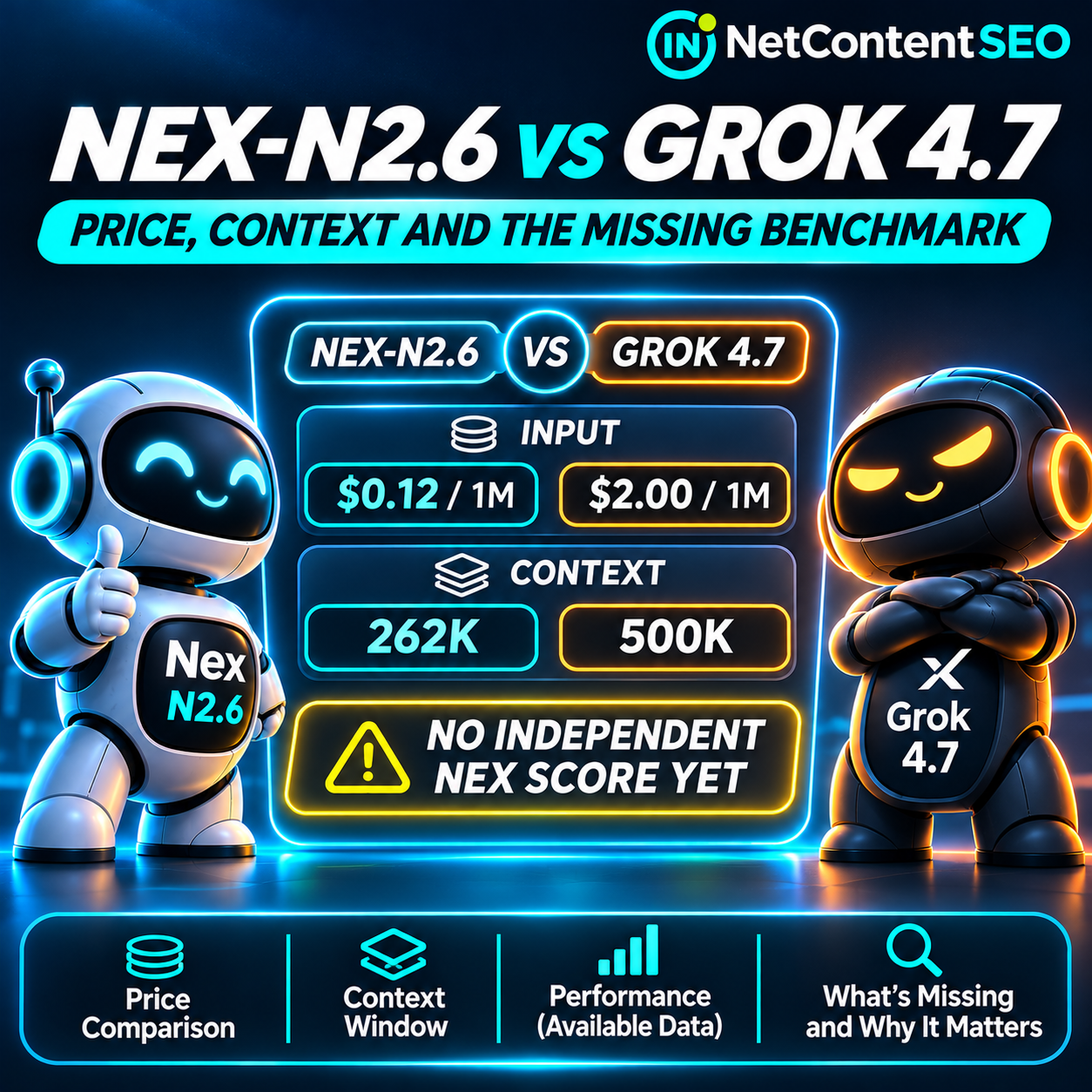
November 10, 2026. A newly released agentic model is drawing attention for a striking price difference with Grok 4.7. Nex-N2.6 is listed at $0.12 per million input tokens and $0.40 per million output tokens, while Grok 4.7 costs $2 and $6 respectively at its standard tier. That makes Nex roughly 16.7 times cheaper on input and 15 times cheaper on output. But the biggest difference may not be price: Grok 4.7 has public benchmark results, while Nex-N2.6 has not yet established a comparable independent performance record.
The comparison was prompted by OrcaRouter's November 10 analysis. We checked its central claims against the Nex-N2.6 model listing, Grok 4.7 API documentation and Grok 4.7 launch announcement. The result is not a winner-takes-all model ranking. It is a practical look at cost, context, tool use and the evidence developers need before choosing a model for AI agents and search workflows.
What are Nex-N2.6 and Grok 4.7?
Nex-N2.6 is an agentic model from Nex AGI, released on November 10, 2026. OpenRouter describes it as built on GLM-5.3-Flash with approximately 321 billion parameters and designed for computer use, coding and longer-running tasks involving tools. Its provider claims it reduces repetitive reasoning and follows the tools available in its environment more closely than Nex-N2.5-Pro. Those are vendor descriptions, not independently established performance gains.
Grok 4.7 was introduced on September 21, 2026. Its developer positions it for coding, agentic tasks and professional knowledge work. It has a documented API, several reasoning-effort settings and publicly reported evaluations. It is a proprietary hosted model, while the accessible Nex listing points to model weights whose public download and licensing conditions should be verified separately.
Nex-N2.6 vs Grok 4.7: verified specifications
| Specification | Nex-N2.6 | Grok 4.7 |
|---|---|---|
| Release date | November 10, 2026 | September 21, 2026 |
| Input price / 1M tokens | $0.12 promotional listing | $2.00 standard tier |
| Output price / 1M tokens | $0.40 promotional listing | $6.00 standard tier |
| Context window | 262,144 tokens | 500,000 tokens |
| Inputs | Text and images | Text and images; file support documented |
| Output | Text | Text |
| Tool calling | Listed as supported | Documented API capability |
| Structured outputs | Listed as supported | Documented API capability |
| Independent benchmark coverage | No comparable public result verified at publication | Published third-party evaluations available |
Prices are snapshots and can change. OpenRouter shows Nex-N2.6's promotional rates as 20% below struck-through prices of $0.15 input and $0.50 output per million tokens. That discount matters when estimating costs after a promotion ends. Grok also documents higher-context pricing for requests exceeding its 200,000-token threshold; consult the current API pricing terms before modeling very long requests.
How much cheaper is Nex-N2.6 in practice?
At the advertised rates, a request with 100,000 input tokens and 10,000 output tokens costs approximately $0.016 on Nex-N2.6 and $0.26 on Grok 4.7, before any other fees or discounts. The calculation is straightforward: multiply input and output tokens by their respective prices per million. That is a 16.25-fold difference for this particular token mix.
For a smaller task using 10,000 input and 2,000 output tokens, the nominal token charges are about $0.002 on Nex and $0.032 on Grok. At a thousand such calls, the difference becomes approximately $2 versus $32 in raw token fees. These examples exclude caching, retries, infrastructure overhead, external tools, provider fees and any long-context price tiers.
Cheap tokens do not necessarily mean cheap successful outcomes. If a model makes more tool-call errors, requires extra attempts or produces answers that need human correction, its apparent savings can disappear. The useful metric is cost per correctly completed task, not simply cost per million tokens.
What does Grok 4.7's larger context window buy?
Grok 4.7 supports up to 500,000 tokens of context, compared with Nex-N2.6's 262,144. That is approximately 1.9 times the capacity. The difference may matter for agents processing large repositories, extensive documentation, long investigations or multi-step workflows that accumulate a substantial history.
However, a larger context window is not a guarantee of better comprehension or retrieval accuracy. Models can miss details even when the entire document technically fits. A retrieval-augmented system using smaller, relevant passages may outperform an oversized prompt on some tasks and cost less to operate.
For an AI search pipeline, a 500K context window may be useful when comparing many documents in one request. For a focused query that retrieves five short passages, the extra capacity may offer little value. Test realistic prompt lengths before paying for the larger limit.
The missing score: why benchmark coverage matters
OrcaRouter's central caution is sound: there is no independently verified, directly comparable Nex-N2.6 score in the reviewed material. That is different from saying the model performs badly. It means the evidence is insufficient to rank it against Grok 4.7 on reasoning, coding, tool use or agent success.
Grok 4.7 has a more substantial public evaluation trail. Its launch announcement includes developer-reported results such as 46.3% on CursorBench 4.0 and 37.6% on Terminal-Bench 4.0. Independent model databases also report third-party evaluations. But benchmark versions, effort settings, harnesses and dates matter. A score from one benchmark revision should not be subtracted from a score obtained under another revision.
OrcaRouter cites an Artificial Analysis Intelligence Index score of 35 for Grok 4.7 under version 5.0.1 and warns that an older score of 46 belonged to version 4.3.2. Those are not directly comparable numbers. More importantly, neither figure provides a score for Nex-N2.6. A fair head-to-head comparison will require the same evaluation tasks, harness settings, budget constraints and grading criteria.
Tool use and agent reliability
Both models are positioned for workflows that interact with external tools. Nex's listing advertises function calling and JSON-schema structured outputs. Grok 4.7's API documentation also supports function calling and structured responses. These features make it possible to build agents that search databases, retrieve documents, call APIs or write structured results.
The presence of a tool-calling interface does not establish reliable tool use. A model can emit valid JSON yet select the wrong tool, misunderstand an API response, loop unnecessarily or fail to finish a multi-step task. Nex's claimed improvement in reducing repetitive reasoning is especially relevant here, but needs reproducible testing.
Before choosing either model, evaluate the complete workflow: task completion rate, number of tool calls, invalid arguments, recovery after failures, hallucinated sources, latency, total tokens and manual intervention.
What this means for AI Search and GEO
The connection to SEO is primarily agent economics and source-processing reliability. AI search products often combine retrieval, summarization, comparison and follow-up tool calls. Lower model costs could make it more economical to run repeated queries, compare more documents or maintain specialized agents. A larger context window could help with particularly document-heavy tasks.
Neither specification proves better search relevance, stronger citation accuracy or more trustworthy recommendations. Those outcomes depend on retrieval quality, source freshness, ranking and filtering logic, grounding, prompt design and the model's ability to use evidence correctly.
There is no verified evidence that Nex-N2.6 changes rankings on Google or Bing, or that Grok 4.7's higher API price makes a brand more likely to be cited. GEO professionals should not equate an agent's reasoning benchmark with a publisher's visibility in public AI answers.
A practical test for publishers and SEO agencies
Instead of asking which model is universally better, build a small, repeatable evaluation that reflects real work:
- Define the task set. Include 30–100 representative jobs such as extracting product facts, comparing local businesses, reviewing technical SEO issues or summarizing source documents.
- Use the same evidence. Give both models identical retrieved pages or documents, and record source dates and URLs.
- Require citations. Check whether every factual claim is supported by the provided material, not merely whether the answer sounds convincing.
- Measure agent completion. For tool-based workflows, grade correct final actions and invalid or repeated tool calls.
- Track full cost. Include retries, caching, external tool usage and human review in addition to token fees.
- Test difficult cases. Include conflicting sources, stale information, missing prices, ambiguous business names and documents longer than a typical context window.
- Record provider conditions. Note model version, reasoning setting, date, region and API route so results can be reproduced.
For GEO research, include source-selection accuracy and citation completeness as separate metrics. A model that produces an elegant answer but invents a supporting URL is unsuitable for a citation-focused workflow, regardless of its price.
When Nex-N2.6 may be the better experiment
Nex-N2.6 is worth evaluating when token volume is high, prompts fit comfortably within 262K tokens, tasks can be automatically graded and the organization can tolerate a new model with limited independent validation. Examples include controlled extraction, classification and repeated tool-driven tasks where success is easy to measure.
It is less attractive when procurement requires established independent benchmarks, a verified deployment record or a larger single-request context. A low promotional price does not eliminate vendor, reliability or governance risk.
When Grok 4.7 may justify the premium
Grok 4.7 may make more sense for long-context work, demanding agent tasks and organizations that need documented API capabilities and a broader public evaluation record. Its larger context window is a tangible technical advantage for prompts that cannot fit into Nex's limit.
Still, higher price does not guarantee superior outcomes on every task. For short, repeatable jobs, the cost difference may outweigh a capability advantage that the workload does not use. Test with the same data and evaluate business results.
What remains unverified
As of this publication, no directly comparable independent Nex-N2.6 benchmark result was verified. Its vendor-reported improvements over Nex-N2.5-Pro are not a substitute for external testing. We also cannot infer production uptime, long-term support guarantees or real-world cost savings from an introductory model listing alone.
For Grok 4.7, public scores exist, but they come from different benchmark families and evaluation configurations. They should be cited with version, date and effort setting. Neither model's benchmark record demonstrates a direct effect on Google rankings, AI Overview citations or publisher traffic.
Frequently asked questions
How much does Nex-N2.6 cost?
OpenRouter lists promotional pricing of $0.12 per million input tokens and $0.40 per million output tokens as of November 10, 2026. Its displayed undiscounted rates are $0.15 and $0.50.
How much does Grok 4.7 cost?
Its official API documentation lists $2 per million input tokens and $6 per million output tokens at the standard tier. Higher-context pricing applies beyond the documented 200K threshold.
Which model has the larger context window?
Grok 4.7 has 500,000 tokens versus Nex-N2.6's 262,144 tokens.
Is Nex-N2.6 better than Grok 4.7?
There is insufficient comparable independent benchmark evidence to make that claim. Nex is cheaper at the listed rates, while Grok offers a larger context window and a more established public evaluation record.
Can Nex-N2.6 use tools?
Its model listing advertises function calling and structured JSON output. Reliability in real agent workflows still requires testing.
Is Nex-N2.6 open source?
Its listing references model weights, but public accessibility and licensing should be verified from the actual repository. Do not assume that a weights link guarantees unrestricted commercial use.
Does Grok 4.7 have independent benchmark scores?
Yes, public third-party evaluations exist. Compare scores only within the same benchmark version and configuration.
Which is better for an SEO research agent?
That depends on source accuracy, tool reliability, context requirements and cost per completed task. Test both against a representative dataset and grade citations and factual correctness separately.
Will a cheaper agent model improve AI citations?
Not automatically. Model pricing is an infrastructure factor, not a public search ranking or citation signal.
The bottom line
Nex-N2.6's pricing makes it an interesting candidate for high-volume agent workflows. Grok 4.7 offers almost twice the context capacity and a more developed public benchmark record. But the comparison has an unavoidable evidence gap: one model is newly released and lacks independently verified scores.
For AI Search developers and GEO teams, the sensible decision is neither to assume the expensive model is better nor to declare the cheap one a breakthrough. Build a task-level evaluation, measure the cost of successful outcomes and wait for comparable independent results before drawing a performance ranking.
Sources
- OrcaRouter — Nex-N2.6 vs Grok 4.7: Price, Context and the Score Gap (November 10, 2026).
- OpenRouter — Nex AGI Nex-N2.6 model listing, prices and capabilities.
- Grok 4.7 official API model documentation.
- Introducing Grok 4.7 — official announcement, September 21, 2026.
- Nexus Explorer — Grok 4.7 independent benchmark and pricing summary.