

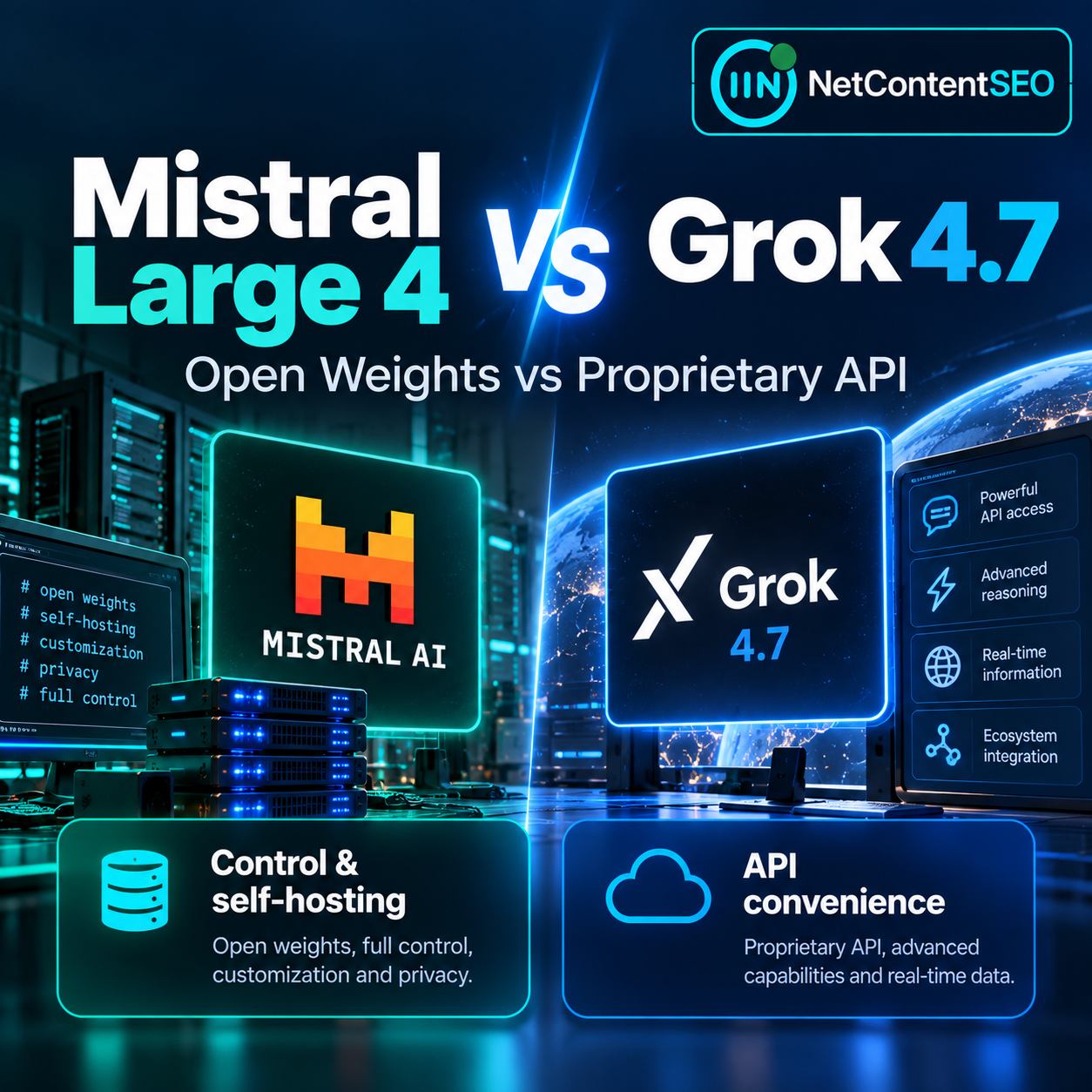

Comparing Mistral Large 4 and Grok 4.7 is not simply a contest between two powerful language models. Both target demanding coding, reasoning and business workloads, but they offer very different trade-offs in price, measured performance and deployment control. A comparison published by OrcaRouter on October 30, 2026 highlights the question that may matter most to enterprise buyers: do you need access to a capable model, or control over the model itself?
Mistral Large 4 comes from Europe's Mistral AI, while Grok 4.7 is offered through a proprietary API. Both are commercially available, but the Mistral model's open-weight approach makes self-hosting and customization possible under its specific license terms.
Specifications and context windows
Mistral describes Large 4 as a trillion-parameter mixture-of-experts model with approximately 52 billion active parameters, designed for multimodal understanding, coding and agentic workflows. Its published context specification reaches roughly one million tokens, while the tested configuration tracked by Artificial Analysis has a 524K-token window. Grok 4.7 offers a 500K-token context window. The difference between vendor-advertised maximums and independently observed served configurations matters: users should test the exact provider and model variant they intend to deploy.
Both context windows are large enough for substantial document collections and extended coding sessions. However, a large window does not guarantee reliable retrieval or reasoning over every token, so long-context accuracy must be tested separately.
API pricing: Mistral is cheaper, but promotions change the picture
Mistral's listed API price is $1.36 per million input tokens and $4.18 per million output tokens. Grok 4.7 lists at $2.00 input and $6.00 output per million tokens. At these standard rates, Mistral is approximately 32% cheaper on input and 30% cheaper on output. The OrcaRouter comparison also notes a temporary half-price promotion for Mistral, reducing rates to $0.68 input and $2.09 output. These promotional prices should not be treated as permanent commitments.
For an illustrative job consuming one million input tokens and 200,000 output tokens, the standard Mistral rates imply approximately $2.20 in API token charges, versus $3.20 for Grok. At Mistral's promotional rates, the same token counts would cost about $1.10. Actual bills can differ because of caching, provider routing, tool charges, model-specific token usage and changing prices.
Which model performs better?
Independent comparisons offer a more nuanced picture than a single winner. In the Artificial Analysis comparison consulted on October 30, 2026, Grok 4.7 (Xhigh) leads Mistral Large 4 Preview on the Intelligence Index, approximately 46 versus 38. Grok also leads on the AA-Briefcase knowledge-work evaluation, while Mistral performs competitively in selected coding and long-context tests. These results refer to specific evaluated variants, not every possible configuration.
Artificial Analysis also reports differences in output speed and task-level token consumption. Such measurements are useful, but performance may vary with workload, provider, settings and benchmark updates. Teams should avoid turning aggregate scores into a universal claim that one model is superior at every task.
The biggest difference: open weights versus proprietary access
For many organizations, Mistral's most significant advantage is that its model weights can be deployed and customized outside a vendor-hosted API. This can support data-residency requirements, internal infrastructure policies and model adaptation. However, its Mistral Ecosystem Open-Weight License is not equivalent to an unrestricted MIT or Apache license: operating certain model-as-a-service businesses requires a separate commercial agreement. Enterprises should review the actual license before deployment.
Grok 4.7, by contrast, is delivered as a managed proprietary model. Organizations do not receive downloadable weights to host or fine-tune independently. The appeal is operational simplicity: customers can integrate a hosted API without taking on the hardware and model-serving responsibilities associated with a trillion-parameter system.
Open weights do not mean inexpensive self-hosting. Compute capacity, model optimization, security, monitoring and maintenance may outweigh API savings unless an organization has sufficient scale or strict infrastructure requirements.
How should companies choose?
Choose Mistral Large 4 for serious evaluation if data sovereignty, deployment flexibility or custom model operations are important. Evaluate Grok 4.7 when a managed API, stable published rates and stronger performance on the particular benchmarks relevant to your use case are the priorities. Neither decision should rest solely on marketing specifications.
A practical comparison should run identical prompts and representative datasets through both models, then measure successful task completion, error rates, latency, total tokens consumed and human review time. For enterprise workloads, cost per successfully completed task is often more informative than cost per million tokens.
What this means for AI applications and search
For teams building AI-powered research, content analysis or search experiences, this comparison also illustrates why infrastructure decisions influence product strategy. The choice between self-hosting and a proprietary endpoint affects privacy controls, vendor dependency, latency, customization and long-term costs. Neither model's benchmark ranking guarantees better search citations or SEO performance, and such claims require separate evidence.
Ultimately, Mistral Large 4 versus Grok 4.7 is a choice between different operational models as much as different AI capabilities. The right answer depends on what an organization needs to own, what it can afford to operate and what its own tests demonstrate.
Sources: OrcaRouter comparison, October 30, 2026; Mistral AI official announcement; Grok 4.7 official announcement; Artificial Analysis comparison.