

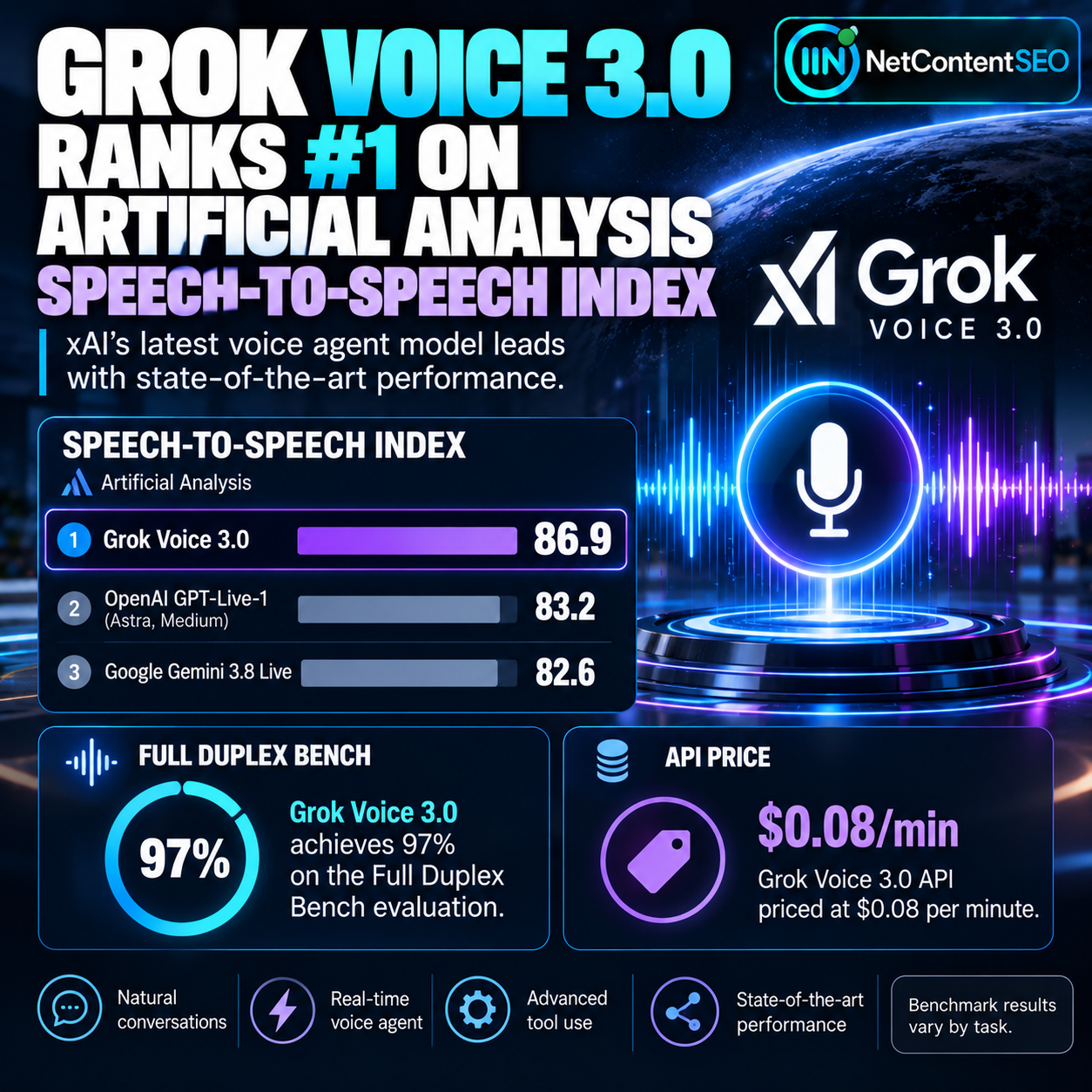

Grok Voice 3.0 ranks first on Artificial Analysis’s Speech-to-Speech Index, scoring 86.9 in testing dated 13 October 2026, according to the benchmark results published by xAI. The new model from SpaceXSI (formerly xAI) scores ahead of OpenAI’s GPT-Live-1 (Astra, Medium) at 83.2 and Google’s Gemini 3.8 Live (Extended Thinking, High) at 82.6.
The result is notable for companies building real-time voice agents, especially for customer support and sales. However, a top score on a composite benchmark does not mean one model wins every task. The component results show meaningful differences between overall performance, conversational flow, task completion and latency.
Grok Voice 3.0’s benchmark results
In its 14 October announcement, xAI says Artificial Analysis’s Speech-to-Speech Index gives Grok Voice 3.0 a score of 86.9. The index combines speech reasoning, conversational dynamics and agentic performance, including task success and preference results from blind head-to-head calls.
The same comparison reports these overall scores:
- Grok Voice 3.0: 86.9
- OpenAI GPT-Live-1 (Astra, Medium): 83.2
- Google Gemini 3.8 Live (Extended Thinking, High): 82.6
- Grok Voice 2.0: 81.3
The figures are attributed to Artificial Analysis testing dated 13 October 2026, as cited in xAI’s release announcement. They should be read in the context of the named models and configurations tested, not as a universal ranking of every voice product or deployment.
What the individual tests reveal
Speech reasoning
Grok Voice 3.0 records 98.5% on Big Bench Audio in the comparison published by xAI. The listed result is higher than Grok Voice 2.0’s 97.2% and GPT-Live-1 (Astra, Medium)’s 90.1%, while Gemini 3.8 Live is listed at 97.7%.
Conversational dynamics
On Full Duplex Bench, which evaluates how naturally a system handles pauses, turn-taking and interruptions, Grok Voice 3.0 scores 97.0%. The comparison lists 95.1% for Grok Voice 2.0, 94.9% for GPT-Live-1 (Astra, Medium) and 91.9% for Gemini 3.8 Live in the tested configurations.
Task completion
The listed task-success rate for Grok Voice 3.0 is 94.8%, compared with 94.6% for Grok Voice 2.0, 87.4% for GPT-Live-1 (Astra, Medium) and 89.1% for Gemini 3.8 Live. This is one component of the comparison, not a guarantee that a production voice agent will complete 94.8% of every business’s calls successfully.
Support-call performance and latency
On ServiceNow’s EVA-Bench, xAI says Grok Voice 3.0 achieves 74% accuracy across realistic enterprise voice-agent scenarios. The release also reports a 71.6% result on τ-Voice, a test involving support calls with varied accents, background noise and interruptions. xAI says this τ-Voice performance is comparable with GPT-Live-1 (Astra) but with about 40% lower latency on that evaluation.
These measures are not interchangeable: the composite Speech-to-Speech Index favours Grok Voice 3.0 in the cited results, while a specific benchmark can emphasise a different skill. Teams should choose tests that match their own calls, languages, escalation rules and success criteria.
Availability and pricing
Grok Voice 3.0 is available through the xAI Voice Agent API at $0.08 per minute, or $4.80 per hour, according to xAI. The company says the price is unchanged from Grok Voice 2.0 and the API interface remains the same.
The alias grok-voice-latest now points to Grok Voice 3.0, so integrations using that alias have been switched automatically. The earlier grok-voice-2.0 identifier is deprecated. Developers who pin a specific model should review their configuration and migration plans rather than assuming every integration updates in the same way.
Why the ranking matters for voice-agent builders
Voice agents need to do more than transcribe speech or generate a convincing reply. In practical support settings, they must understand a caller, respond naturally, manage interruptions, use tools correctly and resolve the issue—or recognise when a human should take over.
A composite benchmark can help developers shortlist models, but it should be only one part of procurement and testing. Before switching a production workflow, teams should test real call recordings or carefully designed simulations, assess language and accent coverage, measure end-to-end latency and verify safe escalation behaviour.
Implications for SEO and AI Search
This is a voice-model benchmark and API release, not a search-ranking or crawler update. The announcement does not establish changes to Google or Bing rankings, web crawling, or how AI systems cite websites.
The SEO connection is indirect. As conversational voice agents become more capable, businesses may use them for customer service, product discovery and other spoken interactions. Digital teams can monitor how these interfaces affect customer journeys, but should not infer that a higher voice benchmark score automatically produces more organic traffic or AI citations.
What to verify before choosing a model
- Use-case fit: compare performance on the actual tasks your agent must handle.
- Latency: measure the full user experience, including network, tools and backend processing.
- Reliability: test interruptions, ambiguous requests, background noise and failure recovery.
- Cost: calculate costs using expected call duration, retries and the full application architecture.
- Version control: decide whether an automatically updated alias or a pinned model is better for your release process.
- Human escalation: confirm that the agent can recognise uncertainty and hand off sensitive or unresolved cases.
The takeaway
Grok Voice 3.0 leads the cited Artificial Analysis Speech-to-Speech Index with 86.9, ahead of the tested GPT-Live-1 and Gemini 3.8 Live configurations. xAI also reports a 97% Full Duplex Bench score and unchanged API pricing at $0.08 per minute. The results make it a significant contender for real-time voice-agent development, but the best choice still depends on the specific task, latency requirements, cost and quality of the end-to-end system.