

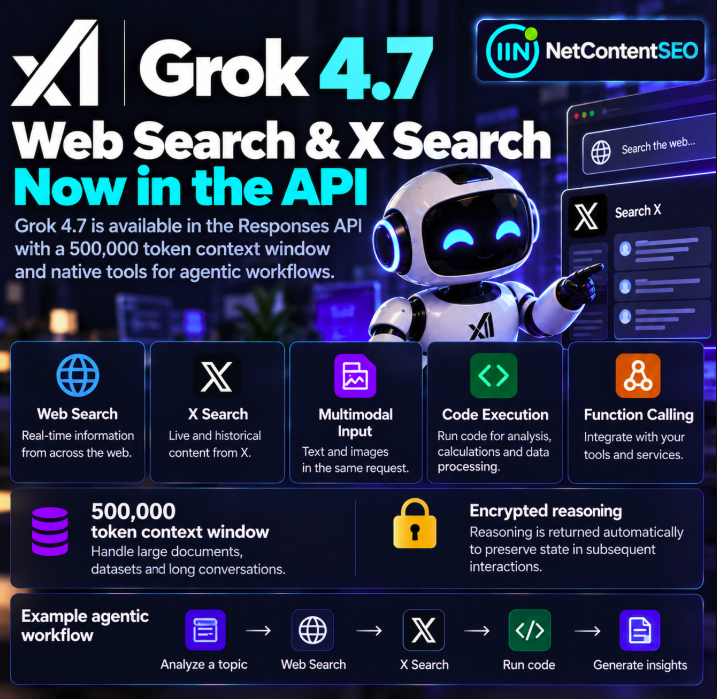

Grok 4.7 is available in the xAI Responses API with native Web Search and X Search tools, giving developers a way to combine web evidence, social posts and agentic analysis in one workflow. Announced September 21, 2026, the model supports a 500,000-token context window, text and image input, text output, code execution and function calling. Its Responses API also returns encrypted reasoning content automatically so the application can preserve the relevant reasoning state across turns. xAI Release Notes and Grok 4.7 Developer Guide document these capabilities.
For SEO and AI visibility researchers, the significant development is the combination of web retrieval and X content in an agent's research environment. That creates new testing opportunities, but does not establish a new public search ranking factor, guarantee source citations or prove that posting on X increases organic Grok visibility.
Grok 4.7: key API specifications
| Feature | Documented capability |
|---|---|
| Model | grok-4.7 |
| API | Responses API |
| Context window | 500,000 tokens |
| Input | Text and images |
| Output | Text |
| Native tools | Web Search, X Search, code execution |
| Additional integrations | Function calling |
| Reasoning state | Encrypted reasoning content returned automatically in Responses API |
| Release | September 21, 2026 |
How Web Search works in Grok's Responses API
xAI's Web Search documentation describes a built-in tool that can search the live web, browse pages and extract information to answer questions requiring current material. In the Responses API, developers can enable it with a web_search tool declaration.
This matters because a model's pretrained knowledge is not the same as access to a current web source. Retrieval can supply recent evidence, while the model still needs to interpret that evidence accurately and communicate any uncertainty.
Tool availability is not a promise that every website can be reached. Crawl restrictions, authentication, content formats and tool execution can affect the outcome. Publishers should distinguish whether a page was discovered, fetched, cited or merely mentioned in a generated answer.
X Search adds posts, users and conversations
The X Search tool supports keyword search, semantic search, user search and thread retrieval on X. This creates a path for agents to examine both web publications and social discussions in one research session.
For brand monitoring, the combination is particularly interesting: an agent can investigate a product announcement on an official site and compare it with relevant posts on X. Yet the presence of an X Search tool does not mean all posts are indexed or retrieved, nor does it demonstrate that an X mention changes public Grok ranking or citation selection.
Using Web Search and X Search together
The xAI documentation provides a Responses API example enabling both tools:
from openai import OpenAI
import os

client = OpenAI(
    api_key=os.getenv('XAI_API_KEY'),
    base_url='https://api.x.ai/v1'
)

response = client.responses.create(
    model='grok-4.7',
    input='Find the latest official announcement and related discussion on X.',
    tools=[
        {'type': 'web_search'},
        {'type': 'x_search'}
    ]
)

print(response)
This is an illustrative research request, not a guarantee that the model will invoke both tools for every prompt. Developers should inspect returned tool activity and sources to verify what was actually searched.
Encrypted reasoning in multi-turn agent workflows
According to the Grok 4.7 guide, Responses API outputs include reasoning.encrypted_content even without explicitly requesting it in the include parameter. Applications can pass those reasoning items back unchanged in subsequent requests to maintain continuity. This is a mechanism for preserving model state across turns, not a human-readable disclosure of private reasoning.
Developers should follow the official message-handling format rather than editing the encrypted payload. The documentation notes that Chat Completions behavior is unchanged.
What the 500,000-token context window enables
A large context window can accommodate long documents, extended conversations and substantial tool outputs. For SEO research, this could help when comparing multiple articles, site documentation, observed citations and social posts. But a high token ceiling does not guarantee complete recall, accurate attribution or economical processing of every large input.
Cost, latency, rate limits and the amount of useful evidence should be evaluated with representative workloads. Large contexts can still contain irrelevant material, conflicting claims and outdated sources.
Three practical AI visibility research workflows
1. Compare website coverage with X discussion
Collect verified URLs and relevant X posts for the same announcement. Record which sources the agent retrieved and cited, and avoid assuming that a social mention caused the web page to appear in the answer.
2. Test entity recognition across channels
Ask a consistent set of questions about an organization, product or author. Observe whether responses identify the entity accurately, which sources appear and whether results differ when the available tools or query wording change. Repeat the tests to account for natural variation.
3. Monitor citation quality, not just mention counts
Distinguish a named brand mention from a clickable source citation. Check whether the citation supports the claim, whether the original publisher is credited and whether the cited URL is accessible. These are observable outputs; they should not be confused with undisclosed ranking signals.
What this does not prove about SEO or GEO
There is no documented rule in this release saying that publishing more posts on X increases a site's Google ranking, Grok citation frequency or web-search visibility. Similarly, a model having access to Web Search does not guarantee that it can access all public URLs or that it will cite a page it visits.
Grok 4.7's tool support describes developer capabilities. Public-facing search behavior, citation selection, source coverage and user traffic are separate subjects that require direct testing.
Costs and operational limits matter
Native tool use can introduce costs beyond model tokens. The official xAI pricing documentation details tool charges, and the X Search pricing model was updated on September 21, 2026 to account for posts and profiles fetched. Developers should consult current pricing and usage fields rather than assume that every search has a fixed cost or that a high model RPS limit translates directly into the same number of simultaneous searches.
For automated SEO monitoring, set budgets, track tool invocations, store source evidence and handle API rate limits. A reliable report must reflect which observations were actually retrieved, not what the agent was merely asked to investigate.
FAQ
When was Grok 4.7 announced for the API?
September 21, 2026, according to xAI's official release notes.
Does Grok 4.7 support Web Search and X Search?
Yes. Both are documented built-in tools for the Responses API.
What is the Grok 4.7 context window?
500,000 tokens.
Can Grok 4.7 analyze images?
Its developer guide lists text and image input, with text output.
What does encrypted reasoning do?
It lets applications preserve reasoning state between Responses API turns by returning encrypted reasoning items for reuse.
Does X Search guarantee that Grok will cite my posts?
No. Search-tool availability does not guarantee retrieval, attribution or citations for any specific post.
Is this a new Grok ranking update?
No. It is a documented API model and tooling capability, not a confirmed change to public search ranking.
NetContentSEO analysis
Grok 4.7 makes combined web-and-social research practical inside a single agent workflow. For SEO and GEO, the research opportunity is to observe which web pages and X posts are retrieved, how entities are represented and whether sources receive accurate citations. The key is disciplined measurement: tool access is a capability; source visibility is an outcome that must be demonstrated.
Official sources: xAI Release Notes, Grok 4.7 Developer Guide, Web Search, X Search.