

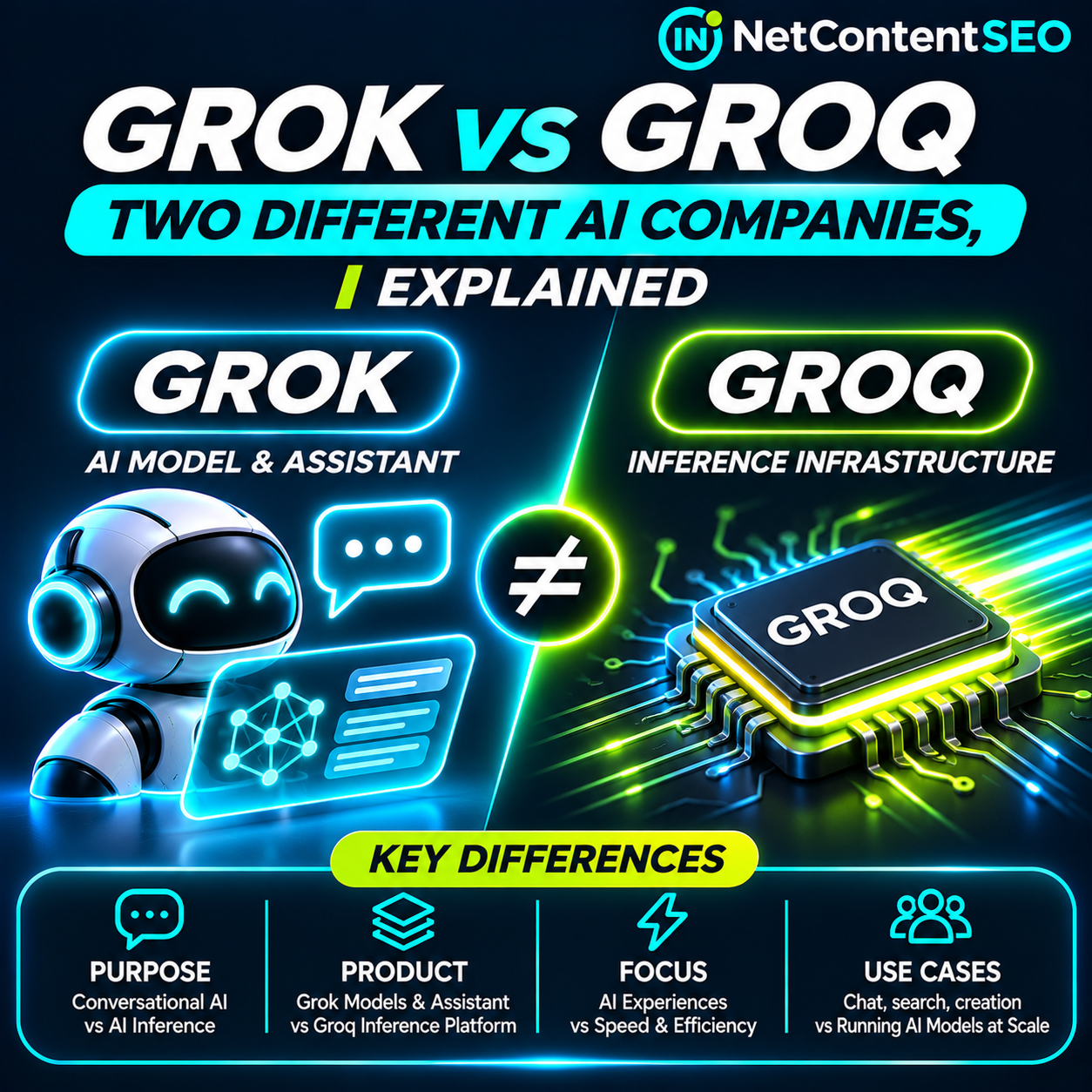

Grok and Groq sound almost identical, but they occupy different layers of the artificial intelligence industry. Grok is a conversational assistant and model family associated with xAI. Groq develops inference technology and provides cloud infrastructure for running supported AI models. Confusing them can lead to mistaken assumptions about model ownership, capabilities, performance and even where a business's data is processed.
This distinction matters increasingly as AI products become combinations of models, search tools, infrastructure and external services. For marketers and SEO professionals, understanding who generates an answer, which tools retrieve information and which company hosts the inference is more useful than treating every AI brand as a chatbot competitor.
Grok vs Groq at a glance
| Question | Grok | Groq |
|---|---|---|
| What is it? | Conversational AI assistant and model family | AI inference technology and service provider |
| Associated organization | xAI / SpaceX AI ecosystem | Groq |
| Main function | Generates answers, reasons, creates content and uses tools | Runs supported AI models efficiently on specialized infrastructure |
| Products | Grok app, Grok models and developer APIs | GroqCloud, LPU inference hardware and enterprise inference services |
| Typical user | Consumers, developers and businesses needing an assistant or model | Developers and organizations deploying models with latency and throughput requirements |
| Search relevance | Can use web and X search tools to answer current questions | Can power applications that retrieve and process information, depending on the deployed model and tools |
These are different categories, so there is no meaningful single benchmark that declares Grok or Groq the “better AI.” The appropriate comparison depends on the task and the model actually running on the infrastructure.
What is Grok?
Grok was introduced in November 2023 as a conversational AI system. The current official Grok overview describes a consumer assistant available through the web and mobile apps, supporting conversation, file analysis, voice, image and video creation, and integrations with connected tools.
For developers, the official model catalog lists Grok models with API access, context windows and token-based pricing. These details change as models are released or retired, so teams should check the live catalog rather than rely on old screenshots or fixed comparisons.
Grok is also relevant to search because it can use external tools. Its official documentation says that up-to-date information requires web or X search tools to be enabled for developer API requests. A model's training data alone does not provide reliable access to current events.
What is Groq?
Groq's Language Processing Unit, or LPU, is a processor architecture designed for AI inference: the process of running a trained model to generate outputs. Groq's infrastructure emphasizes predictable execution and high throughput. Its platform offers managed inference services and enterprise infrastructure options.
Groq is therefore not simply another general-purpose chatbot competing with Grok. A developer can use Groq infrastructure to serve a supported third-party model inside an application. The model determines much of the response behavior; the inference platform affects how efficiently requests are processed. Retrieval tools, safety controls, prompts and application logic add further layers.
Groq publishes architectural performance claims for its LPU technology. These are vendor claims and should not be interpreted as proof that every model or workload runs faster than every alternative. Real-world latency depends on model size, output length, batching, service limits, geographic location and workload.
Why the names are so confusing
Grok and Groq differ by one letter and are often pronounced similarly. Both are prominent in AI, and both may appear in articles discussing language models, developers, inference and agents. That overlap makes the confusion understandable, but it should not obscure the ownership and technology distinctions.
For search users, the ambiguity is also an example of an entity-disambiguation problem. A search engine or assistant must distinguish a model and product brand from an infrastructure company with a similar name. Clear official websites, consistent descriptions, authoritative references and accurate citations help users and retrieval systems avoid mixing them up.
Can you run Grok on Groq?
Not automatically. Groq can run models that its infrastructure and services support, but that does not mean the proprietary Grok model family is available on GroqCloud. Model deployment requires technical compatibility, access rights, commercial terms and an actual supported offering.
Anyone claiming that Grok is hosted on Groq should provide a current official product listing or deployment announcement. Similar names are not evidence of a partnership or integration.
Which one is faster?
This is the wrong comparison without defining a model and a workload. Grok refers to model behavior and an assistant experience. Groq refers to infrastructure that may serve different models. To compare performance fairly, developers should run the same model or functionally equivalent models against a representative workload and measure time to first token, output tokens per second, end-to-end latency, successful task completion and cost.
For a customer-support assistant, low response latency may be essential. For a research agent, answer quality, source verification and tool reliability may matter more than raw tokens per second. The fastest response is not necessarily the most useful or trustworthy one.
How much do Grok and Groq cost?
They have different pricing models. Grok offers consumer subscriptions and developer API pricing based on the model and usage. Groq offers inference services and infrastructure arrangements with pricing tied to the supported model, workload or enterprise configuration.
As a dated example, xAI's official model catalog listed Grok 4.7 at $2 per million input tokens and $6 per million output tokens when checked for this article. That is a Grok API price, not a universal price for all xAI services. Groq pricing must be checked for the specific model and service tier being used. Neither figure alone establishes which solution is cheaper for a finished business task.
To compare actual costs, include prompt tokens, generated tokens, retries, tool calls, search fees, hosting overhead, rate limits and human correction. A lower price per token can be offset by lower task success rates or repeated attempts.
Why this matters for SEO and AI Search
Traditional SEO focuses on making information discoverable and useful in search engines. AI Search introduces additional stages: an assistant may retrieve pages, select sources, synthesize information and recommend a business or service. Infrastructure companies may make those processes faster, but they do not necessarily determine the final sources cited by a particular assistant.
Grok is potentially a discovery surface. When it uses web and X search, a user may encounter websites, brands, posts or documents through its answers. Whether a source appears depends on the query, retrieval tools, available information and the system's response behavior. No universal “Grok ranking factor” can be inferred from the existence of its API.
Groq is primarily an enabling layer. It can help developers build fast assistants, but being hosted on Groq does not itself establish a distinct public search engine, citation index or measurable organic referral channel. An application built with GroqCloud may implement search and citations; another may not retrieve external information at all.
Entity clarity: a practical GEO lesson from Grok and Groq
The similarity between the names illustrates a wider problem for brands: AI systems may confuse organizations, products and services with overlapping names or descriptions. Businesses should make their identity explicit and consistent across their websites and trusted external references.
A useful audit should verify the organization's official name, product names, ownership where relevant, canonical website, accurate descriptions, support documentation and structured data where appropriate. Markup can help express facts, but it is not a guaranteed AI-citation lever.
Teams should also test representative prompts in multiple AI systems. If an assistant confuses two entities, record the exact query, date, answer, cited sources and error type. Then correct factual ambiguity at its source rather than attempting to manipulate a model with unsupported claims.
What publishers should measure
For an assistant such as Grok, publishers can investigate actual referral traffic where analytics exposes a source, verify how their content is described in answers and track whether branded queries return accurate information. For applications powered by Groq, measurement depends on the application: there may be no public discovery interface or publisher-facing analytics at all.
Do not combine model usage, inference volume and website referrals into a single “AI visibility” number. They describe different activities. An infrastructure provider can process millions of requests without creating any identifiable referral traffic for a publisher.
How to choose the right technology for an AI project
- Define the task. Is the goal a conversational assistant, web research, document processing, real-time voice or an API-backed agent?
- Choose the model. Evaluate answer quality, language support, context limits, tool use and safety for representative tasks.
- Choose the inference provider. Evaluate which models are supported, latency, throughput, availability, cost, regional hosting and contractual requirements.
- Define retrieval. If fresh information is necessary, specify the search APIs, document indexes or other external tools the application will use.
- Validate citations. Test whether retrieved sources actually support generated claims and whether the system distinguishes current information from model memory.
- Test end-to-end outcomes. Measure completed tasks, failure rates, response time, total cost and human intervention.
- Recheck live documentation. Models, prices, supported regions and platform capabilities change frequently.
Frequently asked questions
Are Grok and Groq the same company?
No. Grok is an AI assistant and model family associated with xAI, while Groq is an AI inference technology and services company.
Is Groq owned by Elon Musk?
No. The similarly named Grok product is associated with the Elon Musk-led AI ecosystem. Groq is a separate company.
Does Groq make its own chatbot?
Groq's primary offering is inference infrastructure and developer services. Applications built on that infrastructure may include chatbots, but the company should not be confused with the Grok assistant.
Does Grok use Groq chips?
The similarity in names does not establish a hardware or hosting relationship. Any specific deployment claim needs an official technical source.
Can GroqCloud provide real-time search?
An application can combine a supported model with search or retrieval tools. Search capability depends on the application and integrations, not merely the inference hardware.
Which is better for SEO?
They serve different purposes. Grok can be relevant as an AI discovery interface; Groq can power applications that process information. Neither offers a guaranteed shortcut to better rankings or citations.
Is Groq faster than Grok?
That comparison is not meaningful without specifying the model, hosting configuration and workload. Measure end-to-end task performance instead.
What is an LPU?
An LPU is Groq's Language Processing Unit, a specialized processor architecture designed for AI inference.
Do both offer APIs?
Yes, but for different purposes. Grok APIs expose xAI models and capabilities, while Groq's services let developers run supported models on its inference infrastructure.
The bottom line
Grok is an AI assistant and model family; Groq is an inference infrastructure company. The distinction is more than a spelling lesson. Modern AI systems combine models, search tools, hardware and application logic, and each layer affects a different part of the user experience.
For SEO and GEO, the most important question is not which company has the faster chip or the more recognizable chatbot. It is which system retrieves information, how it selects and presents sources, and whether that interaction produces measurable discovery or business outcomes. Understanding the stack prevents marketers from confusing technical capability with actual visibility.