

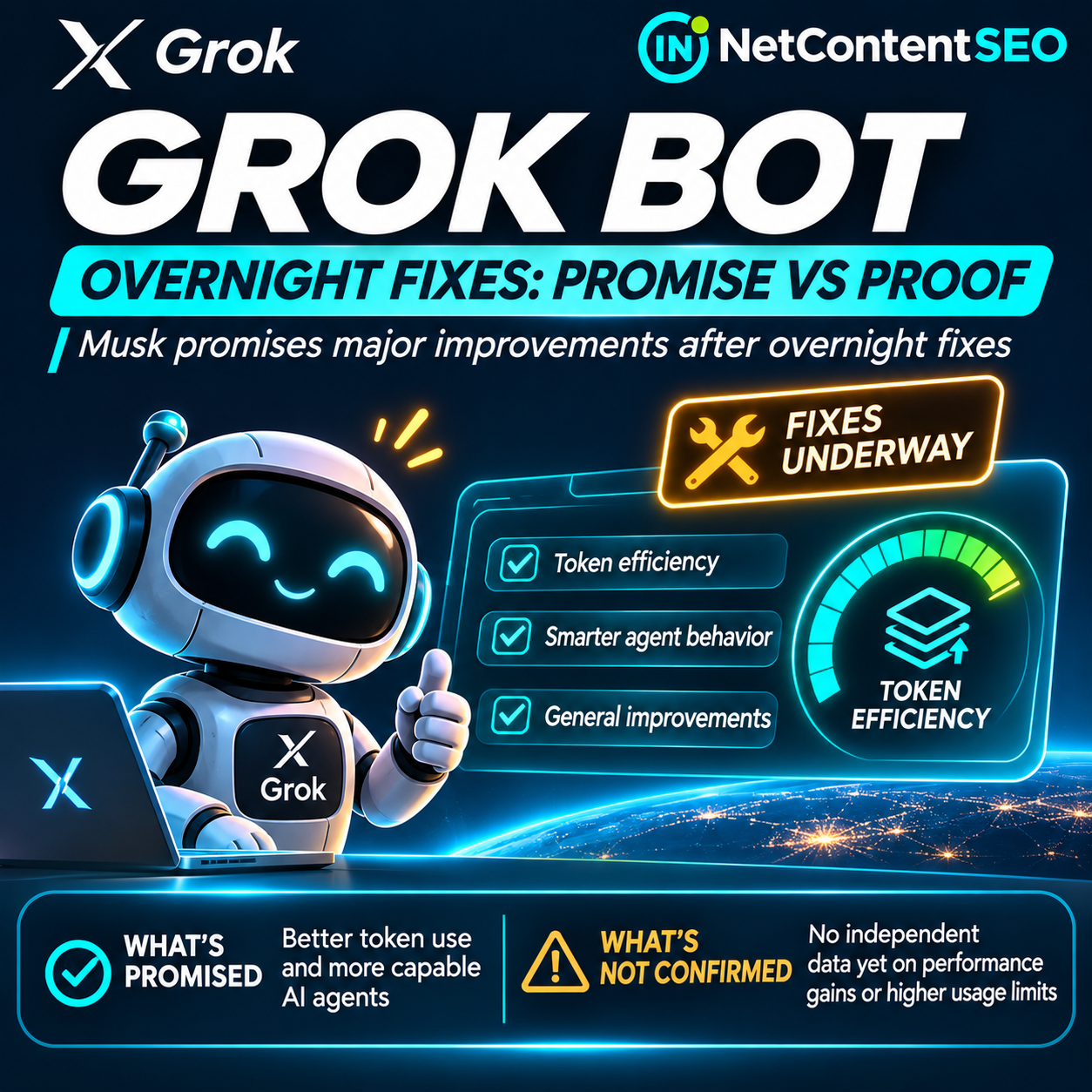

November 9, 2026. Elon Musk says Grok Bot users should notice a major improvement after an overnight round of engineering fixes. The promise follows complaints that paid subscribers were exhausting their weekly usage allowances faster than expected. But as of the reporting reviewed for this article, there are no published before-and-after benchmarks demonstrating a performance improvement, and no announcement of higher limits or lower prices.
According to TeslaNorth's November 8 report, Musk said he had finished a roundtable review with the Grok Bot engineering team and that fixes would be implemented overnight, with improvements expected the following day. In a separate November 8 post, he identified two targets: better token efficiency and smarter behavior. These are stated goals, not independently verified outcomes.
What happened with Grok Bot?
The immediate story is a combination of user complaints and an unusually public engineering response. Some subscribers reported that their weekly allowance was being consumed rapidly. TeslaNorth described a subscriber who said a $200 plan had lasted a week of heavy use previously but was exhausted after about 14 hours of more moderate work. That comparison comes from one user's account, involves different workloads and has not been independently audited.
Musk acknowledged the cost problem on November 1, saying that the cost of serving Grok Bot was unsustainably high relative to revenue. On November 8, he said fixes to token efficiency and behavior were underway. Later, he gave a more specific expectation: users should notice a dramatic improvement after overnight changes. He also invited reports of persistent problems.
None of those statements identifies the software components changed, the model routing strategy, the amount of token reduction achieved or the percentage of tasks expected to succeed. The story should therefore be treated as an announced intervention, not a completed and independently validated performance release.
What is Grok Bot?
Grok Bot is a task-oriented AI assistant designed to work with apps, websites and workflows using its own computer environment. Unlike a conventional chatbot that only generates an answer, a computer-using agent may need to navigate interfaces, retrieve information, execute multi-step tasks and return results. Each step can consume tokens and computing resources.
The product's published subscription model includes weekly usage allowances, with additional usage billed according to token costs. This makes efficiency especially visible to users: a task that requires repeated attempts or long intermediate reasoning can deplete the available allowance even if the final output is short.
Why token efficiency matters more than a headline model score
Token efficiency is the amount of model processing required to complete useful work. In a simple chat, a user may notice only the response time and quality. In an agentic workflow, costs can accumulate through planning, browsing, reading pages, calling tools, recovering from errors and revisiting previous steps.
For example, an agent asked to research a competitor, inspect ten pages and prepare a report may need many model calls before producing a final document. If a navigation error forces it to repeat the same steps, the cost of that mistake is paid in tokens and time. A genuinely more efficient agent would complete comparable tasks using fewer resources while maintaining or improving accuracy.
That distinction is crucial. Lower token usage alone is not a success if the assistant omits important checks or delivers incorrect work. Conversely, a higher token count can be justified when a difficult task requires careful verification. The relevant measure is cost per successfully completed task, not simply tokens per message.
What could “smarter behavior” mean?
Musk did not provide a technical definition. In a computer-using agent, better behavior could mean fewer unnecessary tool calls, more reliable navigation, better recovery after failed steps, more appropriate use of context or fewer repeated attempts. Those are plausible interpretations of the stated goal, not confirmed changes to Grok Bot's implementation.
Claims about changes in underlying models, routing, context limits or infrastructure should be treated cautiously unless supported by a release note or technical documentation. The public statement does not establish which mechanism, if any, produced an improvement.
What has actually been confirmed?
| Claim | Evidence status |
|---|---|
| Musk said Grok Bot fixes were underway. | Reported from his public November 8 statements. |
| The targets include token efficiency and smarter behavior. | Explicitly stated by Musk. |
| He expected noticeable improvement after overnight work. | Public promise, not a verified performance result. |
| Subscribers complained about rapidly exhausted allowances. | Reported user experiences; not independently audited. |
| Grok Bot now uses a specified percentage fewer tokens. | No measured reduction published in the reviewed evidence. |
| Weekly allowances have increased or been reset. | Not announced. |
| Subscription prices have changed. | Not announced in connection with these fixes. |
| A documented production release confirms the changes. | Not established by the reporting reviewed. |
How users can test whether the fixes work
The most useful test is a repeatable workflow, not a subjective impression that an agent feels faster. Users should choose several representative tasks with clear success criteria and run them under similar conditions before and after a documented update.
- Define the task: for example, extract facts from a fixed set of web pages, complete a permitted browser workflow or summarize a known document collection.
- Record the starting conditions: note the date, subscription, available allowance, task instructions, connected apps and any relevant model settings.
- Track the outcome: was the task completed correctly, partially completed or abandoned?
- Measure resource use: record any available token consumption, allowance change, elapsed time and number of retries.
- Check reliability: repeat the task several times rather than drawing conclusions from one unusually good or bad run.
- Compare like with like: keep the task and success criteria constant, and distinguish product changes from differences in websites, network conditions or input data.
Where exact token counts are unavailable, a usage meter can provide a rough signal, but it should not be treated as a precise substitute. The strongest evidence would be official release documentation plus independently reproducible tests showing lower cost without a decline in successful task completion.
Implications for SEO, GEO and agentic search
For SEO professionals, Grok Bot's reported difficulties illustrate a challenge that is increasingly relevant to AI-driven discovery: agents need to retrieve information and act on it efficiently. An agent that consumes excessive resources while inspecting websites may struggle to complete research, comparisons or lead-generation workflows within a user's allowance.
That does not mean the fixes change Grok's web rankings, citation selection or publisher referral traffic. No such search-system update is established by the announcement. Grok Bot is a computer-using agent, and its efficiency improvements should not be conflated with changes to a public search index.
Still, the economics matter. If agents become more reliable and less expensive to run, more businesses may deploy them for tasks such as market research, local service comparison, shopping assistance and operational monitoring. That is a plausible longer-term effect, not a demonstrated consequence of this specific overnight intervention.
What publishers and brands should monitor
Instead of trying to optimize for an unconfirmed Grok Bot algorithm, publishers should focus on information that agents can retrieve and interpret accurately. Clear page titles, accessible content, up-to-date product details, documented procedures and consistent business information can help a wide range of automated workflows.
Teams should separately measure whether an agent finds the right source, extracts the correct facts, selects the appropriate next action and completes the task. A website visit from an agent does not automatically represent a human referral, a citation or a conversion. And an agent's failure may reflect its tool limitations rather than the publisher's search visibility.
For internal SEO automation, test tasks such as extracting canonical tags, checking redirects or reviewing structured data against known expected results. Compare accuracy and the cost of the full run before relying on a newly announced efficiency improvement.
What businesses should do before increasing their Grok Bot usage
Organizations already using Grok Bot for recurring work should inspect the frequency and value of each automated task. A workflow that runs hourly may consume far more usage than one that runs daily, particularly if each run triggers multiple tool calls. Pause redundant routines, narrow broad triggers and keep confirmation steps for consequential actions.
Do not increase a subscription or commit critical workflows solely because a major improvement was promised. Check the official changelog, run controlled tests and confirm that the service now meets the required reliability and cost thresholds. If usage still depletes unexpectedly, document the task, timing and available usage evidence when reporting the problem.
Frequently asked questions
Did Elon Musk announce a Grok Bot fix?
Yes. On November 8–9, 2026, Musk publicly said fixes targeting token efficiency and smarter behavior were being implemented, with a noticeable improvement expected after overnight work.
Has Grok Bot's performance improvement been independently verified?
Not in the evidence reviewed for this article. No comparable before-and-after benchmark or quantified token saving accompanied the announcement.
Will Grok Bot subscribers receive more weekly usage?
No higher allowance or free reset was announced in connection with these statements. Better efficiency, if achieved, could allow more work within an existing allowance, but that outcome remains to be demonstrated.
Did Grok Bot subscription prices change?
No price change was announced as part of the overnight-fix report. Subscribers should check current plan terms directly before making a purchase decision.
What is token efficiency for an AI agent?
It describes how much model processing an agent uses to complete work. The practical measure is resources consumed per correctly completed task, not simply the number of tokens in a response.
Does this change Grok search rankings or AI citations?
There is no evidence that the reported Grok Bot fixes alter public search rankings, citation systems or publisher visibility.
How can I tell if the fix reached my account?
Check official release notes and repeat a controlled task while monitoring success, time and available usage metrics. Do not infer a rollout solely from an isolated good result.
The bottom line
Musk's promise puts a spotlight on an important constraint in the AI agent market: the gap between impressive capabilities and sustainable, predictable usage. For subscribers, the real test is whether Grok Bot can finish more work correctly before its allowance runs out. For the broader industry, the story is a reminder that agent reliability and unit economics matter as much as model intelligence.
Until detailed release notes and repeatable results are available, the accurate headline is that improvements were promised, not that a dramatic performance gain has already been proven.
Sources
- TeslaNorth — Grok Bot Promised ‘Dramatic Improvement’ After Overnight Fixes (November 8, 2026).
- TeslaNorth — Elon Musk Says Grok Bot Cost Too Much to Serve as Users Hit Limits (November 1, 2026).
- Grokbot.guru — Musk says Grok Bot efficiency fixes are underway (November 8, 2026).
- CatchUpLah — November 9 Grok Bot update and changelog check.