

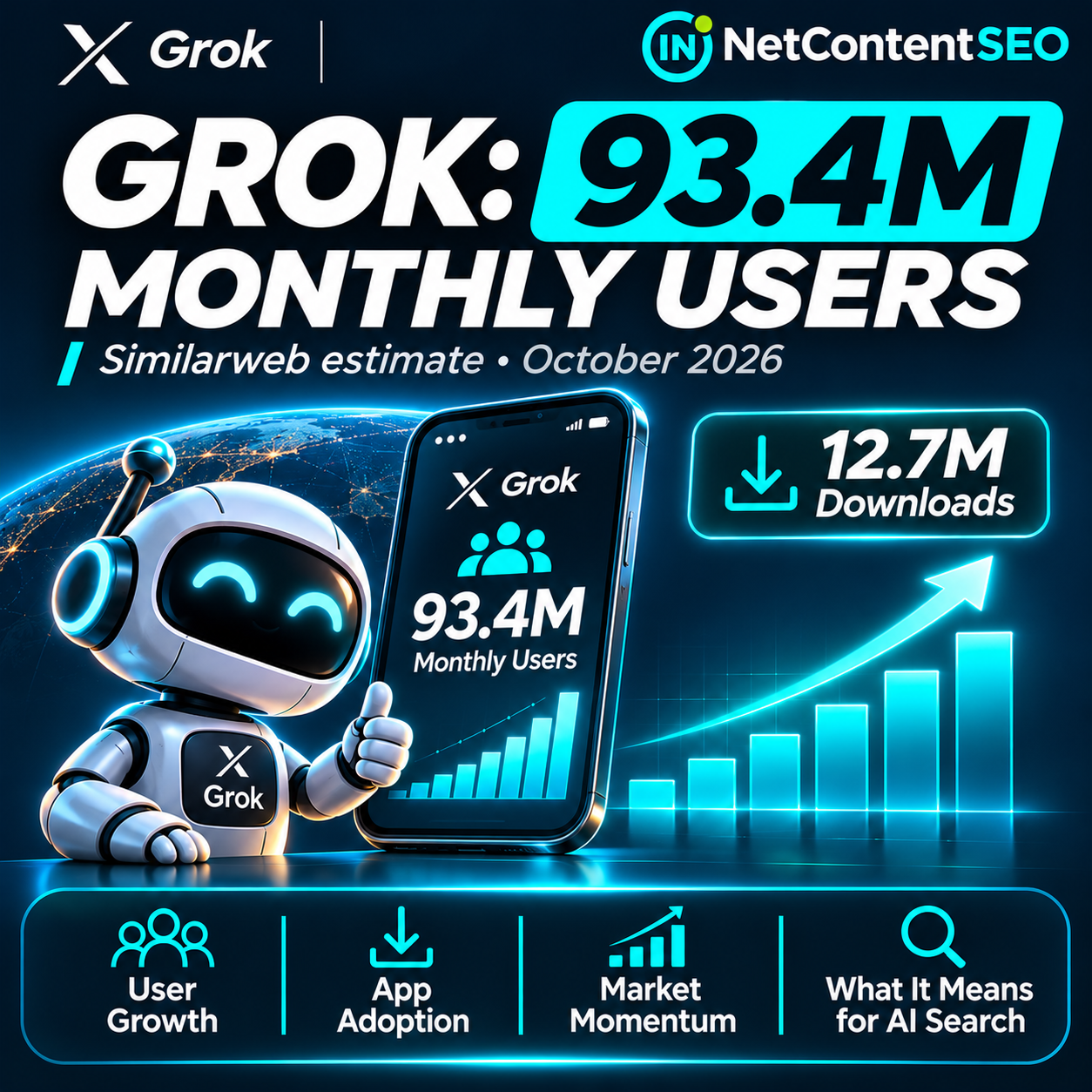

November 9, 2026. Grok's standalone mobile app reached an estimated 93,386,567 monthly active users worldwide in October 2026, according to figures shared by digital intelligence company Similarweb and reported by FourWeekMBA. Similarweb also estimated 12,731,752 app downloads during the month. The numbers suggest a substantial mobile audience for xAI's assistant, but they require careful interpretation: these are third-party estimates, not audited first-party figures from xAI.
Similarweb's October chart covers Android and iPhone worldwide and reports month-over-month growth of 3.32% in monthly users and 3.57% in downloads. The data is relevant to the competition for AI assistant distribution. It does not, on its own, establish how often Grok recommends a brand, which websites it cites or how much referral traffic publishers receive.
Grok's October 2026 mobile app figures
| Metric | October 2026 | Change vs. September |
|---|---|---|
| Estimated monthly active users | 93,386,567 | +3.32% |
| Estimated app downloads | 12,731,752 | +3.57% |
| Geographic scope | Worldwide | — |
| Platforms | Android and iPhone | — |
| Data provider | Similarweb | Third-party estimate |
Using the reported percentage changes, September's implied figures were approximately 90.4 million monthly active users and 12.3 million downloads. These are derived estimates, not independently published September totals, and small differences may arise from rounding.
FourWeekMBA also cites earlier Similarweb figures of 63.86 million users in January, 61.94 million in February and 65.69 million in March 2026. October is roughly 42% above the March estimate. However, the earlier post did not clearly specify the same platform scope, so this longer-term comparison is indicative rather than a rigorously like-for-like growth series. No April-to-August monthly figures are established by the cited report.
What does Similarweb mean by a monthly active user?
Similarweb's methodology defines an active user as a device with at least one qualifying app session during the period. Similarweb assumes one unique user per device and does not distinguish users from devices in this metric. Its documented measurement conditions differ between iOS and Android.
That matters because “93.4 million monthly users” should not be interpreted as 93.4 million verified unique individuals, paying subscribers or people using Grok every day. The estimate also does not measure the frequency, length or commercial value of each session.
Downloads are a separate metric. A download does not necessarily represent a new active user, and the same person may install an app on more than one device. The October download count is approximately 13.6% of the October monthly active-user estimate, but that ratio is not a retention rate, conversion rate or reliable measure of new-user acquisition without more information.
Grok's distribution story is bigger than the app
Grok can be encountered through multiple interfaces, including its standalone mobile app and experiences connected to X. Similarweb's reported October figures cover the standalone app on Android and iPhone. They should not be presented as the total audience of every Grok integration or as an estimate of all xAI users.
The distinction is especially important when comparing AI assistants. Some products rely heavily on mobile apps, others on websites, operating-system integrations, workplace tools or distribution inside established platforms. Comparing one app's monthly active users with another provider's combined web and app audience would exaggerate or distort differences.
The stronger conclusion is that Grok has built a sizable estimated mobile footprint. Whether that footprint translates into deeper engagement, subscription revenue, better retention or greater influence on purchase decisions requires additional evidence.
Why AI assistant distribution matters for SEO and GEO
Traditional search visibility focuses on how people discover content through search engines. AI assistants introduce additional discovery surfaces where users ask for explanations, comparisons, recommendations and help completing tasks. As those surfaces attract audiences, brands may want to understand whether their products and expertise appear in the answers.
A larger Grok app audience could make Grok an increasingly relevant environment to study. But audience size is not citation share. The October Similarweb data does not reveal which sources Grok retrieves, how frequently it links to websites, whether recommendations are geographically representative or how often a mention produces a visit.
For SEO and GEO teams, the practical next step is not to treat 93.4 million as a new traffic opportunity that can be forecast directly. It is to add Grok to a measured, repeatable visibility research program where the product and market justify the effort.
How to measure brand visibility in Grok
A useful evaluation starts with a fixed set of questions representing real customer intent. Include informational queries, product comparisons, branded and unbranded questions, and location-specific requests where relevant. Run them in comparable conditions and record the outputs over time.
- Define a query set: use 20–50 representative prompts covering the topics that matter commercially, rather than only prompts designed to mention your brand.
- Record the environment: document date, interface, account state, language, location context and any available search or browsing settings.
- Separate mentions from citations: track whether the assistant names a brand, links to a source, quotes a claim or recommends a product. These are different outcomes.
- Check source quality: inspect cited pages for relevance, freshness and factual support rather than counting all citations equally.
- Repeat the test: AI responses vary. Use repeated observations to avoid mistaking one answer for a stable ranking.
- Measure downstream behavior: review referral analytics where identifiable, direct conversions and customer-reported discovery sources. Do not assume that every AI mention generates a click.
For publishers, this process can help determine whether their articles are being used as sources in a particular category. For brands, it can reveal whether product facts, reviews and third-party descriptions are represented accurately. Neither test should be confused with an official Grok analytics dashboard, which the Similarweb report does not describe.
What the October growth does—and does not—tell us
Growth of just over 3% month over month in estimated app users suggests continued reach, but it does not identify the causes. Product improvements, marketing, distribution through X, seasonal behavior and measurement changes are all possible influences. The available figures do not isolate their contribution.
The timing also matters. Similarweb's numbers describe October activity and were shared on November 9. They cannot be used as evidence that Grok Bot engineering fixes discussed in November caused October growth. Grok Bot's task automation and token-efficiency issues are separate from the mobile app audience estimate.
Likewise, there is no basis in this dataset for declaring that Grok has overtaken another assistant in total users. A fair comparison would need equivalent geography, platforms, time period and metric definitions across services.
What should AI publishers and marketers do now?
Teams serving audiences that use Grok can add it to their AI visibility monitoring, but should prioritize observed business relevance. Start by checking whether the assistant can find accurate company information, understand the products, distinguish the brand from competitors and cite reliable primary material.
Keep website fundamentals in order: accessible content, consistent organization and product details, current documentation, useful answers to customer questions and clear source attribution. These practices make information easier to verify across many discovery systems. The Similarweb figures do not demonstrate that any particular markup, publishing frequency or optimization tactic increases Grok citations.
For executives evaluating the AI market, separate three questions: how many people access a service, what they do there, and whether those activities create measurable commercial value. Monthly active users help with the first question, but provide little direct evidence for the other two.
Frequently asked questions
How many users did Grok have in October 2026?
Similarweb estimated 93,386,567 monthly active users for Grok's Android and iPhone app worldwide. This is a third-party app estimate, not an official xAI count of all Grok users.
How many times was the Grok app downloaded in October?
Similarweb estimated 12,731,752 downloads worldwide during October 2026, an increase of 3.57% from September according to its chart.
How much did Grok's mobile audience grow in October?
The reported month-over-month increase in estimated monthly active users was 3.32%.
Does 93.4 million mean 93.4 million paying subscribers?
No. Monthly active users measure qualifying app activity under Similarweb's methodology. The figure does not establish subscription status, payment, daily activity or unique people across devices.
Does the figure include Grok users on X?
The cited chart covers the standalone Android and iPhone app. It should not be treated as a combined count for all Grok access points.
Are Similarweb's numbers official xAI figures?
No. They are third-party estimates. The cited reporting does not include an independently published xAI October mobile-user count.
Does Grok's growth mean websites will receive more AI referrals?
Not necessarily. App activity, brand mentions, source citations, outbound clicks and conversions are separate metrics. No referral-traffic increase is established by the October app statistics.
Should SEO teams monitor Grok?
It can be worthwhile when Grok is relevant to a brand's audience. Use a consistent prompt set, record mentions and citations separately, and validate actual referral or business outcomes rather than inferring them from market-size estimates.
The bigger picture: AI reach is not the same as AI visibility
Grok's estimated 93.4 million monthly mobile users is a meaningful signal about the scale of its standalone app. It supports a discussion about AI assistant distribution and the growing number of interfaces where people may discover information and businesses.
For SEO and GEO, the next question is more specific: when people use Grok to research a topic or make a decision, which sources and entities does the assistant select, and can any resulting business value be measured? Similarweb's figures establish neither citation leadership nor referral performance. They make the case for measuring those outcomes more carefully.