

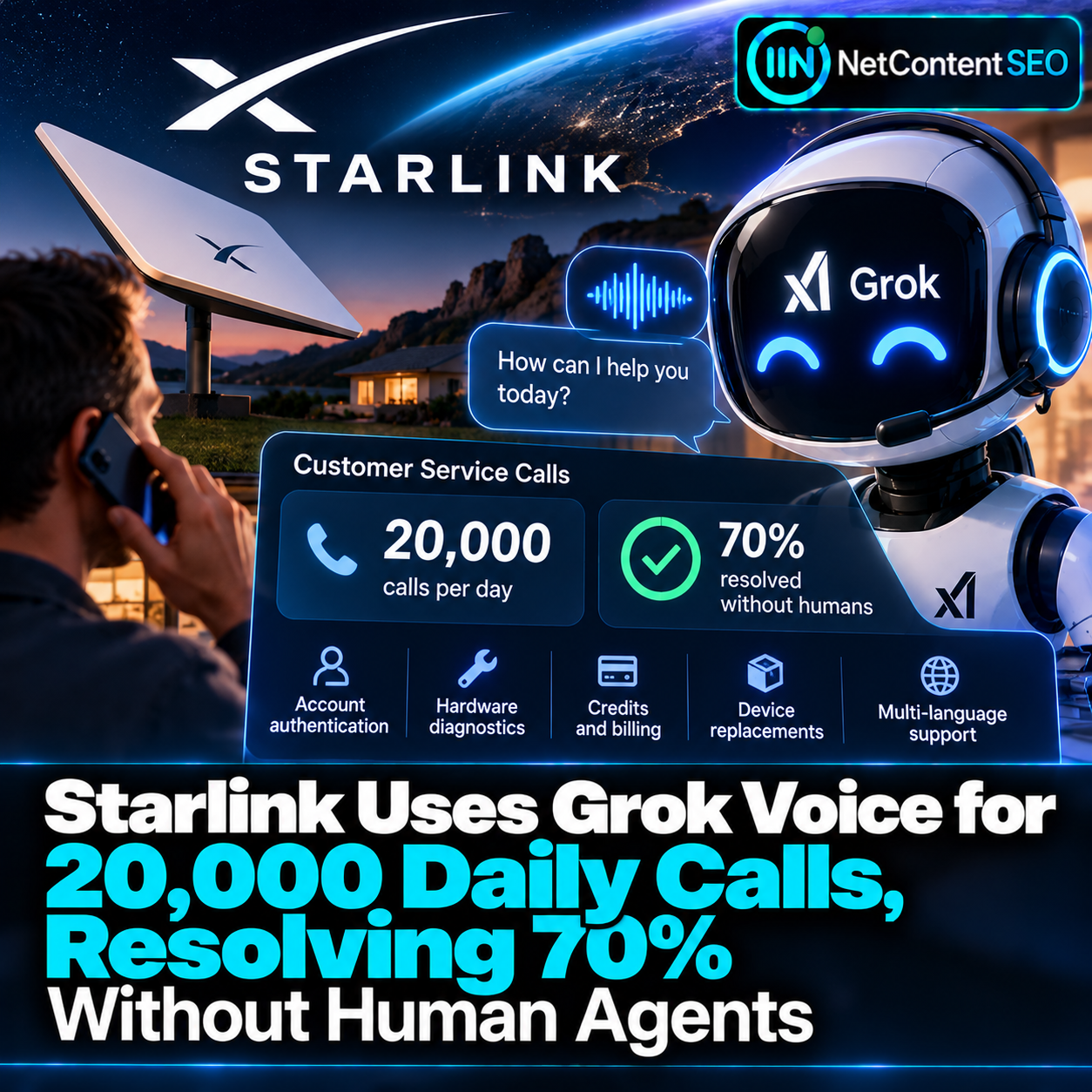

Starlink is providing a high-volume example of AI agents moving beyond scripted customer-service chatbots. According to xAI's official Grok Voice 3.0 announcement, the satellite internet provider uses Grok Voice to answer approximately 20,000 customer calls per day across multiple languages, with roughly 70% resolved without a human agent.
These are company-reported operational figures, not independently audited customer-service outcomes. Still, they offer a concrete illustration of how conversational AI is being deployed to complete real account and support tasks.
What Grok Voice does for Starlink customers
The company says a single Grok Voice agent can verify customer identities, troubleshoot Starlink hardware, issue account credits and arrange replacement equipment. Those actions go beyond generating a spoken answer: they require the assistant to access business tools, follow support workflows and change customer-account or fulfillment records.
Grok Voice supports interactions in multiple languages, although the announcement does not provide a complete language list or specify which categories of calls require escalation to human staff.
20,000 calls a day, with a reported 70% autonomous resolution rate
At the reported volume, 70% would correspond to approximately 14,000 calls per day handled without human involvement, if the percentage applies uniformly to the stated daily total. That is an illustrative calculation, not a separate company disclosure.
Crucially, an autonomous resolution rate is not necessarily the same as verified customer satisfaction or first-contact resolution. The company has not published the full measurement period, criteria for a resolved call, repeat-contact rates or independently audited outcomes. Businesses assessing similar systems should measure whether the customer's underlying problem was actually solved.
Grok Voice also participates in sales
The Grok Voice 3.0 announcement also states that one in four Starlink sales calls results in a purchase before the caller hangs up. This is a company-reported figure and should not be confused with the 70% customer-support resolution rate: the two metrics describe different call types and outcomes.
Combined, the figures suggest a model in which a voice agent supports both post-sale service and sales transactions. That is relevant to the emerging category of agentic commerce, in which assistants do not merely recommend products but can help complete operational steps in a purchase or service journey.
Grok Voice 3.0 pricing and developer availability
xAI says Grok Voice 3.0 is available through its Voice Agent API at $0.08 per minute, equivalent to $4.80 per hour of model usage, unchanged from Grok Voice 2.0. That rate is an API price, not the full cost of operating a customer-support center. Integration, monitoring, telephony, infrastructure, compliance and human escalation add to the real cost per resolved case.
Developers using the grok-voice-latest model alias have been moved to the new version automatically, according to the announcement.
Why voice agents are becoming operational systems
Traditional automated call systems generally route users through predefined menus. Modern voice agents aim to interpret natural-language requests, use tools and complete multi-step actions. For a Starlink customer, that might mean moving from describing a connection problem to running an approved diagnostic workflow or arranging an equipment replacement in the same conversation.
That capability increases the importance of access controls, identity verification, reliable tool calls, auditable changes and escalation paths. A voice assistant that sounds natural but incorrectly issues a credit or orders the wrong replacement can create more work than it saves.
What this means for SEO, AI visibility and customer journeys
For digital businesses, the implication extends beyond call centers. Discovery, evaluation, purchase and support can increasingly take place through AI-mediated interfaces rather than traditional website navigation. Clear product information, accurate support policies and dependable integrations can become as important as a well-optimized landing page.
However, this deployment does not demonstrate any change in search rankings, indexing or organic traffic. Its relevance to SEO is strategic: businesses may need to design information and workflows for customers who interact through agents, not only through browser pages.
NetContentSEO assessment
Starlink's Grok Voice deployment highlights the distinction between conversational AI and action-taking AI agents. The headline numbers—20,000 calls per day and 70% handled without people—are meaningful because the agent reportedly performs authentication, troubleshooting, credits and equipment replacement. The next test is whether those automated interactions deliver accurate, durable outcomes at a lower total cost, with appropriate safeguards and easy access to human support when needed.
Sources: xAI, Introducing Grok Voice 3.0; Digital Today.