

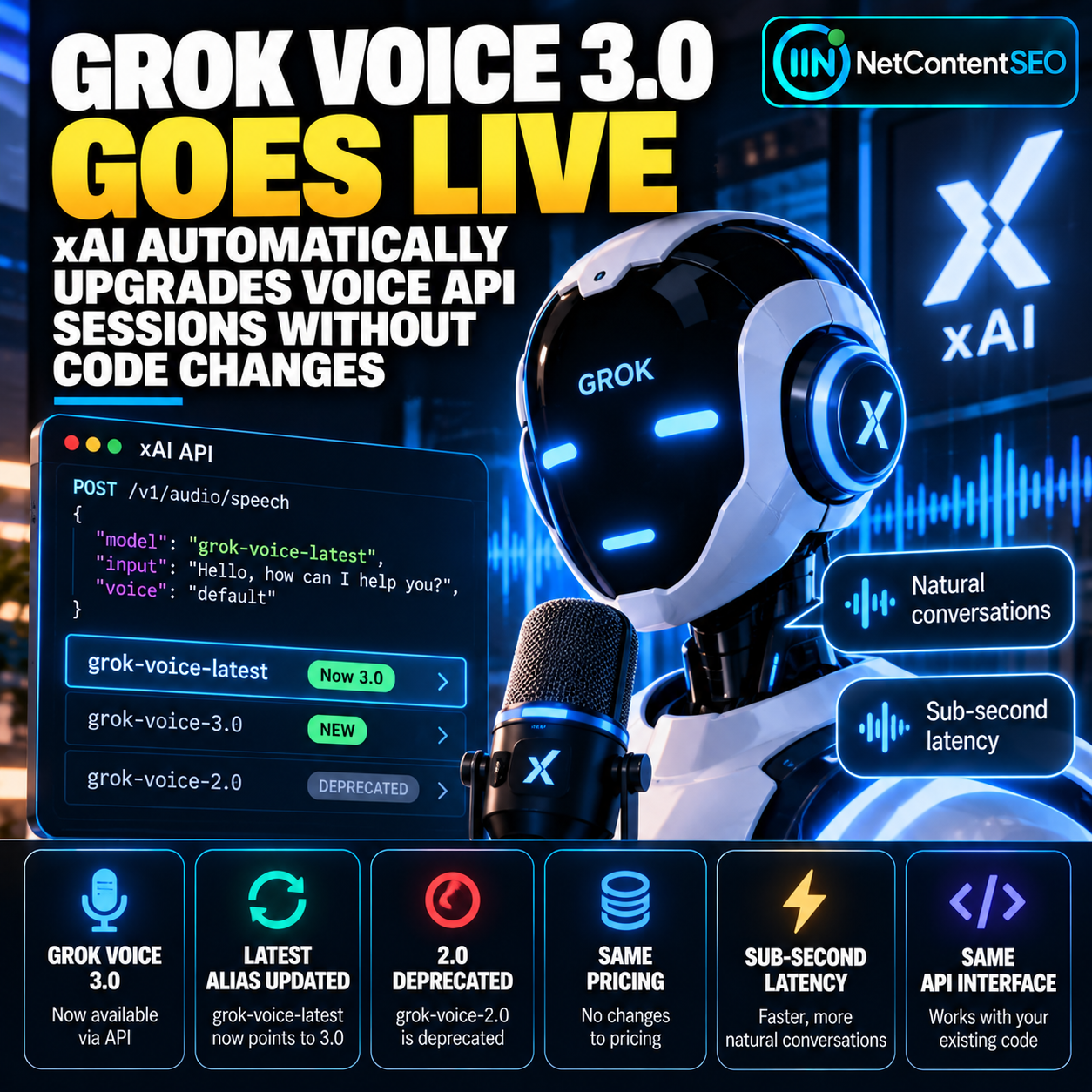

xAI has released Grok Voice 3.0, its latest speech-to-speech model, through the Voice Agent API. The 14 October 2026 release keeps the API interface and pricing unchanged, while automatically routing the grok-voice-latest alias to version 3.0. The previous grok-voice-2.0 model is now deprecated, so developers using the alias do not need to change their code to receive the new version.
xAI says Grok Voice 3.0 delivers speech-to-speech latency below one second. Its announcement also cites external benchmark results for speech reasoning, conversational turn-taking and task completion. These figures are useful context, but they should be read as benchmark-specific results rather than a guarantee that every real-world voice application will perform identically.
What changed in Grok Voice 3.0?
- New model:
grok-voice-3.0is available for speech-to-speech applications through the xAI API. - Automatic alias update:
grok-voice-latestnow points to Grok Voice 3.0, upgrading existing integrations that use the alias. - Previous version deprecated:
grok-voice-2.0is deprecated; developers can use the explicit 3.0 model name or the latest alias. - Same API interface: xAI says the API interface has not changed, so integrations using the alias do not require code changes for this version switch.
- Unchanged price: the Voice Agent API remains priced at $0.08 per minute, or $4.80 per hour, according to xAI.
- Sub-second latency: xAI reports latency below one second for the new voice model.
What the benchmark results say
In its announcement, xAI references testing by Artificial Analysis. The company reports a score of 86.9 on the Speech-to-Speech Index and 97% on Full Duplex Bench, which evaluates conversational dynamics such as pauses, turn-taking and interruptions. The published comparison also reports a 94.8% task-completion success rate in the listed benchmark.
These numbers describe specific evaluation setups and should not be collapsed into a single universal measure of voice quality. Performance in production will depend on the task, audio conditions, accents, background noise, system design and how success is defined.
xAI also cites ServiceNow's EVA-Bench, where Grok Voice 3.0 is reported to score 74% accuracy. Benchmark claims should be attributed to the named evaluations and the company's announcement; they are not independent guarantees of results for every customer deployment.
Why the automatic alias change matters
Model aliases such as grok-voice-latest let developers follow the provider's current version without editing an application each time a model is updated. In this release, xAI has switched the alias to version 3.0 and deprecated the explicit 2.0 identifier.
This reduces migration work for applications already using the alias, but it also means the model behind a stable identifier can change over time. Teams that require highly controlled releases may prefer to pin a specific model version, test updates in staging and review release notes before rolling a change into critical workflows.
Where low-latency speech-to-speech can help
Voice agents are used in customer support, hands-free assistants and other interactive workflows where a long pause can make the conversation feel unnatural. Lower latency can help an agent respond more fluidly, but latency is only one part of the experience: accuracy, interruption handling, task completion, safety and escalation to a human also matter.
xAI says Grok Voice powers millions of conversations a day across Tesla and SpaceX. The announcement also describes use in Starlink call centres, where the company says the system handles 20,000 customer calls daily across multiple languages and resolves roughly 70% without a human agent. Those operational figures are reported by xAI and should be understood in that context.
What developers should do
- Check the model identifier. Confirm whether your application uses
grok-voice-latestor pinsgrok-voice-2.0. - Review deprecation notices. If your integration explicitly names version 2.0, plan a change to
grok-voice-3.0or the latest alias. - Run representative tests. Test real call flows, interruptions, noisy audio, language coverage, latency and fallback behaviour before relying on the update in a critical environment.
- Monitor production quality. Track task completion, transfer-to-human rates, error patterns and cost—not just response speed.
- Decide between aliases and pinned versions. Use an alias for convenient automatic updates when appropriate; pin a version when reproducibility and controlled rollout are more important.
Does this change Grok Search or SEO?
No search-engine or crawler change is announced in this release. Grok Voice 3.0 is a speech-to-speech API update, not an announced change to Grok Search, web crawling, ranking or AI citation behaviour.
For SEO and AI Search teams, the relevance is indirect: voice interfaces are another way people may interact with AI products, and companies building voice-enabled customer experiences may use the API. However, this release alone does not establish that websites will receive more or fewer citations, or that search visibility signals have changed.
The takeaway
Grok Voice 3.0 is available through xAI's Voice Agent API, with sub-second latency claimed by xAI, unchanged pricing and an automatic switch of grok-voice-latest to the new model. The previous grok-voice-2.0 model is deprecated, while the API interface remains unchanged. Developers should verify whether they use a pinned version or the alias, test production workflows and treat the published benchmarks as results from specific evaluations—not universal performance guarantees.