

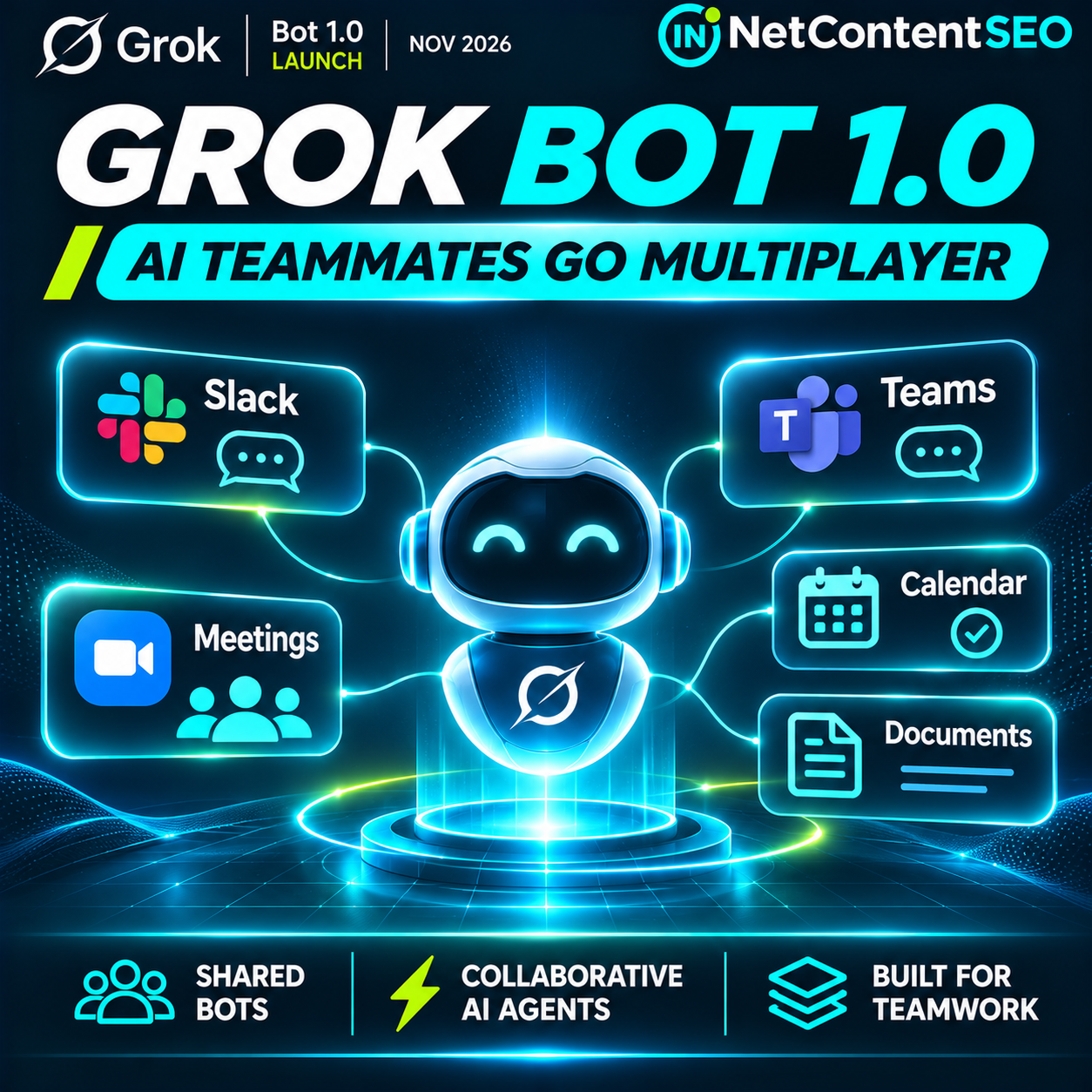

Grok Bot 1.0 brings AI teammates into shared workplace conversations. In an official announcement, xAI describes Bots that can be shared across teams, participate in Slack and Microsoft Teams, join video meetings, and offer to help with work without waiting for a new prompt. The release represents a shift from an individual AI assistant to a collaborative agent operating within a team's existing workflow.
The chronology deserves precision. The official launch article is dated November 2, 2026, while xAI's November 11 changelog lists version 1.0.1, including 1.0.0, and details meeting participation, Microsoft Teams integration and shared connectors. Public coverage and launch promotion intensified around November 11. This is a confirmed product release, but the vendor's claims about improved speed, reliability and efficiency have not been substantiated by independent comparative benchmarks in the materials reviewed.
What changed in Grok Bot 1.0?
xAI groups the update into three areas. First, multiplayer teammates allow several people to use a shared Team Bot, with context accumulated from collaboration. Second, proactive teammates can identify unfinished work and offer to take it on. Third, xAI says Bots are more capable at browser tasks, document writing and presentations, while requiring fewer resources for certain jobs.
The distinction between these capabilities is important. Shared Bots are a collaboration feature; proactive suggestions are a workflow behavior; and improved task execution is a performance claim. The official announcement describes all three, but it does not publish a reproducible test suite or numerical speed and success-rate improvements.
Shared Bots in Slack and Microsoft Teams
Team Bots can be made available to specific colleagues or groups. In Slack, a Bot can participate in conversations and provide assistance in the same workspace where people already coordinate projects. Microsoft Teams integration enables channel mentions, direct conversations and group chats, subject to administrator approval.
According to xAI's Microsoft Teams documentation, a team must have a published Team Bot. A team administrator enables Microsoft Teams in the Grok Bot dashboard, and a Microsoft Teams or Global administrator authorizes the integration. The Bot's owner or a Manager can then connect it. This is not a universal one-click feature available to every account.
The Bot acts in the context of the person who requested an action and uses that person's usage allowance. It asks before risky operations. For businesses, these distinctions matter because an agent that can answer a question is not necessarily authorized to send a message, open a document or change a connected service on behalf of every participant.
Grok Bot joins meetings—but does it speak?
xAI documents meeting support for Google Meet, Zoom and Microsoft Teams. A user can paste a meeting link into a Bot conversation and ask it to join. After approval, the meeting host admits the Bot, which appears as a participant identified as transcribing.
The Bot can listen, take notes, answer questions in the meeting chat and send a summary and action items afterward. Users can also request the summary or transcript of a past meeting. Some scheduled meetings can be joined automatically when a Bot follows the relevant calendar.
Crucially, the documented interaction in meetings is through chat. The available release documentation does not establish that the Bot holds a natural, spoken, back-and-forth conversation with participants during the call. Describing it as a fully conversational voice participant would overstate what the source confirms.
Meeting participation is available on Team, Enterprise and Ultra plans. Enterprise administrators can enable or disable Meetings. The meeting organizer and host should ensure that participants understand when transcription and AI note-taking are taking place and that applicable consent and workplace policies are followed.
Proactive agents: initiative without unrestricted autonomy
xAI says Grok Bots can notice work that needs attention, offer to continue an unfinished task and bring humans into decisions requiring judgment. For example, an agent might recognize that a document still needs revisions or that a follow-up is outstanding. That is different from promising that every Bot can autonomously execute any task without supervision.
The release emphasizes human approval for sensitive actions. In shared environments, a Bot is also supposed to check whether information is suitable for the audience before posting it in a public channel. These safeguards are vendor-described design behaviors; organizations should verify them in their own environment before granting access to sensitive information.
Team memory, reviewed learning and shared connectors
A Team Bot can retain information about a team's working practices, decisions and preferences. This may reduce repeated instructions across projects, but shared memory introduces governance questions: who can teach the Bot, who can approve a new rule, and which information should never become shared context?
The November 11 changelog describes a Review learnings step: information taught to a Team Bot by colleagues waits for approval by its owner or a Manager. Team administrators can restrict Bot sharing. Owners and Managers may also share an application login as a connector, but only after an administrator enables the Allow Shared Logins setting.
Those controls are particularly relevant to security and compliance. Sharing a connector can give an AI teammate access to business data, and the fact that multiple people can interact with a Bot does not mean all of them should have equivalent permissions.
What else improved since beta?
xAI reports better website navigation and sign-in handling, more capable document and slide generation, collaborative interactive Pages, and improved connections to services including Gmail, Google Calendar and GitHub. It also describes smarter approval handling and additional Bot settings and analytics.
These are useful operational claims, but readers should separate a feature's existence from its measured reliability. The launch announcement does not quantify how often browser tasks succeed, how much time users save, or how many resources are consumed relative to earlier versions or competing products.
Availability and plans
The official launch says Grok Bot 1.0 is available, with Team Bots on Team and Enterprise plans and Meetings on Team, Enterprise and Ultra plans. Some capabilities require administrative configuration. The announcement does not give a comprehensive price table, so buyers should check current official pricing and plan documentation before budgeting a deployment.
Availability of a plan also does not guarantee that a particular organization has enabled every integration. A Teams administrator, a Bot owner and, in some cases, an enterprise administrator each have a role in authorizing specific features.
Why this matters for SEO and AI Search
The most important SEO implication is not a new ranking signal. Grok Bot 1.0 is an agent collaboration release, not an announcement that xAI has changed search indexing or citation rules. Its significance is that research, discovery and content-related work can increasingly take place inside team conversations and agent workflows.
Consider a marketing team asking a shared Bot to research competitors, compare product claims and prepare a presentation. The agent may retrieve information through the browser, summarize it for colleagues and produce a document without each team member visiting every source. A publisher's content could influence the deliverable even when traditional website referral data captures only part of the research process.
That is a plausible implication of agent-mediated workflows, not a measured change in traffic caused by this release. xAI has not published publisher-facing citation attribution or referral studies demonstrating a specific effect from Grok Bot 1.0.
From search visibility to workflow inclusion
Traditional SEO often asks whether a page ranks and receives clicks. Agentic discovery adds another question: can a system find, understand and use reliable information about an organization while completing a task? Clear official documentation, consistent entity information, accessible product details and trustworthy third-party corroboration can support accurate retrieval and interpretation.
However, the presence of those elements does not guarantee that Grok Bot will choose a particular brand. The release does not reveal a Grok Bot source-ranking formula, a new markup requirement or a way to buy organic inclusion in its outputs.
For GEO practitioners, it is important to separate source retrieval, answer mention, visible citation, website visit and completed business action. Those are distinct events, and none should be inferred solely from another.
A practical evaluation plan for businesses
- Confirm entitlement. Verify that the relevant Team, Enterprise or Ultra plan includes the intended Bot or Meetings feature.
- Configure administrators first. Enable only the required Slack, Teams, meeting and connector integrations.
- Choose one limited workflow. Start with a low-risk task such as meeting notes, a research brief or a document draft.
- Define access boundaries. Test whether the Bot respects different users' permissions and avoids exposing restricted material in shared channels.
- Review learning approvals. Decide who can approve shared knowledge and how incorrect or sensitive information is corrected.
- Test a meeting transparently. Notify participants, obtain necessary permissions, admit the Bot and inspect the resulting notes and action items.
- Audit citations and facts. Open original sources and verify claims before distributing a research report or publishing content.
- Measure accepted work. Track human review time, successful task completion, errors and usage cost—not merely the number of Bot messages.
- Recheck integrations after updates. Version changes can alter permissions, approval flows or user-visible behavior.
What remains unverified?
The official material does not establish independent performance benchmarks, universal rollout across all accounts, a single fixed cost per task, or guaranteed success for complex browser workflows. It also does not show that meeting Bots can speak aloud in natural dialogue or that proactive behavior overrides human approvals.
For SEO specifically, no measured increase or decrease in publisher traffic, AI citations or conversion rates has been tied to Grok Bot 1.0. Claims about such effects would require separate evidence.
Frequently asked questions
What is Grok Bot 1.0?
It is xAI's major update to its AI teammates, adding broader sharing and collaboration, proactive work suggestions and vendor-reported improvements to task execution.
When was Grok Bot 1.0 released?
The official product article is dated November 2, 2026. The public changelog records version 1.0.1 on November 11, including version 1.0.0, and public launch promotion appeared around that later date.
Can Grok Bot work in Slack and Microsoft Teams?
Yes. Shared Team Bots can work in those collaboration environments, subject to plan eligibility and required administrator permissions.
Can Grok Bot join Zoom or Google Meet?
Yes. xAI documents support for Google Meet, Zoom and Microsoft Teams meetings on eligible plans.
Can it talk during a video meeting?
The documentation confirms that the Bot can listen and answer in meeting chat, then provide notes and summaries. It does not confirm full spoken back-and-forth participation.
Can Grok Bot take action without a new prompt?
xAI says Bots can identify unfinished work and offer to take it on. Sensitive actions still require appropriate approval.
Does a shared Bot remember what teammates teach it?
It can learn team preferences and working context. The November update adds a review step before newly taught information is approved for shared learning.
Which plans support shared Team Bots?
xAI lists Team and Enterprise for Team Bots. Meetings are listed for Team, Enterprise and Ultra.
Does Grok Bot 1.0 change search rankings or GEO citations?
No ranking or citation algorithm change was announced. Its GEO relevance is indirect: agents can discover, use and summarize information inside business workflows.
Is Grok Bot 1.0 faster than competing agents?
xAI claims improvements in speed, reliability and resource use, but the launch materials do not provide independent comparative measurements.
The bigger shift: AI agents become colleagues in the workflow
Grok Bot 1.0 is a concrete example of agentic AI moving from individual prompts toward shared, persistent collaboration. The product can now participate in more of the places where teams already coordinate work, including chat channels, meetings and connected applications.
The next competitive questions will be practical: Can these agents respect permissions, preserve context accurately, deliver reliable results and justify their cost? For SEO and AI Search, the parallel question is whether organizations remain discoverable and correctly represented when information is selected and acted upon by agents rather than only by human searchers.