

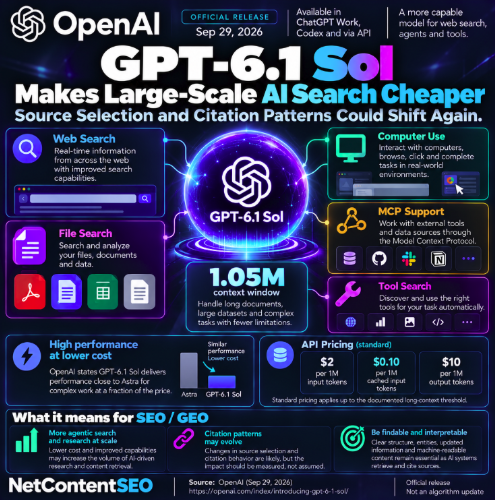

OpenAI released GPT-6.1 Sol on September 29, 2026, positioning the model as a lower-cost option for complex coding, computer use and professional work with performance approaching GPT-6 Astra.
For AI search and GEO, the important combination is capability plus economics: GPT-6.1 Sol supports built-in web search and a broad tool stack while standard token pricing is one-fifth of Astra's corresponding $10 input / $50 output rates.
Web search is a native supported tool
GPT-6.1 Sol supports OpenAI's web search through the Responses API. Agentic web search allows a reasoning model to search, inspect results and decide whether additional searches are needed before producing an answer with sourced citations.
That makes the model directly relevant to source discovery: it can participate in multi-step research workflows rather than relying only on knowledge encoded during training.
File search, computer use, MCP and tool search are supported
The official model documentation lists web search, file search, computer use, MCP and tool search among GPT-6.1 Sol's supported tools. It also supports function calling, structured outputs, code interpreter, hosted shell and other agentic capabilities.
Tool search is particularly relevant to large agent environments because it allows the model to discover and load tools dynamically instead of placing every tool definition into the context in advance.
A 1.05-million-token context window
GPT-6.1 Sol has a 1,050,000-token context window and supports up to 128,000 output tokens.
Long context can matter in research workflows involving many retrieved pages, large document collections or extensive tool output, although context capacity alone does not guarantee better source selection.
Standard API pricing starts at $2 input and $10 output
For prompts within OpenAI's standard long-context threshold, GPT-6.1 Sol costs $2 per million input tokens, $0.10 per million cached input tokens and $10 per million output tokens.
OpenAI describes the model as delivering near-Astra performance at substantially lower cost. Its developer materials characterize Sol's standard token prices as one-fifth of Astra's.
Lower cost can make agentic research easier to scale
The SEO implication is economic rather than an announced ranking change. When a capable reasoning model with web search becomes cheaper to run, developers can potentially execute more research tasks, process more documents and deploy more agentic retrieval workflows within the same budget.
That could increase the volume of machine-driven discovery occurring across the web.
Could source selection and citation patterns change?
Potentially — but this needs measurement. A new model can formulate different searches, evaluate retrieved evidence differently or decide to continue searching where another model would stop.
Those behavioral differences can affect which pages ultimately become sources. However, OpenAI has not announced a GPT-6.1-specific crawler, citation-ranking algorithm or guaranteed change in source selection.
Any shift in cited domains, source diversity or retrieval depth should therefore be established through controlled comparison rather than assumed from the release.
The NetContentSEO view
GPT-6.1 Sol matters for GEO because it lowers the cost of combining reasoning, web retrieval, large context and tool use in the same workflow.
If developers increasingly use models like Sol for high-volume research and autonomous agents, publishers may face more discovery journeys where machines search, evaluate and synthesize their content before a human ever visits the page.
The optimization principle remains familiar: be crawlable, clearly structured, current and easy for retrieval systems to interpret. But the scale at which AI agents can perform that retrieval may continue to increase as capable models become cheaper.