

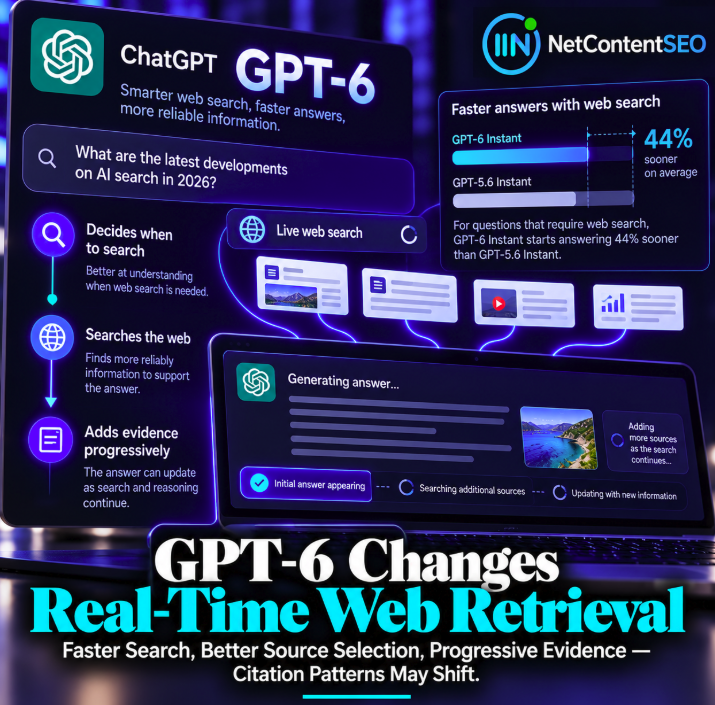
GPT-6 changes more than ChatGPT's model intelligence. OpenAI says it also changes when the system decides to search the web, how reliably it finds supporting information and how quickly a web-grounded answer begins appearing.
For publishers tracking AI citations, that matters because retrieval is not merely a hidden technical step. It determines which sources enter the model's evidence set — and GPT-6 can now continue searching and reasoning while the answer is already being delivered.
GPT-6 decides better when web search is necessary
In its October 7, 2026 launch documentation, OpenAI says GPT-6 improves answers that require web search in two ways.
First, it makes better decisions about when to look something up. Second, it more reliably finds information that supports the answer.
This means retrieval quality begins before a source is selected. The model must first recognize that its internal knowledge is insufficient or that current external evidence is needed.
Web-search answers begin 44% sooner
OpenAI reports that, for questions requiring web search, GPT-6 Instant starts answering 44% sooner on average than GPT-5.6 Instant.
The number comes from OpenAI's own evaluation and should therefore be treated as a first-party benchmark rather than an independently reproduced measurement.
It also describes time until the answer begins, not necessarily total task-completion time.
The answer no longer has to wait for all retrieval to finish
The architectural change behind that speed is especially interesting.
OpenAI says GPT-6 can begin answering while it continues to think or use tools, then add further findings without requiring another prompt.
In other words, retrieval, reasoning and presentation can overlap.
The user can begin reading an initial answer while the model continues gathering evidence.
Search becomes a progressive process
Traditional descriptions of retrieval-augmented generation often sound sequential: retrieve documents, reason over them, produce an answer.
GPT-6's user experience can be more dynamic.
An answer may start with the evidence already available and then gain additional details as further searches or reasoning complete.
That makes the visible response closer to a progressively assembled research result than a static final document delivered only after every lookup has ended.
Why this could matter for citations
A citation is downstream of several decisions: whether to search, what query to issue, which results to retrieve, which evidence to trust and which claims need attribution.
If GPT-6 changes those decisions, the distribution of cited sources can change even when the user's prompt remains identical.
A publisher could therefore gain or lose citation visibility because of retrieval behavior rather than because its traditional Google ranking changed.
Faster retrieval does not mean the first source always wins
The 44% figure should not be interpreted as evidence that GPT-6 simply takes the earliest available search result and stops.
OpenAI explicitly says the model can continue thinking and using tools after the response begins.
That leaves room for later evidence to refine, expand or potentially supersede earlier information.
For GEO measurement, this means the timing of a citation may become as interesting as its final presence.
Initial citations and final citations may deserve separate measurement
If a response evolves during generation, AI visibility platforms may eventually need to distinguish between the first evidence surfaced and the final evidence present after the answer stabilizes.
A source might appear immediately and remain. Another might enter only after a deeper search. A third might support an intermediate statement but disappear from the completed answer.
OpenAI has not published a formal citation-stage taxonomy, so this is a measurement implication rather than a documented ranking mechanism.
But progressive generation makes the distinction technically relevant.
Source selection becomes a more important optimization target
Classic SEO asks whether a page can be crawled, indexed and ranked.
AI Search adds another question: is the page likely to be selected as useful evidence when the model performs live retrieval?
That depends on much more than merely existing in an index.
Freshness, topical specificity, clear factual statements, identifiable entities, original evidence and source authority can all affect how useful a document is for answering a particular question, although OpenAI has not published a deterministic GPT-6 citation-ranking formula.
The retrieval window may become more fluid
Progressive web search also suggests a less static concept of the retrieval window.
Instead of assuming the model collects one fixed set of sources before writing, publishers should consider that additional evidence may be discovered while the answer is already forming.
For breaking news and rapidly changing topics, that could be particularly important.
A newly published authoritative source may enter a later retrieval step even if it was not part of the model's initial evidence.
Freshness can matter at answer time
Live web search already makes publication timing important for AI visibility.
GPT-6's improved decision about when to search reinforces that dynamic.
When the model recognizes that a question requires current information, the available web at that moment becomes part of the competitive environment.
This is one reason fast indexing, clear timestamps, updated factual information and accessible pages matter for publishers covering time-sensitive subjects.
Better search decisions could also reduce unnecessary retrieval
“Better decisions about when to look something up” has another side.
A model that more accurately determines that web search is unnecessary may retrieve fewer external sources for some questions.
That means improved model behavior does not automatically imply more citation opportunities for publishers.
For certain prompts, better internal reasoning could reduce external retrieval; for others, better recognition of freshness or factual uncertainty could increase it.
Citation volatility may reflect the model, not only the web
SEO teams often investigate citation changes by looking for page edits, ranking shifts, indexing changes or competitor activity.
Model upgrades introduce another variable.
If GPT-6 uses a different decision policy for invoking search or selecting evidence than GPT-5.6, citation patterns can shift even when the underlying web documents remain unchanged.
AI visibility monitoring should therefore annotate major model releases alongside content and ranking changes.
Benchmarking needs model-level segmentation
A citation benchmark that mixes GPT-5.6 and GPT-6 responses can hide the effect of the model transition.
Teams tracking AI visibility should record the model family, date, prompt, search state and ideally the full set of visible sources for each observation.
That allows changes in citation rate or source diversity to be compared against the rollout timeline rather than attributed automatically to SEO activity.
The 44% speed gain is a UX metric, not a citation-quality metric
OpenAI's performance claim concerns how soon GPT-6 Instant starts answering when web search is required.
It does not demonstrate that citations are 44% faster, 44% more accurate or 44% more diverse.
OpenAI separately states that GPT-6 more reliably finds supporting information, but the company has not published a publisher-level citation benchmark showing how individual domains gain or lose visibility.
Those questions require independent measurement.
Progressive answers complicate AI visibility testing
Researchers should also be careful about when they capture a response.
If GPT-6 can add findings while search continues, recording the output too early could miss later citations or updated claims.
Automated monitoring systems may need to wait for a clearly completed response state rather than scrape the first visible text.
For longitudinal studies, that collection method should remain consistent.
What publishers can do now
The practical response is not to chase an undocumented GPT-6 ranking formula.
Publishers should instead strengthen the properties that make a source useful during live retrieval: crawlability, fast access, precise titles and headings, current information, explicit authorship, original evidence, clear entity relationships and unambiguous factual statements.
They should also monitor whether important pages appear across repeated prompts and follow-up questions rather than treating one citation as proof of stable visibility.
NetContentSEO take
GPT-6 turns web retrieval into a more visibly real-time part of answer generation.
OpenAI says the model is better at deciding when to search, more reliable at finding evidence and able to start web-search answers 44% sooner while reasoning and tool use can continue.
For GEO, the important implication is not simply speed.
The retrieval process itself is changing. Source-selection windows may become more dynamic, evidence can arrive progressively, and model upgrades can alter citation patterns even when the web has not changed.
AI visibility teams should therefore measure more than “was I cited?” They should measure which model retrieved the source, at what stage of the conversation, whether the citation persisted and what evidence ultimately shaped the completed answer.