

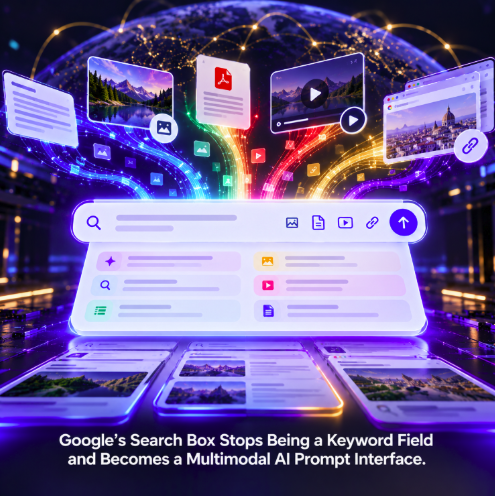

Google is redesigning the most recognizable interface in web search around a new assumption: a search request no longer has to be a short string of keywords. Its new intelligent Search box can expand as a user describes a more complicated need, suggest ways to formulate the request with AI, and accept text, images, files, videos and Chrome tabs as inputs to the same search.
Google unveiled the redesign at I/O 2026 and described it as the biggest upgrade to the Search box in more than 25 years. The rollout began May 19 across all countries and languages where AI Mode is available. Rather than introducing a separate experimental input surface, Google is bringing prompt-like behavior into the familiar starting point of Search.
For publishers and SEO teams, the important shift is conceptual. Search demand can now be expressed through a combination of natural language and user-supplied context rather than being compressed into a few words. A photograph, PDF, video or open browser tab can become part of the information need before Google decides what to retrieve from the web.
Autocomplete is becoming AI-assisted query formulation
Google says the redesigned box is built to anticipate intent and provide AI-powered suggestions that go beyond conventional autocomplete. The difference is meaningful. Autocomplete historically helps users complete a likely text query. An AI suggestion can instead help articulate a task whose wording is not yet fully formed.
The box also expands dynamically to provide more room for detailed requests. That physical change mirrors what has already happened inside AI Mode, where users routinely submit longer, more nuanced questions than they would in conventional Search.
Google says AI Mode queries have been more than doubling every quarter and that the product has surpassed one billion monthly users. The interface redesign therefore follows observed behavior: as people ask Search to handle more complex tasks, the input field itself is being rebuilt to accommodate them.
The query can now contain a document, image, video or browser context
The multimodal input list is unusually broad. Google explicitly says users can search using text, images, files, videos or Chrome tabs, and that Search can reason across those inputs.
That means the search box can receive context that previously would have required separate products or workflows. A user can bring an image into a question, attach a document that needs interpretation, supply video context or ask Search to reason across pages already open in Chrome.
Google had already demonstrated this direction in April with its AI Mode integration in Chrome. On Chrome desktop and mobile, users can select recent tabs through the plus menu and mix multiple tabs with images or files such as PDFs. Google’s example includes a student combining class notes, lecture slides and academic papers with open tabs, then asking AI Mode for additional examples.
The I/O redesign turns that behavior into a broader Search-interface principle: the query is no longer necessarily something the user types. It can be a package of context.
For SEO, the keyword is becoming only one component of intent
Keywords are not disappearing. Text remains one of the supported inputs, and conventional Search results continue to exist. But a keyword-only model of demand becomes less complete when the system can begin with visual, documentary and browsing context.
Consider a user who uploads a photograph of a damaged component and asks how to replace it. The underlying information need may never contain the exact product terminology that an SEO team expects to see in a keyword tool. Google can use the image to infer objects and attributes before retrieving supporting information.
A researcher might attach a technical PDF and ask for evidence that challenges one of its claims. A shopper could supply several Chrome tabs and ask Search to compare the products against a personal constraint. A traveler could combine screenshots, an itinerary file and a natural-language request.
In each case, the explicit text is only part of the query representation. The rest comes from supplied context.
Chrome tabs turn browsing history into active search context
The ability to attach recent Chrome tabs is particularly important because it collapses the boundary between browsing and searching. A page the user is already reading can become an input into the next retrieval step without requiring the user to summarize it manually.
Google says AI Mode can use selected tabs to provide a tailored response and recommend additional websites to explore. In practical terms, a publisher’s page can therefore participate in a search journey in two roles: as a result Google retrieves, or as context the user explicitly feeds into the next search.
This creates a discovery path that conventional rank tracking does not model well. A user may arrive on one website through any channel, attach that page to AI Mode and then ask Google to find alternatives, corroborating sources or related information. The original page has helped shape the next query even if it is not the destination of the next click.
Multimodal discovery is becoming measurable in Search Console
Google’s interface changes are arriving alongside new measurement tools for publishers. Search Console now includes reporting designed to expose web visibility from multimodal search experiences.
NetContentSEO recently covered Google’s multimodal Search Console reporting for Lens and visual discovery. That reporting helps publishers isolate a class of searches that may begin with an image rather than a conventional typed query.
The new Search box makes that measurement direction more important. As modalities converge inside one interface, analytics teams need ways to distinguish how discovery began rather than assuming every Search impression originated from text.
AI suggestions can shape the question before ranking begins
The AI-powered suggestions introduce another layer that matters for discovery. Search engines have long influenced query formulation through autocomplete and related searches. A more intelligent prompt-assistance layer can potentially help users express constraints, broaden a question or turn an ambiguous thought into a more actionable request.
Google has not published a deterministic formula for those suggestions, nor has it said publishers can optimize directly for them. The important point is that query formation itself is becoming more mediated by AI.
For SEO analysis, this means the observed search phrase may increasingly be the output of an interaction between the user and Google rather than a pristine statement of the user’s original wording. The distinction matters when teams infer intent from query strings.
The Search box is becoming the entry point to a conversation
Google is also eliminating some of the friction between conventional Search, AI Overviews and AI Mode. Users can ask a follow-up directly from an AI Overview and move into a conversational exchange with AI Mode while retaining context.
Google says the supporting links and articles can become more relevant as the user explores more deeply. The search box therefore no longer marks the beginning of an isolated request followed by a static results page. It can start a stateful sequence in which the information need evolves.
NetContentSEO has documented the same trajectory in AI Mode’s experiments with automatic follow-up queries. Those tests push the model even further by letting Google suggest or generate the next step in the search journey.
Query fan-out becomes more consequential when the starting prompt is richer
AI Mode already uses query fan-out to break complicated questions into multiple related searches. A multimodal prompt gives that mechanism richer material to reason over before the fan-out begins.
A document may contain entities, claims and terminology that generate several subqueries. An image can contain multiple objects whose relationships need investigation. A group of browser tabs can reveal which options the user has already considered, allowing Search to look for missing alternatives or comparisons.
That creates a potentially much larger retrieval space than the visible wording in the search box suggests. NetContentSEO has examined how Google is beginning to expose aspects of query fan-out through AI Mode’s interface. Multimodal inputs make that decomposition problem even more central to understanding source visibility.
Publishers need content that remains useful when the user supplies the context
Traditional SEO often starts from the question, “What query will lead someone to this page?” Multimodal AI Search introduces the reverse scenario: the user may already have a page, image, document or video and ask Google what to do next.
That favors content that contains clear, extractable evidence and relationships. Product specifications should be explicit rather than hidden behind ambiguous interface elements. Images benefit from meaningful surrounding context. Video content benefits from understandable titles, descriptions and supporting text. Documents should make entities and claims easy to interpret.
This is not because Google has announced a special ranking factor for multimodal prompts. It is because richer source material gives retrieval and reasoning systems more usable information when the starting query itself is no longer purely textual.
Search still promises links, even as the input becomes more AI-native
Google is careful to say that users will continue receiving a range of Search results. The redesigned box is not presented as the elimination of web results in favor of a closed chatbot.
At the same time, the journey to those results is changing. AI can help formulate the question, reason across uploaded context, decompose the request into additional searches and continue the interaction after the initial response.
That makes the relationship between query and result less linear. A publisher may become relevant because of a subquestion inferred from a file, a detail recognized in an image or a comparison triggered by another browser tab rather than because the user explicitly typed the publisher’s target keyword.
The redesign is rolling out wherever AI Mode is available
This is not a U.S.-only experiment. Google says the intelligent Search box began rolling out across all countries and languages where AI Mode is available. That is broader than the April Chrome upgrade, which initially launched in the United States before Google said it would expand internationally.
The distinction matters when interpreting screenshots or user reports. Individual interface availability can still vary during rollout, but Google’s stated deployment target is the global AI Mode footprint rather than a limited Search Labs test.
Search is becoming an interface for expressing problems, not merely entering terms
The search box has survived decades of interface change because its job was simple: turn a typed query into results. Google’s I/O redesign changes the job itself.
The new box can expand around a complex request, help formulate that request with AI and accept several kinds of context that cannot be represented faithfully as keywords. It then feeds into an AI Mode system capable of reasoning across those inputs, searching multiple subtopics and continuing the session conversationally.
For SEO, that does not make keywords obsolete. It makes them one signal inside a larger expression of intent. The optimization target is shifting from matching a phrase toward supplying evidence that remains discoverable when Search understands the user through text, images, documents, video and browsing context at once.
Google still calls it a Search box. Functionally, it is becoming a multimodal prompt interface to the web.