

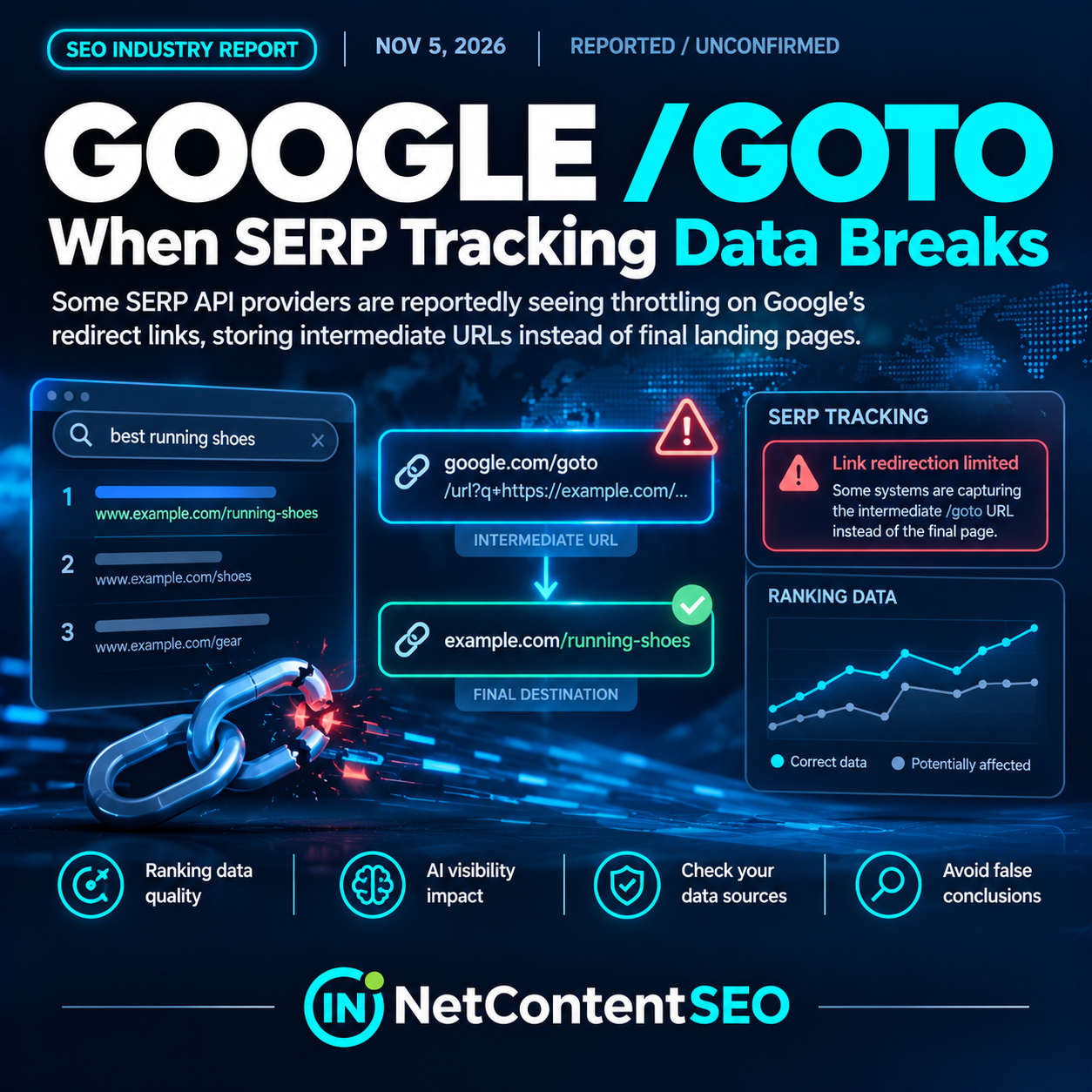

November 6, 2026. Several SERP API providers report that Google has begun slowing the resolution of its google.com/goto redirect links, causing some automated ranking datasets to contain Google intermediary URLs rather than the actual destination pages. The incidents began around October 30, according to provider status reports. This is a data-collection integrity issue, not evidence that affected websites have necessarily lost their organic positions.
Google previously confirmed the rollout of its /goto link format in August 2026, but it has not publicly confirmed the newly reported per-results-page throttling mechanism. The latest observations come from vendors including DataForSEO, Serper and SerpApi. SEO teams should treat the reported mechanism as vendor evidence and audit their own exports before interpreting apparent URL-level ranking losses.
What changed: the redirect layer between the SERP and the website
Instead of exposing a direct destination URL in every search-result link, Google increasingly uses an intermediary such as https://www.google.com/goto?.... A browser can follow the link to reach the target site. But an automated data collector that needs the final URL for each organic result must resolve the redirect before storing a clean landing-page address.
In August, Search Engine Roundtable reported Google's confirmation that the /goto rollout was taking place. Google's spokesperson framed the change as part of broader technical measures to protect services and users against abuse. That confirmation applies to the redirect rollout; it should not be misrepresented as a Google statement confirming the October throttling behavior.
On November 5, Search Engine Journal documented provider reports that following multiple /goto links from one results page can trigger increasing delays or a verification screen. Some APIs consequently return the Google redirect instead of the destination page.
What the vendors observed
DataForSEO described a per-results-page limit: in one example involving 18 result links, the first five or six could resolve immediately, while later links incurred escalating waits. It reported instances of waits as long as 120 seconds for one URL. According to its account, rotating IP addresses or changing queries did not remove the limitation because the control was associated with the original results page.
Serper recorded an incident beginning at approximately 01:30 UTC on October 30. Its initial mitigation resolved the top three organic links and returned /goto links for some remaining results; the company also added a /resolve endpoint. On October 31 it reported another method for obtaining destination URLs, while describing that approach as potentially temporary.
SerpApi recorded incidents involving intermediary URLs on October 30 and again on November 3, after an initial fix. Its earlier September explanation also makes clear why this matters: titles, snippets and positions can remain available while the URL field becomes unreliable. A status marked fixed at one moment does not prove that every provider, endpoint and collection mode remained unaffected afterward.
Separately, cloro published measurements from October 30 describing verification waits and differences between providers. Those figures are vendor-reported observations under particular testing conditions, not a universal failure rate for all rank trackers.
Why a URL can appear to disappear without losing its ranking
Imagine a tracker that normally records example.com/category/shoes in position four for a keyword. On the next crawl, the SERP still contains the same result in the same position, but the API stores google.com/goto?... in the landing-page field. A URL-level dashboard comparing yesterday's and today's records may interpret that mismatch as the original page disappearing.
The underlying search result may not have changed at all. The broken step is the mapping between the observed result and its final destination. This can create false landing-page churn, incorrect attribution of rankings to Google URLs, missing-page alerts and misleading competitive reports.
The problem does not automatically invalidate every ranking position, title or snippet collected by an affected provider. Its effect depends on the fields, endpoint, collection mode and vendor workaround. A keyword-position report and a landing-page-level report may have different reliability during the same period.
What about AI Overview, AI Mode and AI visibility data?
The same redirect format has appeared in multiple Google result types, including some AI-related interfaces. SerpApi's August technical report described impacts across organic, news, video and AI-related result parsing. But the October throttling incident should not be assumed to affect every AI Overview or AI Mode source equally. cloro reported that several AI source fields were less affected in its sampled tests, with exceptions.
For AI visibility, distinguish three independent measurements: the appearance of a citation or recommendation, the destination URL attached to that citation, and an actual referral or user action. An unresolved intermediary URL can corrupt the second without proving a change in the first or third.
That matters for entity-level reporting. A system that groups citations by host could accidentally assign links to google.com rather than the publisher, making a source appear to lose visibility. Analysts should preserve raw observations and flag unresolved destinations rather than silently treating them as real external domains.
Immediate audit: check October 30 onward
- Export raw SERP records for the period from October 30 through the latest collection date, including result position, displayed URL, stored URL, query, locale, timestamp, provider and API mode.
- Find intermediary URLs in destination fields using a host-aware check for
www.google.comorgoogle.comwith path/goto. Do not assume every Google-hosted URL is a broken result. - Calculate the affected share by day, keyword group, provider, endpoint and rank position. Look for sudden changes rather than interpreting one isolated record.
- Compare result identity using title, snippet, position and displayed destination when available. A matching result with an unresolved link is not automatically a ranking loss.
- Cross-check Search Console query- and page-level impressions, clicks and average position over comparable periods. Remember that GSC and third-party trackers use different sampling and aggregation methods; disagreement alone does not prove which is right.
- Review provider incidents and ask whether your specific request mode returns resolved landing pages. Standard, live and high-priority endpoints may behave differently.
- Reprocess or recollect affected records using documented provider methods once reliable destination resolution is available. Preserve the original raw data for auditability.
- Annotate dashboards with a collection-quality incident, and delay conclusions about URL-level ranking losses until the destination field is trustworthy.
A simple SQL quality-control query
For teams maintaining their own SERP database, the following illustrative SQL can identify records requiring review. Adjust table and field names to your schema:
SELECT DATE(collected_at) AS day,
       provider,
       COUNT(*) AS total_results,
       SUM(CASE WHEN LOWER(stored_url) LIKE 'https://www.google.com/goto%'
                  OR LOWER(stored_url) LIKE 'https://google.com/goto%'
                THEN 1 ELSE 0 END) AS unresolved_goto
FROM serp_results
WHERE collected_at >= '2026-10-30'
GROUP BY DATE(collected_at), provider
ORDER BY day, provider;
This is a detection example, not a complete URL validator. In production, parse the URL host and path rather than relying solely on string matching, account for HTTP and URL normalization, and avoid treating any intermediary link as the destination domain. The query does not repair a redirect or prove that a page lost its position.
What to ask your SERP API provider
Ask whether the vendor has observed the /goto incident, which endpoints and priority modes were affected, whether destination URLs are fully resolved, how unresolved results are represented, whether raw links are preserved and whether historical records can be reprocessed. Request incident dates and a concrete sample response from the exact endpoint your team uses.
DataForSEO told Search Engine Journal that its Standard Priority mode resolves all /goto URLs, although it may take longer, while some faster modes resolved only a portion. That vendor-specific report should not be generalized to every plan or future API version. Confirm current behavior directly with the provider.
Three mistakes to avoid
First, don't call a URL mismatch a ranking drop. Verify the identity of the result and the destination before concluding that Google removed a page. Second, don't merge intermediary URLs into normal domain reports. Keep them flagged as unresolved so that attribution and AI citation counts remain meaningful. Third, don't infer Google's intentions from a vendor incident. The exact enforcement mechanism and motivation have not been confirmed in an official Google announcement about the October event.
The right operational response is improved data quality, not aggressive workarounds to bypass access controls. Use supported APIs and provider resolution methods, respect applicable service terms and avoid building reports on unverified URL fields.
How to communicate the issue to clients
A suitable reporting note is: “Some third-party SERP data collected since October 30 may contain Google intermediary redirect URLs rather than final landing-page addresses. We are validating affected URL-level rankings before classifying apparent page losses as actual search changes. This does not, by itself, establish a change in Google rankings.”
For stakeholder reporting, show the number of records flagged, the providers and date ranges affected, the validation method and whether Search Console shows a corresponding change. If the evidence remains inconclusive, mark the finding as pending rather than assigning a cause.
Frequently asked questions
Did Google confirm the new redirect throttling?
Google confirmed the broader /goto rollout in August 2026. As of November 6, the newly reported throttling mechanism is based on vendor observations, not a specific Google confirmation.
When did the reported problem begin?
Multiple vendors recorded problems around October 30, 2026, with additional incidents and mitigations in early November.
Does this mean Google rankings changed?
Not necessarily. Some reports can preserve positions while storing the wrong destination URL. Actual ranking changes require separate verification.
Which services reported issues?
Search Engine Journal cited DataForSEO and Serper; SerpApi also recorded incidents, and other vendors published their own observations. The scope varies by provider and collection mode.
Can Google Search Console confirm the problem?
Search Console provides a useful independent comparison for a site's search performance, but it does not directly diagnose a third-party API's redirect-resolution bug. Compare like-for-like queries, pages and dates.
Does this affect AI Overview citations?
Some Google AI-related link formats have used intermediary URLs, but the reported October throttling impact varies. Audit each AI citation endpoint rather than assuming universal failure.
Can I fix old ranking exports?
Potentially, if your provider offers a supported way to resolve or recollect destinations. Keep the original records and document any corrections.
Should I change SEO strategy because of this?
No strategic change is justified by a data-collection artifact alone. Verify the data before rewriting pages, altering internal links or reporting a loss of visibility.
Conclusion: validate the measurement layer before explaining the SERP
Google's /goto redirect rollout is confirmed; the more recent throttling behavior is supported by multiple vendor reports but not yet by an official Google explanation. For SEO and AI visibility teams, the practical consequence is immediate: a broken URL-resolution step can make stable results look unstable.
Before diagnosing a ranking problem, rule out a measurement problem. Reliable SEO analysis depends not only on what search engines display, but also on whether the tools collecting those results preserve the correct destinations.
Sources
- Search Engine Journal, November 5, 2026 — SERP Data Providers Say Google Is Throttling Goto Result Links.
- Search Engine Roundtable, August 26, 2026 — Google confirms /goto rollout.
- SerpApi — Google’s New /goto Redirect URLs: Resolution in Progress.
- SerpApi — September resolution update.
- cloro, October 30, 2026 — Provider measurements and incident analysis.