

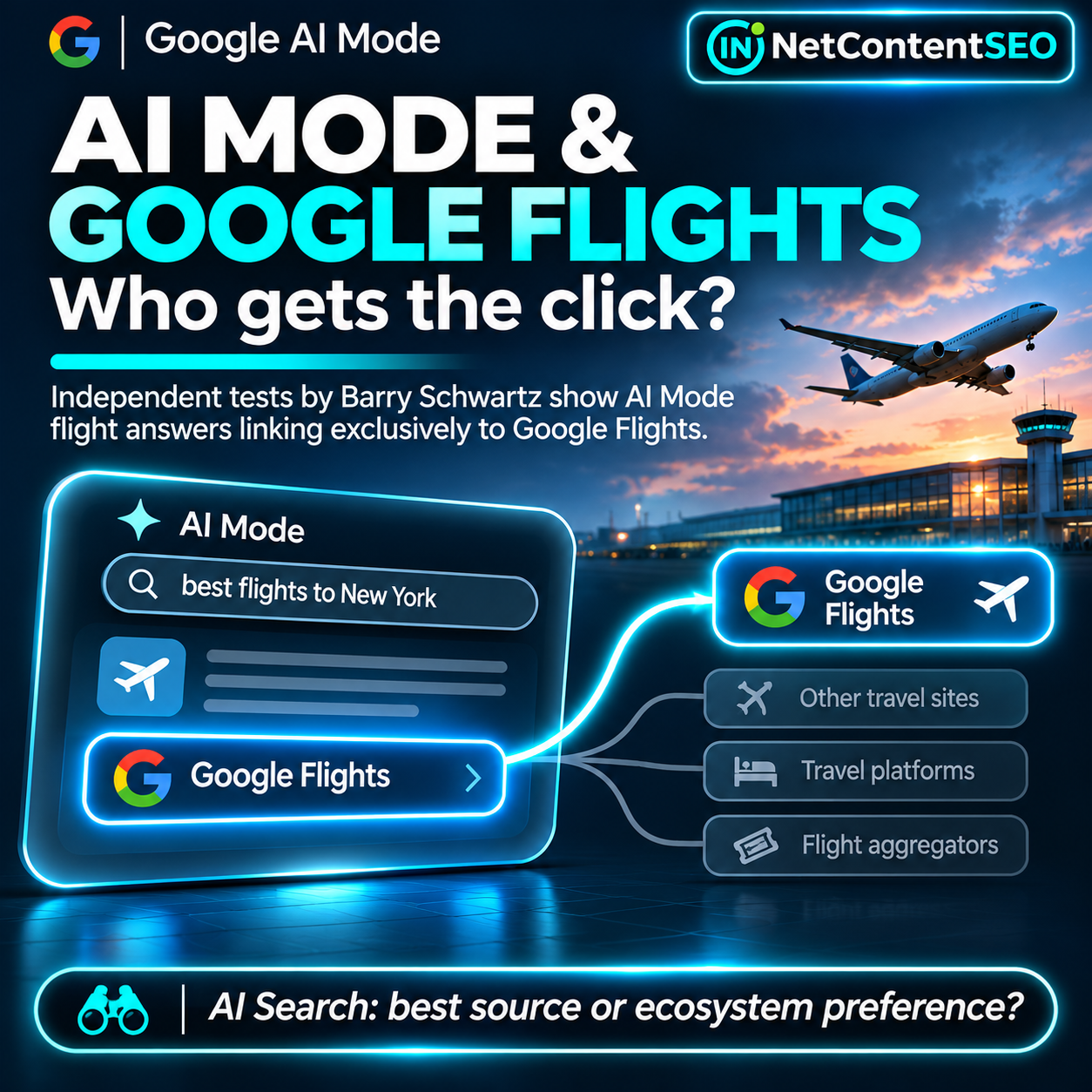

November 6, 2026. A series of independent checks has raised an important question about Google's AI Mode: when people search for flights, does the AI answer offer meaningful access to competing travel websites, or does it direct them mainly to Google Flights?
On November 3, Search Engine Roundtable editor Barry Schwartz reported that every flight-related AI Mode answer he manually checked linked only to Google Flights. His tests included domestic US and international destinations. An earlier observation by SEO specialist Natzir on October 30 had highlighted the same pattern. Those are observations from limited testing, not proof that AI Mode behaves identically for every query or user.
A separate, more structured test published on November 3 complicates the picture: of 49 links collected from 24 US flight searches, 35 went to Google properties. That is about 71%, not 100%. Some answers did include external links, mostly to airlines. The combined evidence points to substantial concentration in the tested scenarios, while ruling out a universal claim that external links never appear.
What Barry Schwartz observed in Google AI Mode
In Google AI Mode Biased: It Only Shows Links To Google Flights, published November 3, Schwartz described testing several flight destinations over the preceding weekend. In every response he inspected, the available links pointed to Google Flights. He said he had numerous screenshots and noted that the pattern could attract attention from European regulators.
The observation matters because AI Mode is not merely a list of ranked web pages. It composes an answer, chooses which references to show and determines the path users take next. A travel company can rank well in traditional search yet receive no visible link in an AI answer about the same flight route.
However, Schwartz's article does not publish a full query dataset, a sample size, geographic and personalization settings for each test, or a repeated-run methodology. It should therefore be described as a documented informal observation, not a representative measurement of all flight searches.
A second test found 35 of 49 links going to Google
A November 3 SERP analysis by SaaS Link Building examined 24 US English-language flight searches, comparing AI Mode links with standard organic results for the same queries. Its findings add a quantitative snapshot and an important correction to the most absolute interpretation of the earlier screenshots.
| Measure | Reported result |
|---|---|
| Flight queries tested | 24 |
| Total AI Mode links counted | 49 |
| Links to Google pages | 35 of 49, approximately 71% |
| Links to booking and comparison sites | 2 of 49, approximately 4% |
| AI Mode answers linking only to Google or showing no links | 18 of 24, 75% |
| Booking and comparison results in standard organic listings | 104 of 212, approximately 49% |
The researchers recorded inline links and references, resolved destinations behind Google redirects and categorized links into Google, airline, booking/comparison and other domains. Six AI Mode answers included at least one non-Google link, while one answer displayed no links. That is why the headline finding should be strong concentration in a limited sample, not “AI Mode never links outside Google.”
The methodology was confined to US English-language searches over a short time window on one day. The sample mixes route queries with travel-advice queries. It does not establish global frequency, long-term trends, user-level click-through rates or the impact of personalization. The comparison is between displayed links, not actual traffic volumes.
Why organic visibility and AI Mode visibility are different
The strongest SEO implication is the gap between being eligible to appear in ordinary results and being selected as a destination in a synthesized answer. The 24-query study found booking and fare-comparison sites represented nearly half of standard organic listings but only a small fraction of AI Mode links in that sample.
That does not mean the organic rankings were wrong, nor does it prove that Google applied a hidden penalty to external travel companies. The two interfaces may use different product integrations, answer formats and link-selection processes. But for a business that depends on search referrals, the result is the same operational concern: ranking visibility does not guarantee a clickable presence in the AI answer.
For AI Search measurement, it is useful to distinguish four stages: whether a brand or site is mentioned; whether a source is cited; whether a clickable link is shown; and whether a visitor ultimately arrives. These are different metrics. A named airline without a link has visibility but no direct referral opportunity in that particular answer.
Does Google Flights actually compare third-party offers?
Google's own Google Flights documentation says the product compares offers from more than 300 travel partners, including airlines, online travel agencies and aggregators. It also describes how flight options and booking links are ordered within Google Flights, including price, convenience, airline versus agency link types, link quality and mobile usability.
This distinction is essential. An AI Mode link to Google Flights is not necessarily the final booking destination: users may still select an airline or third-party agency within Google Flights. But it means the initial navigation stays within a Google-owned product rather than taking the user directly to the external provider.
Google's published ranking factors for booking links inside Google Flights should not be mistaken for a public explanation of how AI Mode chooses its outbound citations. The available documentation does not disclose a complete, auditable rule set for deciding when AI Mode links to Google Flights versus an external travel site.
Is this self-preferencing? What the evidence can and cannot prove
Self-preferencing is a relevant question when a platform that controls a discovery interface also operates a competing destination service. The observed link concentration gives researchers and regulators a concrete behavior to examine.
But a high share of links to Google properties, by itself, does not prove unlawful discrimination, intent or a breach of the European Union's Digital Markets Act. Legal assessment would require details about the applicable service, market, jurisdiction, rules and effects. The US-only quantitative sample cannot be treated as a measurement of EU compliance.
Google may argue that integrated flight data and consistent booking workflows improve the user experience. Competing travel sites may argue that directing users first to Google-owned pages limits their opportunity to compete for discovery and traffic. Both propositions should be tested with reproducible evidence rather than inferred from a handful of screenshots.
A separate Spanish editorial check published November 4 tested six routes on google.es: five responses linked only to Google Flights and the sixth showed no links. This adds a geographically different observation, but its small, one-day desktop sample still cannot establish population-wide behavior or legal conclusions.
What travel SEO teams should measure now
Start with a repeatable query panel rather than isolated screenshots. Include high-volume route searches, flexible-date searches, destination-only searches, branded airline queries and informational questions such as when to book. Separate transactional intent from travel advice because they may produce different link patterns.
For each query, record the date and time, country, language, device, login state, exact prompt and whether the interface is AI Mode or standard search. Capture the full answer and all visible citations and inline links. Follow redirects to the final destination domain before categorizing them.
Next, compare the AI Mode result with the conventional organic SERP for the same query. Record whether your site is present in the top results, mentioned in the AI answer, cited as a source or offered as a clickable link. Avoid treating a brand mention as a click or assuming a link guarantees traffic.
Repeat the panel over several dates. AI responses can change between runs; a single test may capture an interface experiment or temporary variation. Keep the raw evidence and the counting rules so another analyst can reproduce the measurements.
A practical AI Mode visibility scorecard
| Metric | Definition | Why it matters |
|---|---|---|
| Organic presence | Queries where the domain appears in standard search | Traditional discovery baseline |
| AI mention rate | Queries where the brand is named in AI Mode | Visibility without requiring a link |
| AI citation rate | Queries where the domain is cited | Source selection |
| AI link share | Share of displayed outbound links to the domain | Direct navigation opportunity |
| Google-owned link share | Share of AI links to Google properties | Measures interface concentration |
| Referral sessions | Verified arrivals attributable to the channel where possible | Business impact, subject to attribution limits |
For a domain-level AI link share, divide the number of qualifying AI Mode links to that domain by all qualifying links in the tested answers, and publish the denominator. Decide in advance whether repeated links count separately and how answers with zero links are handled. This prevents a visually striking but misleading percentage.
Can travel websites improve their chances of appearing in AI Mode?
There is no verified optimization technique that guarantees inclusion in AI Mode flight answers. Travel businesses should maintain accurate, crawlable and useful pages, but they should not assume that adding structured data or rewriting copy will override Google's product-level link choices.
The independent 24-query study suggests that informational travel questions sometimes produced external references even when direct route searches leaned toward Google Flights. That makes original, current travel guidance worth testing: fare research, booking-window analyses, baggage policy comparisons, airport transfer guidance and route-specific advice can provide value beyond a generic fare listing.
However, the study does not prove that publishing such content will increase AI citations. Test query types, document actual citations and compare outcomes. Publishers should also protect existing organic discovery channels and direct audience relationships instead of treating AI Mode as the only source of future demand.
How this connects to agentic search
Google has described agentic capabilities in AI Mode that help users find reservations, tickets and appointments and then move toward booking. Flight discovery illustrates a related strategic question: as search interfaces become more transactional, the platform can influence not only which information users see, but also which service receives the next click.
The flight observations do not show that AI Mode completes airline ticket purchases on the user's behalf. They show a potential concentration of navigation at an earlier stage. The distinction between answer selection, outbound link selection and final transaction matters when assessing competition and user choice.
What remains unknown
The available tests do not establish whether Google Flights receives the same share of links across all markets, accounts, devices, query types or future product versions. They do not measure how many users click those links, whether travelers subsequently book through third-party providers, or whether the observed link patterns cause specific losses of organic revenue.
Nor do the sources demonstrate that Google intentionally suppresses individual travel websites, that the AI answer uses a particular hidden ranking signal, or that any regulator has reached a finding based on these tests. Those questions require additional evidence.
Frequently asked questions
Does Google AI Mode only link to Google Flights?
Not universally. Barry Schwartz found only Google Flights links in his informal flight tests, but a separate 24-query US study found external links in some answers. The pattern was strong in the tested examples, not absolute.
What percentage of flight links went to Google?
In the November 3 study of 24 US flight searches, 35 of 49 displayed AI Mode links went to Google properties, approximately 71%. This is a sample statistic, not a global market share.
Does this prove Google is violating competition law?
No. It raises a question about preferential routing and competition, but a legal finding requires a broader factual and jurisdiction-specific analysis.
Why does this matter for SEO?
A site can appear in ordinary organic results yet be absent from the links selected for an AI Mode answer. SEO teams should measure ranking, mention, citation, linking and actual traffic separately.
Can airlines and booking sites still receive traffic through Google Flights?
Yes. Google Flights includes airline and travel-agency booking options. The concern is that the initial click from AI Mode may go to a Google-owned intermediary rather than directly to the provider.
How can I test this for my travel website?
Build a fixed query panel, record AI Mode and organic results under documented settings, classify all link destinations, repeat across dates and compare visibility with verified referral traffic where attribution permits.
The larger AI Search question
The most important finding is not that every AI Mode flight query must lead to Google Flights. The evidence does not support that claim. It is that AI answer interfaces can concentrate navigation even when traditional search displays a much broader set of competitors.
For travel brands, this is a reason to develop a separate AI visibility measurement program. For policymakers, it is a reason to demand transparent and reproducible evidence. For users, it is a reminder that a helpful synthesized answer and a competitive range of outbound choices are not necessarily the same thing.
Sources
- Barry Schwartz, Search Engine Roundtable, November 3, 2026 — original manual test and screenshots.
- SaaS Link Building, November 3, 2026 — 24-query US comparison with methodology and link counts.
- el SEOmanal, November 4, 2026 — six-query Spanish follow-up test.
- Google Travel Help: How to find the best fares with Google Flights — first-party documentation of Google Flights partners and booking-link ranking.
- Google Search Labs: Agentic capabilities in AI Mode — context on transactional search experiences.