

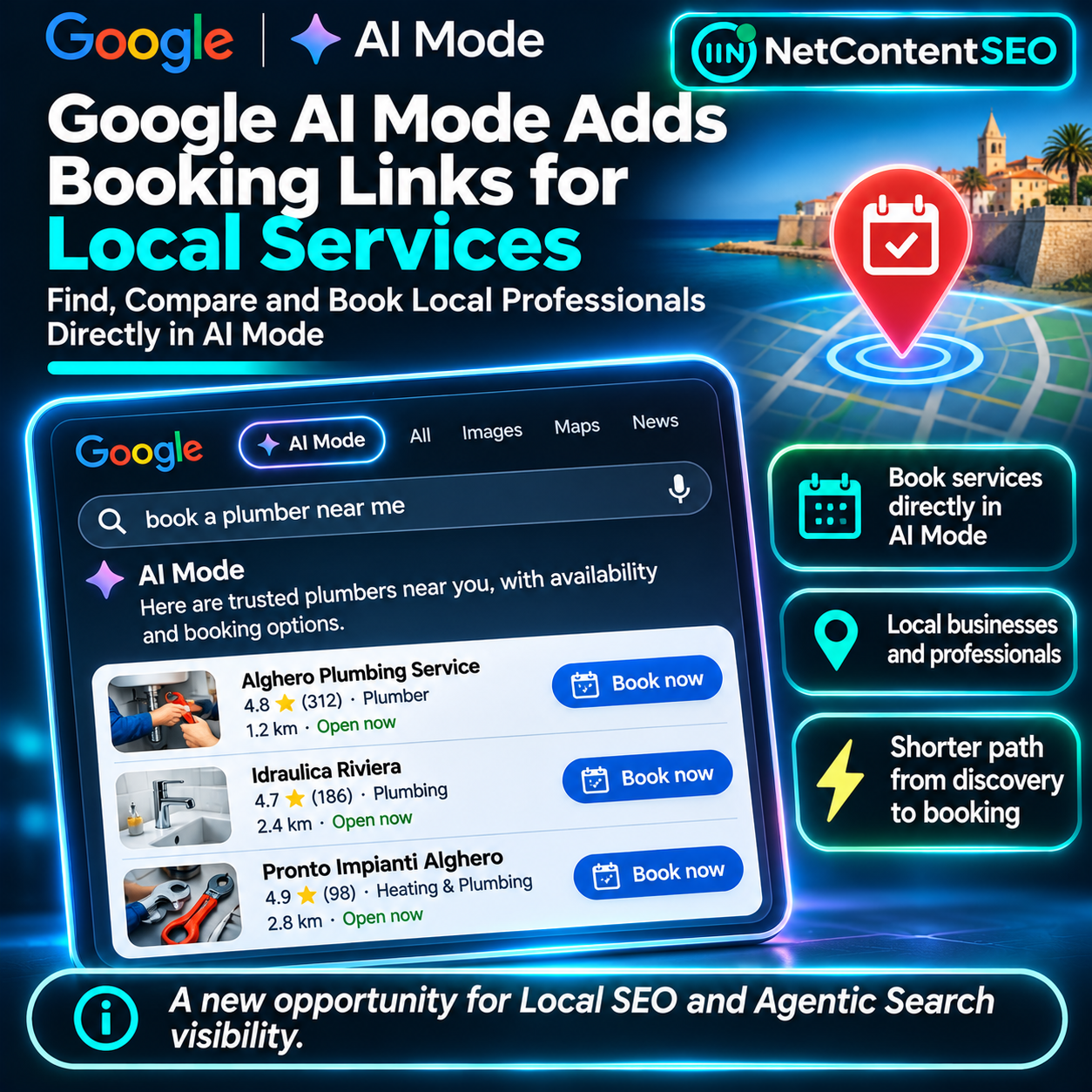

Google is extending AI Mode beyond finding local businesses and into helping users book them. On November 4, 2026, Google Search product vice president Robby Stein announced direct booking and quote-request links for home services in the United States, using partners including Angi, Thumbtack, Housecall Pro and Jobber. ServiceTitan is expected to join later.
The development matters because it shortens the journey from a conversational search to a concrete action. Instead of finding a plumber in a traditional results page, visiting several websites and manually comparing availability, a user can ask AI Mode for a suitable professional, review recommendations and proceed toward a booking or quote request through a partner link. But Google has not disclosed exactly how it chooses or orders recommended businesses, and partner eligibility varies.
What Google announced
As reported by Search Engine Land on November 4, the U.S. rollout adds links to home-service booking and quote workflows through four named partners: Angi, Thumbtack, Housecall Pro and Jobber. Stein said ServiceTitan is coming soon.
Stein described using AI Mode after a sewer line backed up at his home. According to his account, the system compared local pricing, considered reviews and suggested plumbers suited to his circumstances. He then booked a plumber who visited and repaired the problem. The example illustrates the intended experience, but it is not a controlled evaluation of the accuracy or completeness of AI Mode's recommendations.
In Google's demonstration described by Search Engine Journal, a user requested a handyman to assemble furniture the following day. AI Mode displayed local professionals, descriptions and ratings, with appointment availability for at least one option and quote-request paths for others.
Booking links are not the same as autonomous booking
It is important to distinguish an agentic discovery experience from a fully autonomous transaction. Google can help research options, surface availability and connect the user to a partner's booking or request form. That does not mean every appointment is confirmed entirely inside AI Mode, or that Google completes payment and scheduling without the user's final action.
Different partners also support different next steps. Angi says that a homeowner selecting a professional from AI Mode is taken to that professional's Angi profile to learn more and request a quote. Jobber can connect eligible businesses to their booking or request forms. The precise handoff can therefore vary between providers.
For Local SEO, that handoff is central. The AI response may become the discovery and comparison layer, while the partner platform becomes the transaction interface. A business's own website may still support credibility and customer acquisition, but it is no longer necessarily the page a customer visits immediately before requesting service.
Which partners are involved?
Angi and Thumbtack are home-services marketplaces that connect homeowners with professionals. Their inclusion gives AI Mode access to established discovery and lead-generation environments. Angi has described a path to individual professional profiles and quote requests. Thumbtack was named by Google, although details of its specific implementation were not publicly explained in the initial coverage.
Jobber and Housecall Pro are field-service software platforms used by businesses to manage customers, schedules and jobs. Their integrations can connect AI Mode discovery with operational information such as request forms and appointment slots.
ServiceTitan was named as a future partner rather than an already-live integration in the November 4 announcement. Businesses should not assume that its AI Mode booking flow is available before a separate launch is confirmed.
Eligibility rules differ across platforms
Search Engine Journal reported that Jobber's eligibility requirements include an active paid subscription, a complete business address, a connected Google Business Profile at the same location and a booking or request form associated with Google. Trial subscriptions are excluded from the described eligibility pathway. Jobber also says eligible U.S. customers can receive these requests without a lead fee.
Housecall Pro's description differs. Its materials say professionals may be automatically enrolled and that availability can be drawn from their calendars, while also indicating that its integration is coming soon for eligible U.S. customers. Housecall Pro says a Google Business Profile is not required for its pathway and describes the arrangement as having no lead fees.
Those differences are a warning against universal checklists. A requirement that applies to Jobber cannot be assumed to apply to Angi, Thumbtack or Housecall Pro. Likewise, the absence of a Google lead fee in one partner's announcement does not prove that every marketplace or booking workflow is free of commercial charges.
How does Google decide which local businesses to recommend?
This is the biggest unanswered question. Google's announcement did not publish a ranking formula, eligibility matrix across partners, weighting of reviews or distance, or rules explaining which professionals are included in the AI-generated shortlist.
Google's broader AI Mode documentation describes gathering information from the web and, in some circumstances, contacting businesses to check availability or pricing. But those capabilities do not explain how the new home-services booking recommendations are ranked.
Jobber has suggested that collecting reviews and using a booking form rather than only a request form can help businesses be recommended more frequently. That is partner guidance, not an independently verified Google ranking factor or a guarantee of placement. Businesses should treat it as operational advice rather than proof of how the AI selection system works.
Why this matters for Local SEO
Traditional Local SEO often focused on whether a business appeared in Maps, the local pack and organic results. AI Mode introduces another stage: whether a business is selected as a suitable provider for a particular task and whether the user can take action from that recommendation.
A search such as “plumber near me” expresses broad intent. A conversational request such as “find someone who can fix a blocked sewer line tomorrow morning and give me an estimate” contains constraints around service type, urgency, location, price and availability. A useful recommendation must satisfy those constraints, not simply match a generic category label.
That makes accurate service descriptions, coverage areas, availability and reliable business data more operationally important. It does not mean that any single field or schema property guarantees AI Mode inclusion. Google has not published such a guarantee.
For businesses already using one of the named partners, the immediate task is to review their profile and integration status, confirm that the correct services and location are represented, and test the customer journey where the feature is available.
From ranking to selection—and then conversion
The more significant shift is conceptual. In conventional search, a user often sees ranked links and makes their own selection. In AI Mode, the system can interpret the task, narrow the candidates and present actionable booking paths. The business must not only be discoverable but also be suitable for the user's requested outcome.
That suggests three distinct measurements for agentic local search: visibility (whether a business appears), selection (whether it is included among actionable recommendations), and conversion (whether a user requests a quote or books). None can be inferred reliably from the others.
A business could be frequently mentioned without receiving bookings. Another might appear less often but receive high-intent requests. And a partner integration may improve access to booking links without demonstrating an improvement in the underlying recommendation ranking.
Will websites lose the final click?
Some customer journeys may bypass a business homepage and go straight to a partner profile or booking form. That is a plausible consequence of the announced design, not a measured traffic loss established by Google's launch.
Businesses should therefore avoid using website sessions as the only indicator of local search performance. If a customer discovers a provider through AI Mode and books through a partner, conventional organic landing-page analytics may not capture the full journey. Partner reporting, lead records, booking source information and customer intake data become important complements.
Attribution will be imperfect. Referral parameters may be absent or inconsistent, and partner dashboards may not distinguish AI Mode from other Google discovery surfaces. Businesses should document those limitations instead of treating all unattributed bookings as AI-driven.
How local businesses should prepare
First, confirm whether the business uses a supported partner and check that partner's current U.S. eligibility rules. Where required, connect and verify the Google Business Profile, confirm that the business address matches and ensure the correct request or booking form is available.
Second, make operational details reliable: service categories, service areas, hours, pricing information where appropriate, and appointment availability. A system helping users complete a task needs accurate information about what a business can actually do and when it can do it.
Third, maintain strong customer-facing content and review management. Reviews may influence consumer trust and can be useful information for recommendation systems, but Google's specific AI Mode ranking weights remain undisclosed.
Fourth, test the end-to-end workflow. A booking link that leads to an outdated form, incorrect service area or unavailable appointment undermines conversion regardless of how prominently the business appears.
Finally, report on qualified leads and completed bookings alongside impressions, clicks and calls. The value of agentic discovery ultimately depends on whether the right customers reach the right provider and complete a useful action.
What Google has not yet explained
The initial announcement leaves several open questions: how providers are selected and ranked; whether participation through a named partner is necessary for inclusion in the recommendation list or only for direct booking links; how consistently real-time availability is checked; how fees and attribution work across marketplaces; and how the experience will expand beyond the United States.
It is also not clear that every named partner is equally live on the same day. Google's broad announcement and individual partners' rollout timelines should be read separately.
The broader agentic search roadmap
Google's direction did not begin with this release. In August 2025, the company introduced agentic capabilities for restaurant reservations and discussed future local-service appointments. At Google I/O in May 2026, it described extending agentic booking to local experiences and services, including links to finish booking with providers and the ability to call businesses for certain tasks.
The November home-services partner announcement is a concrete step in that roadmap. It links the conversational interface to marketplace and field-service software infrastructure, creating an actionable path from a user's question to a potential appointment.
The takeaway for SEO and agentic search
Google AI Mode's new home-service booking links show how search is evolving from a list of places to visit into a workflow for getting something done. The feature is available in the United States through named partners, with ServiceTitan expected later, but selection criteria and partner-specific availability remain partly opaque.
For Local SEO, the strategic question is expanding beyond “Where does my business rank?” to “Can an AI system identify my business as suitable, present it as an option and connect the customer to a working booking path?”
In agentic search, visibility is only the beginning. Being selected and being bookable are increasingly separate, measurable parts of the customer journey.
Sources
- Danny Goodwin, Search Engine Land, “Google AI Mode adds home services booking links,” November 4, 2026
- Matt G. Southern, Search Engine Journal, “Google AI Mode Adds Booking & Quote Links For Home Services,” November 5, 2026
- Google, “A new era for AI Search,” May 19, 2026
- Google, “AI Mode in Search gets new agentic features,” August 21, 2025
- Google Search Help, “Use AI Mode to check local availability and pricing”