

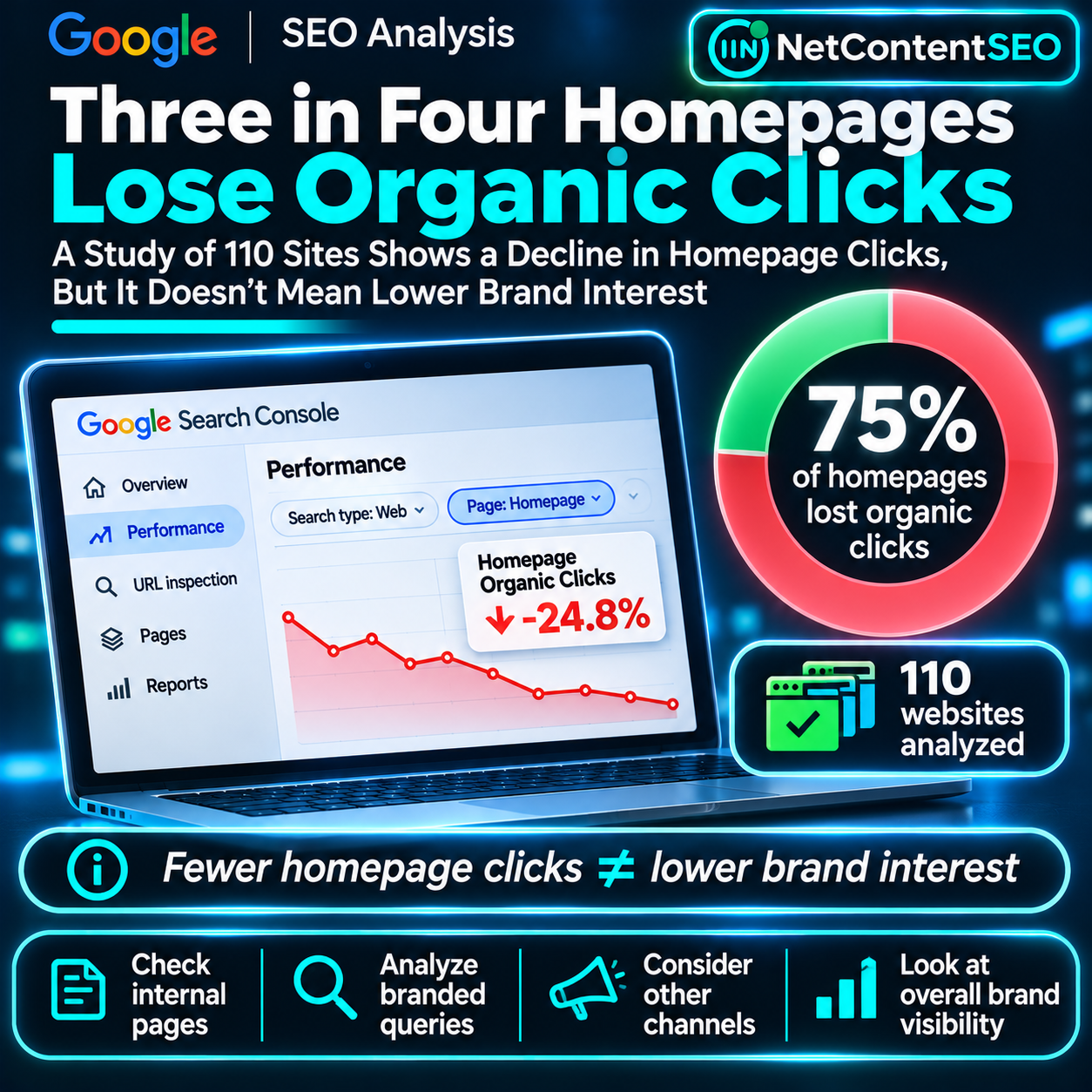

Nearly three in four homepages in a new 110-site analysis lost Google organic clicks year over year. The finding sounds like a warning about declining brand visibility, but the underlying data suggests a more complicated story: users may be reaching companies through deeper landing pages, getting simple brand facts directly from search results, or discovering content through AI-powered interfaces without visiting the homepage at all.
In an analysis published by Search Engine Land on November 4, 2026, Jenny Lee Lynch compared Google Search Console clicks for 110 homepages across six industries in Q3 2026 against Q3 2025. Of those, 81 homepages (74%) recorded fewer organic clicks. The median decline was 21%. Those are homepage-level findings, not evidence that 74% of the businesses lost total organic traffic, brand demand or revenue.
What the 110-site study actually measured
The dataset included 34 ecommerce sites, 25 SaaS businesses, 19 education and information sites, 14 finance sites, 10 logistics sites and eight healthcare sites. It used Google Search Console clicks for the homepage URL, comparing the same quarter across two years.
The middle half of sites experienced changes ranging from a 37% decline to a 3% increase. Only 15 of the 110 homepages—about 14%—lost at least half their clicks. That distribution matters: the headline captures a widespread direction of change, but it does not mean that most homepages suffered catastrophic losses.
The study emphasized medians rather than averages because very large websites and extreme growth outliers can distort a mean. Across all 110 homepages, total clicks fell by 16%, but that decline was 7% when the four largest sites were removed. The median therefore offers a more representative view of the typical homepage in the sample.
Which industries lost the most homepage clicks?
SaaS recorded the sharpest median decline at 35%, with 84% of its 25 homepages losing clicks. Education and information sites also saw 84% of homepages decline, with a median loss of 21%. Logistics sites had a median loss of 21%, but a smaller 60% share of declining homepages.
Ecommerce recorded a median decline of 18%, with 74% of homepages down. Finance had a median decline of 11%, with 64% declining. Healthcare was comparatively stable, showing a median decline of 3% and half of the eight sites losing clicks. The healthcare sample is small, so its apparent resilience should be treated as directional rather than a definitive sector-wide result.
One plausible explanation is query intent. SaaS homepages often target broad category terms such as “project management software” or “CRM software.” Users researching those topics may now encounter AI summaries, comparison articles and specialized landing pages rather than navigating to a vendor's homepage. Education sites can face a similar pattern for broad informational questions. But the dataset does not establish a single causal explanation for each decline.
The homepage is no longer always the main entrance
A homepage historically served as a central gateway: users searched for a brand, clicked the root domain and navigated to the section they needed. Modern search behavior can bypass that step. A person searching for a company's pricing, refund policy, course requirements or product specifications may land directly on the most relevant internal page.
That can reduce homepage clicks without reducing interest in the brand. In one SaaS example from the study, the top three landing pages for modified branded searches were all pricing pages and together generated more than 8,000 clicks in Q3 2026. The homepage was not among the top ten landing pages for those queries.
This is a useful reminder that the landing-page distribution matters as much as the domain total. A business whose homepage loses visits while pricing and product pages gain qualified visitors may be experiencing a change in entry point rather than a collapse in demand.
What the AI visibility data shows—and what it does not
The study also examined page-level impressions from Google's Search Generative AI performance reporting. For 63 of 110 sites (57%), an internal page rather than the homepage led the site in AI-feature impressions during Q3 2026. The remaining 47 sites had the homepage as the leading page.
However, leading in AI visibility did not protect the homepage from click declines. Where the homepage led AI impressions, median homepage click change was -20% and 72% of homepages declined. Where a deeper page led, the median change was -22% and 75% declined. Those differences were small and do not establish a meaningful protective relationship.
Crucially, this is a site-level snapshot of which page earned the most AI impressions, not a query-by-query test proving that AI citations caused homepage clicks to fall. The AI visibility report measured impressions rather than clicks, and its rollout did not permit a like-for-like year-over-year comparison in this dataset.
Branded search can be redistributed across pages
Across a subset of ten sites, branded queries accounted for an average of 79.6% of homepage clicks in Q3 2026. That makes brand demand especially important when interpreting homepage declines.
But a branded query does not necessarily lead to the homepage. Searchers increasingly append modifiers such as “pricing,” “reviews,” “alternatives,” “login,” “returns” or “support.” Google can send those users to the corresponding internal page. It may also answer straightforward navigational questions directly in the results.
For an SEO team, the correct question is not simply whether the homepage lost clicks. It is whether branded clicks across the entire domain fell, whether demand shifted toward modified brand queries and whether high-intent internal pages gained visibility or conversions.
Zero-click results and AI answers add another layer
Not every homepage click that disappears is redistributed to another page. Some searches end without a website visit because users find a phone number, opening hours, description or answer directly in Google. AI Overviews and other search features can also provide information before a click.
The original analysis cites outside studies reporting rising AI Overview coverage for branded searches in late September 2026. Those findings provide context, but the timing matters: many increases were concentrated in the final days of September, meaning the Q3 homepage comparison may capture only a small portion of their effect.
It would therefore be too strong to say that AI Overviews caused the 74% decline. The data establishes a broad homepage click pattern and identifies possible mechanisms. It does not isolate a causal effect of AI features from ranking changes, evolving query behavior, direct answers or page-level search demand.
How can homepage clicks fall while organic click share rises?
Another Search Engine Land report published the same day described Semrush findings that the share of U.S. Google desktop searches producing organic clicks to external sites rose from 39.74% in July to 46.11% in September 2026, a 15-month high.
These results are not contradictory. The Semrush report describes the share of desktop searches producing external organic clicks in a broad clickstream panel over a three-month interval. The 110-site study describes year-over-year organic clicks to specific homepage URLs in a selected sample. Their denominators, populations, devices and time comparisons differ.
A greater proportion of searches may lead to external websites overall while the destinations shift away from homepages toward articles, product pages, pricing pages and other internal URLs. A domain can gain clicks on deeper pages even when its homepage loses them. Equally, a site's total clicks can decline despite a broader market-level improvement.
The right interpretation is not that one study disproves the other. It is that where clicks go and how often searches generate clicks are different questions.
A better framework for measuring brand visibility
Homepage clicks remain a useful diagnostic metric, but they should not be treated as a standalone measure of brand health. A more complete view separates brand demand, search distribution, AI exposure and commercial outcomes.
Branded search demand: Track branded queries across all URLs in Google Search Console, including modified brand terms. Compare impressions and clicks using consistent periods, and investigate whether changes reflect demand, rankings or SERP presentation.
Organic landing-page mix: Examine how clicks and sessions are distributed between the homepage, product pages, pricing pages, category pages and editorial content. Identify which sections are gaining or losing qualified visitors rather than focusing only on the root URL.
AI visibility: Monitor where the brand and its pages appear in AI-generated responses, distinguishing mentions, citations and measurable referrals. An AI impression is not a click, and a citation does not prove that the user visited the site.
Other channels: Review direct, email, paid, social and referral traffic. GA4's direct channel is not a pure brand-awareness metric because it can include unattributed visits, but channel trends can help explain shifts in how users arrive.
Business outcomes: Evaluate organic conversions, leads, purchases and revenue across all landing pages. A pricing page attracting fewer but more qualified visitors may deliver more value than a high-volume homepage visit.
What SEOs should audit when homepage clicks decline
Start with a year-over-year Search Console comparison for the homepage, then repeat it for the entire property. If homepage clicks fall but total branded clicks remain stable, inspect the internal pages now receiving those branded visits. If both fall, investigate whether demand, rankings, SERP changes or technical issues are responsible.
Segment by device and country. Check whether branded queries with modifiers are rising, whether competitors have entered important SERPs and whether a redesign, migration or canonicalization change affected the homepage. A broad market trend should never become an excuse to ignore a genuine technical problem.
Then review the experience of deeper landing pages. If visitors increasingly enter through a pricing page, product category or resource article, that page must explain the brand, establish trust and provide clear next steps. Internal links should help users move to related content, relevant products and conversion paths without forcing a detour through the homepage.
Finally, compare landing-page conversion rates and outcomes. A decline in homepage traffic is less alarming when internal pages are generating more qualified visits and conversions. If the decline coincides with weaker branded demand and falling revenue, it deserves more urgent investigation.
Methodological limits of the study
The 110-site sample spans six industries but is not a random or necessarily representative census of all websites. Industry sample sizes vary substantially, and the eight-site healthcare group is particularly small. The study documents correlation and distribution, not the causal effect of AI search on each homepage.
The author excluded impressions from the year-over-year comparison because Google Search Console reporting was affected by the end of support for the &num=100 parameter and a confirmed impression-logging issue during the 2025 baseline. Clicks were not affected by those issues, making them the more defensible comparison metric.
For AI visibility, the study used a 2026 page-level snapshot, not a 2025-versus-2026 trend. Readers should not interpret its AI-feature impression comparisons as evidence of a quantified traffic transfer from the homepage to AI answers.
The takeaway: every important page can be a front door
The finding that 74% of sampled homepages lost organic clicks is significant, but the headline is not a verdict on brand health. The homepage may be becoming less important as the default entry point while remaining valuable for identity, navigation and trust.
For modern SEO and GEO reporting, the stronger question is whether a brand is still being discovered, understood and chosen—across search results, AI answers, internal pages and other channels. Visibility is not a homepage visit. It is the ability to reach the right audience and help them complete the next meaningful step.