

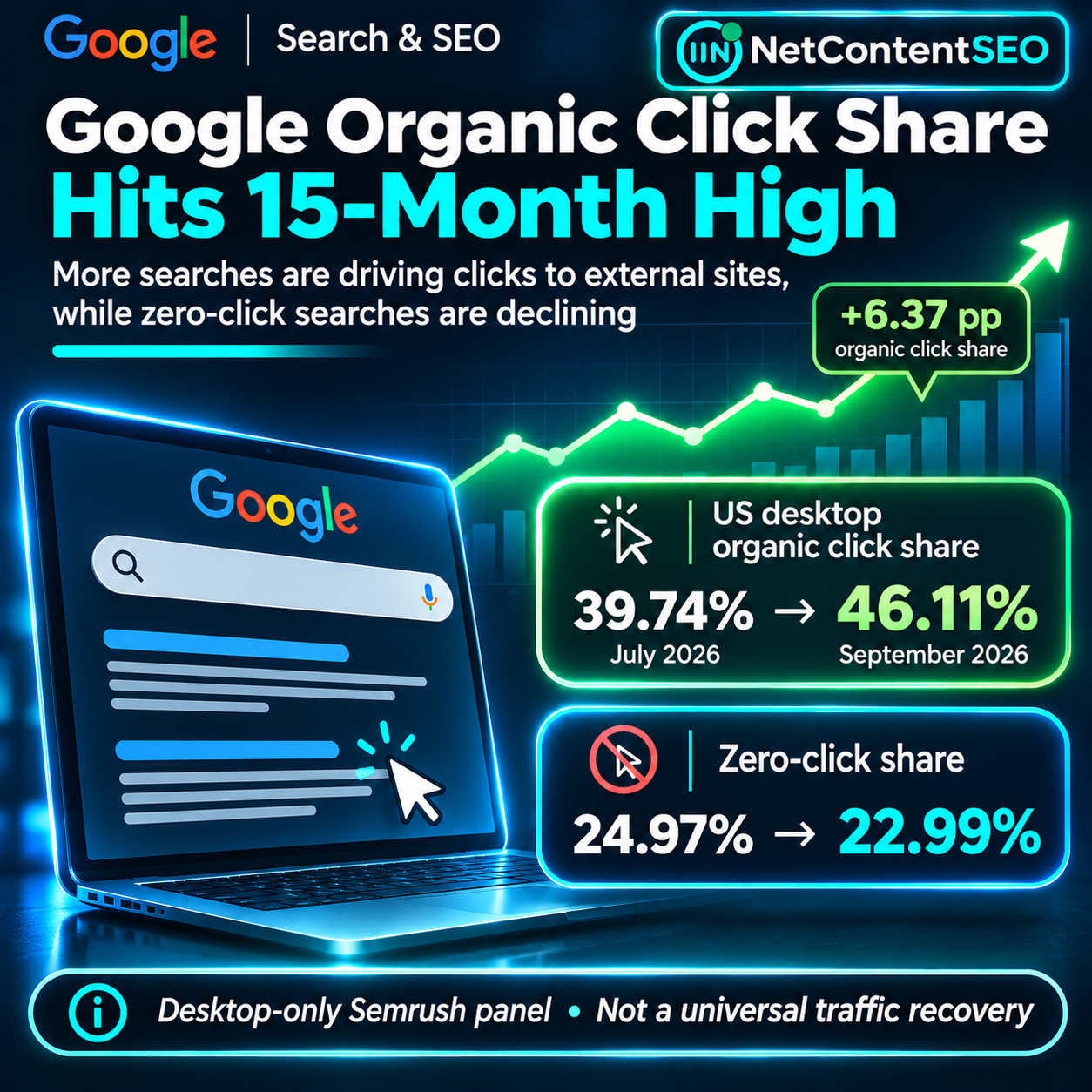

Google Search is still sending users to external websites, and a new Semrush analysis suggests that the share of desktop searches producing organic clicks increased markedly during the third quarter of 2026. In the United States, the share rose from 39.74% in July to 46.11% in September, the highest level observed during the report's 15-month study period. At the same time, the share of searches ending without a click fell from 24.97% to 22.99%.
These figures, published in Semrush's State of Search Q3 2026 report and covered by Search Engine Land on November 4, challenge a simplistic narrative that Google is sending an ever-decreasing proportion of searches to publishers. They do not prove that every website is recovering organic traffic, that mobile search behaves the same way, or that AI-generated answers no longer affect click-through rates.
What the Semrush report found
Semrush examined desktop activity in the United States and 32 European countries, including the United Kingdom, between July 2025 and September 2026. The study considered traditional search engines, AI tools, ecommerce sites and social platforms. It did not include mobile activity.
In the U.S. Google desktop sample, the proportion of searches that produced an organic click to an external website rose by 6.37 percentage points between July and September, from 39.74% to 46.11%. This is a percentage-point change, not a 6.37% relative increase. The relative increase is approximately 16% against the July baseline.
Over the same interval, the U.S. zero-click share declined by 1.98 percentage points, from 24.97% to 22.99%, its lowest reading since March in the report. Clicks to Google-owned properties also declined, from 17.84% in August to 14.19% in September. Those movements suggest that the destination mix of observed search sessions changed during the quarter.
In Europe, the organic click share reached 49.56% in September, while the zero-click share fell to 20.99%. Those are regional aggregates across the European markets in the study, not guaranteed outcomes for individual countries or websites.
Why organic click share is not the same as organic traffic
The key word is share. Semrush is describing the proportion of observed search activity leading to organic clicks on external websites. A rising share does not automatically mean the absolute number of organic visits grew for every publisher.
Consider a simplified example: if a market has 100 searches and 40 produce external organic clicks, the organic click share is 40%. If the next period has 80 searches and 37 produce organic clicks, the share rises to 46.25% even though the number of click-producing searches falls from 40 to 37. The reverse can also happen: total organic visits can rise while the share declines if search volume grows faster.
At the site level, outcomes depend on query demand, rankings, SERP features, geography, brand strength, device mix and the type of content. A national aggregate may improve while a particular publisher loses visibility or clicks in informational queries. A retailer focused on transactional searches may experience a very different trend from a news website or a software documentation portal.
Desktop-only findings cannot describe the entire search market
The report's desktop scope is not a minor footnote. Mobile search behavior can differ substantially because of screen size, local intent, app usage, visual layouts and the prominence of SERP features. A 15-month high in U.S. desktop organic click share therefore cannot be generalized to all Google searches across all devices.
For SEO teams, the correct next step is to check whether their own Google Search Console data shows a comparable movement after segmenting by device and country. A combined property-level chart can hide divergent trends: desktop clicks may increase while mobile clicks stagnate or fall, or vice versa.
Search Console also measures impressions, clicks, CTR and average position for a site's own properties, not the full market-wide distribution of post-search behavior. Its figures are useful for diagnosing a site's performance, but they are not interchangeable with third-party clickstream shares.
Why this appears to conflict with zero-click research
Earlier 2026 research from SparkToro and Similarweb reported a much higher U.S. zero-click rate, around 68% during January through April, as summarized by Search Engine Land in June. At first glance, that seems incompatible with Semrush's September figure of 22.99%.
The two estimates should not be compared as if they came from the same measurement instrument. The studies use different providers, sampling frames, periods and operational definitions. SparkToro's analysis incorporated desktop and mobile web activity and treated certain follow-up searches as non-click outcomes; the Semrush Q3 report covered desktop activity only. The definitions and denominator behind a particular 'zero-click' rate matter as much as the headline number.
Even within a single methodology, changes over time are usually more defensible than comparisons between unrelated studies. Semrush's July-to-September movement is meaningful as a trend within its own reported sample. It does not invalidate SparkToro's findings, and SparkToro's figures do not automatically disprove Semrush's trend.
AI usage continued to grow during the same period
The organic click-share increase did not coincide with a disappearance of AI tools. Semrush found that AI tools accounted for 1.29% of U.S. desktop activity in September 2026, up from 0.72% a year earlier, an increase of roughly 79%. Traditional search accounted for 9.47%, down from 10.29% in September 2025.
In Europe, AI tools represented 1.42% of desktop activity, up from 0.86% a year earlier. Traditional search's share moved from 9.68% to 9.95%. These percentages refer to the study's broader desktop activity categories, not the share of Google searches or the share of website referrals.
Google AI Mode also grew within the report's observation window. Its share of U.S. desktop activity rose from 0.15% in July to 0.31% in September. In Europe, the share reached 0.53% in August before easing to 0.43% in September. Those are small but evolving segments, and they should not be mistaken for the frequency of AI Overviews in ordinary Google results.
Search behavior is changing, not simply disappearing
Another finding concerns query length. U.S. Google desktop searches longer than 15 words represented 2.58% of queries in September, up from 1.67% in August. In Europe, the corresponding share was 1.32%, compared with 0.33% a year earlier.
Longer queries may reflect users becoming more comfortable asking search engines detailed, conversational questions. Rand Fishkin, co-founder of SparkToro, suggested that people may increasingly treat Google like an AI assistant. That interpretation is plausible, but query length alone cannot establish why users write longer searches or whether they prefer AI-generated answers over external sources.
For content strategy, the implication is not to manufacture extremely long keyword phrases. It is to make pages useful for specific, nuanced questions and to provide clear evidence, definitions and practical detail when users need more than a short answer.
What does a 15-month high mean for SEO?
It suggests that, at least in the observed desktop sample, Google was generating a higher proportion of organic outbound clicks in September than at any other point during the study period. That is encouraging for the continuing role of the open web in search discovery.
But it is not proof of an SEO recovery across industries. Some publishers have reported falling referrals, and individual SERP features can suppress clicks on specific informational queries. Google may send more clicks in one segment while reducing them in another. Aggregate improvements and localized declines can coexist.
It is also possible for AI-powered search usage to increase alongside a recovery in conventional organic click share. Users do not make a single permanent choice between Google, ChatGPT, AI Mode and websites. They may consult several interfaces during the same research or purchase journey.
A practical reporting framework for publishers
First, separate market behavior from site performance. Semrush's clickstream study describes observed market-level activity. Google Search Console describes the impressions and clicks earned by your property. Analytics platforms describe sessions and downstream behavior. Each answers a different question.
Second, segment Search Console by desktop and mobile, then by country and page type. Compare July, August and September using consistent date windows, and inspect clicks, impressions and CTR together. If clicks increased, determine whether the change came from stronger visibility, higher CTR, increased query demand or a different mix of queries.
Third, distinguish informational content from commercial, navigational and branded searches. An aggregate click-share increase may be driven by some intents more than others. Do not assume a site covering broad informational topics will benefit in the same way as a transactional business.
Fourth, monitor AI visibility separately from organic clicks. Mentions in AI-generated answers, linked citations and measurable referral visits are related but distinct outcomes. Rising visibility in AI responses does not necessarily produce traffic, just as rising organic click share does not prove a specific brand has gained exposure.
Why the measurement debate matters
SEO discussions often collapse several questions into one: Is Google growing? Are users clicking less often? Are publishers losing traffic? Are AI answers replacing visits? Those questions require different denominators and datasets.
A click-share metric is not a count of visits. A zero-click percentage depends on the study's definition of a search and a click. A site-level CTR is not a market-wide click-through probability. And a decline in referrals from one publisher does not automatically demonstrate a decline in Google's total outbound traffic.
For analysts, the goal should be to explain the mechanism behind changes rather than choose whichever industry-wide headline confirms an existing position. That means documenting device coverage, geography, time period, data source and denominator whenever reporting a percentage.
The takeaway: a more nuanced picture of Google Search
Semrush's State of Search Q3 2026 report offers a meaningful counterpoint to claims that organic clicks are declining uniformly. In its U.S. desktop sample, the share of Google searches producing organic clicks to external sites reached 46.11% in September, the highest point in 15 months, while the zero-click share fell to 22.99%.
The results deserve attention precisely because they are not universal. They describe a specific panel, period and device category. They do not prove that every publisher is recovering traffic, and they do not negate evidence that AI-powered results can reduce clicks for particular queries.
Organic search is not one trend. It is a collection of changing behaviors, intents and interfaces. The most useful SEO reporting separates them before drawing conclusions.
Sources
- Danny Goodwin, Search Engine Land, “Google organic click share reaches 15-month high: Report,” November 4, 2026
- Search Engine Land, “Google zero-click searches reach 68% in early 2026: Study,” June 9, 2026
- Search Engine Journal, “Google Search Traffic To Open Web Drops To 23%, Data Shows,” June 10, 2026