

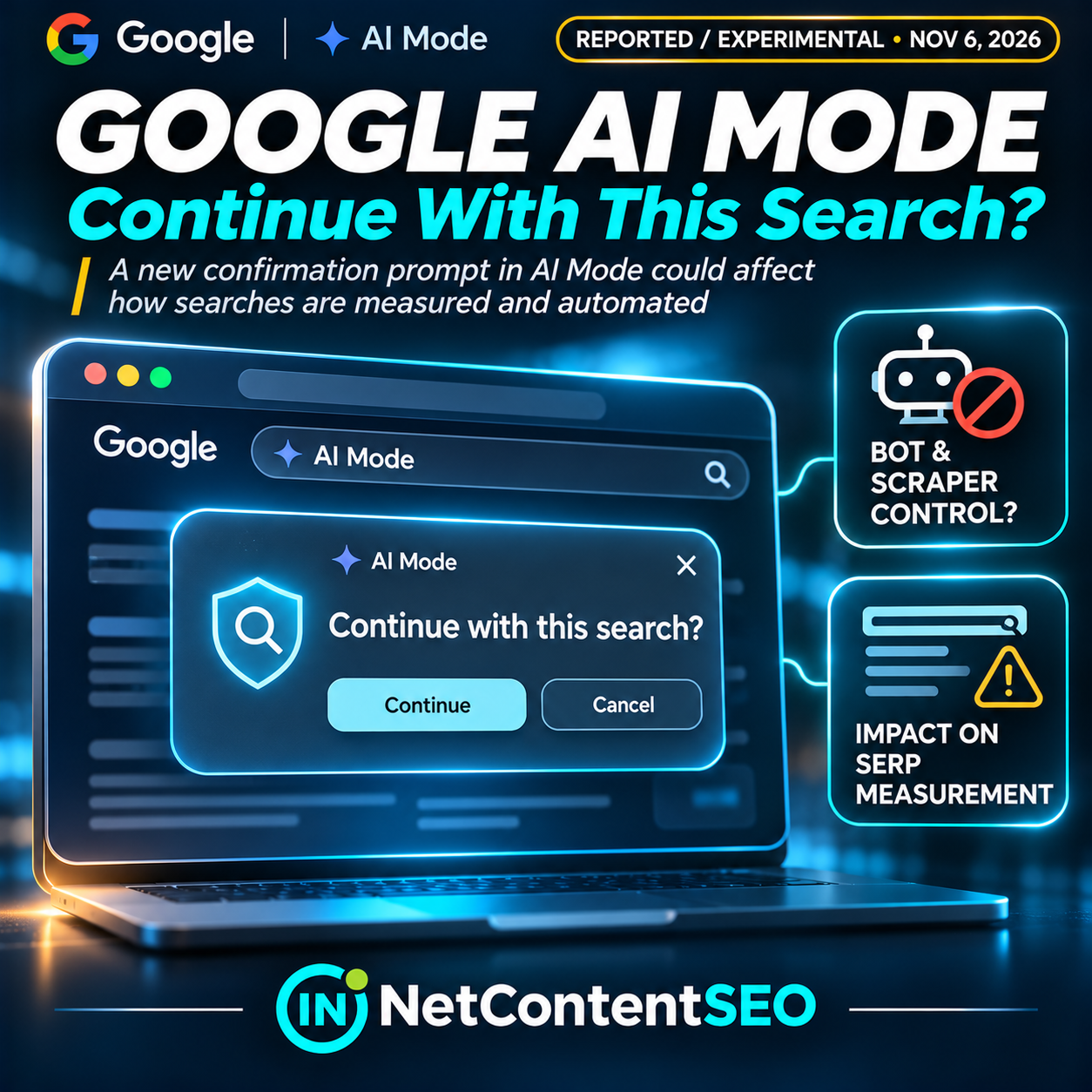

November 7, 2026. Google AI Mode has been observed displaying an unexpected confirmation screen asking users whether they want to continue a search. The sighting was documented by Barry Schwartz at Search Engine Roundtable on November 6, based on screenshots shared by Damien Andel. The interface is noteworthy for teams measuring AI search results automatically, but its purpose and prevalence remain unknown. Evidence status: REPORTED / EXPERIMENTAL.
The prompt includes a warning that malicious queries could lead to unsafe or harmful actions. Schwartz suggested that the interaction might be part of a bot- or scraper-control mechanism, but explicitly framed this as his own suspicion. Google has not publicly confirmed that explanation, announced a rollout or described a new policy for AI Mode data collection.
What the screenshot actually shows
The reported screen asks “Continue with this search?” and warns: “Malicious queries could result in unsafe or harmful actions.” It displays the pending search query, which in Andel's case concerned a trending entertainment news topic.
Andel explained that he encountered the message after selecting a trending item in a Google app Discover widget. That interaction led him into AI Mode through a “view image” search flow, where the confirmation appeared before the search continued. The observation does not establish that the same prompt appears for every user, every query or every entry point into AI Mode.
Schwartz interpreted the screen as a possible anti-automation check, noting that Google has used sign-in and confirmation controls in other contexts. That is an informed hypothesis, not an official Google statement or a verified description of the underlying trigger.
Three plausible explanations—and why none is proven
1. A safety confirmation. The wording explicitly refers to malicious queries and unsafe actions. That may indicate a user-facing safeguard for a particular search context, but no documented trigger conditions have been released.
2. An anti-bot or anti-scraping measure. A confirmation step could interrupt automated flows that expect an immediate AI response. Schwartz raised this possibility, but the screenshot alone cannot prove that automation detection caused the prompt.
3. A user-experience experiment. AI Mode supports follow-up questions and multiple entry points. A confirmation might help users decide whether to resume or launch a query. Again, no controlled experiment details or Google explanation have been published.
These explanations are not mutually exclusive. An interface can simultaneously serve safety, usability and abuse-prevention goals. The responsible conclusion is narrower: one new confirmation state was observed, and its function is not yet verified.
Why SERP and AI visibility trackers should pay attention
Automated AI search measurement often assumes that submitting a query produces an answer, a set of cited sources or an explicit error. A confirmation screen introduces another possible state: the query has not yet reached a completed answer.
If a data collector mistakes this intermediate screen for a completed AI Mode response, it may record zero citations, no brand mentions or an empty answer. An analyst could then interpret that missing output as a loss of visibility, even though the measurement system never observed the actual answer.
This is a potential failure mode, not proof that any named provider currently suffers from it. The observed prompt has not been shown to affect a representative sample of tracking tools. Nonetheless, it offers a practical reason to design robust collection-quality checks.
Do not confuse a blocked observation with a missing citation
Suppose a brand appeared in four of ten sampled AI Mode answers last week. This week, three of the ten collection attempts encounter an unhandled confirmation screen. A naive report might count all three as answers in which the brand was absent, reducing the apparent share of voice. A quality-aware report would mark those three attempts as unobserved, not negative results.
The denominator matters. A citation rate should be calculated using successfully collected and validated answers, with the coverage rate reported alongside it. If the sample is systematically incomplete, even a valid-answer-only rate can be biased. Teams should disclose the missingness pattern rather than presenting a precise trend unsupported by the sample.
Likewise, a failure to collect AI Mode output is not evidence that Google changed the ranking of a publisher, reduced a brand's eligibility or removed its sources. Those conclusions require independent observations of completed responses.
A practical validation checklist for AI Mode monitoring
- Record collection status. Distinguish completed answer, confirmation required, sign-in required, verification challenge, timeout, parsing error and unsupported response.
- Preserve evidence. Retain timestamps, locale, device or browser context, entry point and a privacy-safe snapshot of the observed UI state.
- Verify completion. Do not count an attempt as a successful answer until the expected answer structure or source output is present.
- Track valid-response coverage. Report the proportion of attempts producing usable answers, by day, country, device and collection method.
- Keep failed attempts out of negative-mention counts. A missing answer is not a verified answer without a brand mention.
- Compare independent observations. Where appropriate and authorized, use ordinary manual checks or supported data sources to determine whether a reported anomaly is reproducible.
- Check for interface changes. Review parser assumptions whenever AI Mode introduces new confirmation, consent or navigation states.
- Respect platform controls. Do not treat a security confirmation as an invitation to bypass protections; use authorized, policy-compliant collection methods.
- Annotate trend reports. Flag days when collection quality changes materially and avoid drawing causal SEO conclusions from incomplete samples.
How to report collection coverage correctly
Consider a daily monitoring batch with 100 planned prompts, 84 validated completed answers, 10 confirmation screens and six timeouts. The validated answer coverage is 84%. The other 16 attempts are not confirmed brand-negative answers. If 21 of the 84 validated answers mention the brand, the observed mention rate among validated responses is 25%, with an explicit warning that the missing 16% may not be random.
This example is illustrative, not a measured result of Google's November 6 interface. The purpose is to show why coverage and answer-level visibility must be reported separately.
For long-running monitoring programs, track whether interruptions cluster around particular queries, languages, regions, sessions or entry points. Such patterns may indicate sampling bias or an integration problem, but they do not reveal Google's internal enforcement criteria.
What this does not mean for publishers
The reported prompt is a user-interface observation, not an announced change to crawling, indexing, ranking or AI Mode citation selection. It does not establish that Google has stopped using certain sources, that publishers are receiving fewer referrals or that AI Mode is broadly inaccessible.
Google's official AI Mode overview describes the product as a search experience supporting complex questions, follow-up queries and links to the web. The November 6 screenshot does not overturn that product description or demonstrate a new public ranking signal.
It also should not be conflated with the separate reports of google.com/goto redirect-resolution issues affecting some SERP data providers. A redirect-resolution error corrupts the recorded destination URL; an intermediate confirmation screen may prevent a completed AI answer from being observed. Both can affect measurement quality, but they are different mechanisms and require different checks.
How much evidence would establish a broader rollout?
At minimum, researchers would need repeated observations across users, devices, locations and query types, with dates and reproducible entry paths. Ideally, Google would publish an official explanation. A single screenshot, even when credibly reported, cannot establish prevalence or the reason the prompt appeared.
For an agency, the right response is to add a quality-control state to monitoring systems and watch for corroboration—not to revise a client's GEO strategy because one user encountered a new dialog.
Frequently asked questions
What did Google AI Mode show on November 6, 2026?
A user observed a confirmation asking whether to continue a search, alongside a warning about potentially harmful queries. Search Engine Roundtable published the screenshot report on November 6.
Who first reported the screen?
Damien Andel shared the observation and screenshots with Barry Schwartz, who reported them at Search Engine Roundtable.
Is this confirmed anti-bot protection?
No. Schwartz suggested that explanation, but Google has not confirmed the prompt's purpose or triggering rules.
Is the feature available to all US users?
There is no evidence establishing general availability or a broad rollout. The report concerns an observed interface state.
Does the prompt change AI Mode rankings or citations?
No ranking or citation-selection change has been demonstrated. The direct concern is whether automated measurement systems correctly identify completed answers.
Could this cause false drops in AI visibility reports?
Potentially, if a tracker records an interrupted query as a completed answer with no brand mention. Whether this is happening in practice requires provider-specific testing.
Should trackers automatically click through the prompt?
Not without confirming that the interaction is authorized and consistent with the platform's terms and security controls. The safer first step is to flag the state accurately and use supported collection methods.
How should missing answers be counted?
As missing or incomplete observations, not as confirmed negative mentions. Report validated-answer coverage alongside citation or mention rates.
Conclusion: the first question is whether the answer was actually observed
The November 6 sighting is a modest interface report with an important measurement lesson. Google AI Mode may display a confirmation before continuing a query, but neither its purpose nor its prevalence is confirmed. For technical SEO and GEO teams, the immediate priority is to ensure that automated systems can distinguish an incomplete interaction from a genuine answer that does not cite a brand.
Before reporting an AI visibility loss, verify that the monitoring system actually collected the AI response.