
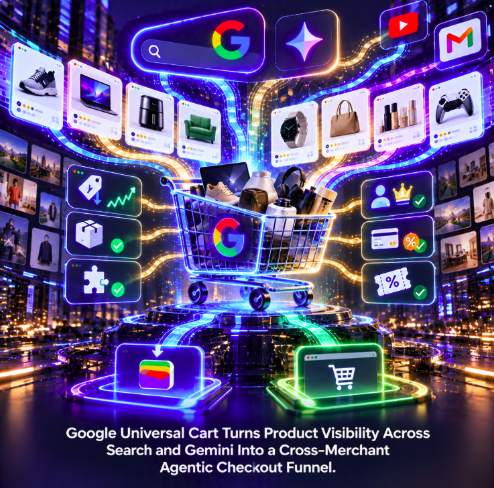
Google is turning product discovery across Search and Gemini into a persistent shopping funnel that can survive the move between merchants, queries and Google surfaces. Universal Cart is an intelligent cross-retailer cart that lets shoppers collect products while searching or chatting with Gemini, then keeps working in the background on price, stock, compatibility and payment decisions until the user is ready to buy.
Google introduced Universal Cart at I/O 2026 as the next layer of its agentic-commerce architecture. According to Google’s official Universal Cart announcement, the feature is rolling out across Search and the Gemini app in the United States, with YouTube and Gmail to follow. Google says the cart works across retailers, while the brand remains the merchant of record regardless of whether checkout happens on Google or after a transfer to the retailer.
For ecommerce teams, this changes the meaning of product visibility. A product discovered in Search no longer has to convert during that Search session. It can enter a Google-managed cart, sit beside products from other merchants and remain subject to agentic evaluation as prices, inventory and the shopper’s circumstances change.
The cart starts working before the shopper checks out
Universal Cart is not simply a synchronized list of saved products. Google says that as soon as an item is added, the cart begins working in the background. It can find deals and price drops, provide price-history insights and alert the shopper when an unavailable item returns to stock.
The cart runs on Gemini models, which gives Google a reasoning layer over the basket rather than treating each line item independently. Google says the system can proactively identify product incompatibilities and suggest alternatives before the shopper discovers the problem later.
That turns the cart into another ranking environment. The question is no longer only which product earns visibility during discovery, but whether the product continues to make sense once Google reasons over the complete basket.
Products from different merchants can share one Google shopping context
The cross-retailer design is strategically important. Traditional merchant carts are bounded by a single store. Google’s Universal Cart can hold items discovered across different retailers and across multiple Google products.
A shopper can therefore research one category in Search, discuss another purchase in Gemini and place both into the same higher-level shopping context. YouTube and Gmail are scheduled to join that environment later, extending the funnel into video discovery and email.
For merchants, the immediate competitive set can consequently expand beyond the products appearing next to them on one SERP. The cart can retain candidates discovered at different moments and compare them against the shopper’s broader objective.
Compatibility becomes a post-discovery qualification test
Google specifically says Universal Cart can flag incompatibilities and recommend alternatives. That matters for categories where the wrong combination creates friction: electronics, accessories, replacement parts, furniture, home equipment and other products with technical or physical dependencies.
A product can therefore be relevant enough to earn discovery and still become unsuitable after it enters the cart. If another item creates a compatibility constraint, the agent has a reason to reconsider the original choice.
Google has not announced “compatibility” as a conventional organic ranking factor. It is better understood as an agentic qualification variable inside the shopping task. Once the objective is assembling a working basket rather than returning product links, compatibility becomes information the agent can use to solve the task.
Google Wallet lets the cart reason about loyalty and payment perks
Universal Cart is built on Google Wallet, giving the system access, where applicable and permitted, to information that can affect the economics of the purchase. Google says the cart can understand payment-method perks, loyalty information and merchant offers and help the shopper choose between payment methods.
This means the displayed product price is not necessarily the end of the comparison. A shopper’s loyalty status, available offer or card benefit can change which purchase path is more attractive.
For merchants, promotional competitiveness can therefore become individualized. Two shoppers considering the same basket may have different effective economics because their available benefits differ.
UCP connects discovery directly to checkout
The infrastructure behind this transition is the Universal Commerce Protocol, or UCP. Google describes UCP as an open standard for agentic commerce that lets merchants turn conversational AI interactions into immediate purchases while remaining the merchant of record and retaining their customer relationships and data.
For participating merchants, UCP can support native checkout inside Google surfaces. Google’s current developer documentation describes checkout integration for AI Mode in Search and Gemini, with Google Pay providing a low-friction payment path.
Google’s I/O announcement named Nike, Sephora, Target, Ulta Beauty, Walmart, Wayfair and Shopify merchants including Fenty and Steve Madden among brands where selected checkout features were expected to become available.
Checkout on Google is only one path
Universal Cart does not require every purchase to finish inside Google. The shopper can also transfer items to the retailer’s website and complete the purchase there.
Google has formalized that path in the UCP Cart API. The initial Cart API supports one-way creation and transfer: when the shopper chooses to transfer the basket, Google can call the merchant’s CreateCart endpoint and populate a cart on the retailer’s system.
The merchant responds with a continuation URL that takes the shopper to the pre-populated cart. Google’s documentation is explicit that the initial Cart API is separate from the Checkout API and does not itself handle payments or the full purchase lifecycle.
The first UCP Cart API is intentionally limited
The technical boundaries matter because “Universal Cart” can sound more synchronized than the first merchant-transfer implementation actually is. Google says the initial Cart API, introduced with UCP version 2026-04-08, supports cart creation and transfer through CreateCart.
Updating, deleting or synchronizing cart contents between Google and the merchant system are not supported in that initial release. The flow is therefore a handoff from Google’s shopping context into a merchant cart rather than a permanent bidirectional mirror of the retailer’s cart state.
That distinction is important for implementation planning and for understanding attribution. Once the shopper transfers, the merchant regains the familiar onsite environment and can continue the purchase journey, including upselling and cross-selling.
Product feeds become inputs to an agentic purchase system
Google’s UCP developer materials tell merchants they can use their existing Merchant Center shopping feeds to reach high-intent users across AI surfaces. The familiar product-data layer therefore remains relevant even as the interface changes.
But the agentic environment puts more pressure on the quality of those facts. Price, availability, variants and other product attributes can affect not only whether a listing appears during discovery but whether the product remains viable later in the basket.
For merchants, feed quality increasingly connects merchandising with execution. A stale stock status or ambiguous product specification can create friction after the product has already earned the user’s attention.
Search visibility can now persist into Gemini
Universal Cart also weakens the assumption that Search and Gemini represent separate conversion funnels. A product discovered in Search can remain in the cart while the shopper continues researching through Gemini, and products found during a Gemini conversation can enter the same shopping hub.
That continuity is strategically important because conversational shopping often unfolds through multiple questions rather than a single commercial query. The shopper may discover a product broadly, ask Gemini about compatibility or alternatives and only later decide to buy.
The product’s competitive environment therefore persists beyond the original impression. Discovery creates candidacy; the cart keeps the candidate alive while additional reasoning occurs.
YouTube and Gmail will extend the funnel beyond explicit shopping sessions
Google says Universal Cart will later extend to YouTube and Gmail. Those surfaces introduce different discovery moments.
A product encountered while watching a creator’s video can enter the same cart as an item discovered through Search. An offer, receipt or product-related message in Gmail can eventually participate in the broader shopping environment as well.
Google has not said that every email or video automatically becomes a commerce signal, so marketers should avoid overinterpreting the planned integrations. The confirmed direction is that the cart is designed to follow the user across Google services rather than remain attached to one Search session.
Merchant selection and product selection become different optimization problems
Cross-merchant carts make an old ecommerce distinction more important. A shopper can prefer a product while still having several possible merchants from which to buy it, or prefer a retailer while comparing substitutes.
Price, stock, loyalty benefits, payment perks and merchant offers can all influence the final path. Universal Cart’s reasoning layer can help the user resolve those trade-offs after discovery.
That means winning product visibility is necessary but may not be sufficient. The transaction can still move toward another option if the basket-level economics or constraints favor it.
The merchant remains the seller even when Google owns more of the interface
Google repeatedly emphasizes that the brand remains the merchant of record. Its UCP documentation says merchants keep customer data and customer relationships, while the protocol provides an accountability chain among merchants, credential providers and payment services.
This is an important distinction from a marketplace model in which the platform becomes the seller. Google is positioning itself as the agentic discovery and transaction layer while leaving the underlying commercial relationship with the retailer.
For merchants, however, retaining merchant-of-record status does not mean retaining every interface step. Discovery, comparison, basket management and portions of checkout can increasingly happen on Google before the customer reaches the retailer’s own site.
The conversion funnel becomes harder to measure from website analytics alone
If a shopper researches in Search, adds a product to Universal Cart, continues in Gemini, waits for a price alert and later checks out on Google, conventional website analytics can observe only a fraction of the journey.
A merchant receiving a transferred UCP cart has a clearer onsite handoff, but even then much of the consideration process occurred upstream. The eventual visit can arrive with a basket already assembled rather than as an exploratory product-page session.
This makes platform reporting, Merchant Center data, UCP transaction instrumentation and first-party commerce data increasingly important complements to web referral analytics.
Agentic commerce rewards machine-readable operational truth
Universal Cart reinforces a pattern appearing across Google’s new agentic Search features: the system needs current operational information, not only persuasive content.
NetContentSEO recently examined the same shift in local services, where Google can gather pricing and availability and call businesses on the user’s behalf. In ecommerce, UCP and Universal Cart provide a more structured path for carrying product and transaction state through the agentic journey.
The common requirement is reliability. An AI agent cannot complete a task confidently if the price, inventory, compatibility or checkout state it receives is wrong.
Universal Cart turns visibility into continuing eligibility
The strategic shift can be summarized in two stages. First, a merchant still has to earn product visibility across Search, Gemini and eventually other Google surfaces. Then the product has to remain eligible for the shopper’s evolving basket.
A price drop can strengthen the candidate. An out-of-stock state can weaken it. A compatibility conflict can trigger an alternative. A loyalty benefit or payment perk can change the effective value of one purchase path.
Those events happen after the initial discovery moment, which is why optimizing only the product impression is increasingly incomplete.
Google is building a cross-surface agentic checkout funnel
Universal Cart connects several pieces Google has been developing separately: the Shopping Graph, Gemini reasoning, Google Wallet, Merchant Center, UCP and agentic checkout. The result is a persistent commerce layer capable of carrying intent from discovery toward transaction across more than one retailer and more than one Google product.
The initial rollout is centered on Search and Gemini in the United States, with YouTube and Gmail to follow. Participating merchants can support checkout on Google through UCP or receive a transferred, pre-populated cart on their own site.
For ecommerce SEO and GEO teams, the implication is larger than a new shopping widget. Product visibility can now initiate an agentic funnel that keeps evaluating the item after the SERP or Gemini answer disappears from view.
The new optimization question is not simply whether Google can find the product. It is whether the product can survive the cart.